
If you are working out how to turn business discovery into content angles, start with what makes your business specific. Look at who you help, the problem they face, when it becomes urgent, the options they consider, and the proof you can share with care.
Turn each input into a buyer question. Soon, you will have a topic backlog that supports your offer. You will not need to search every week for something—anything—to post.
Understand the difference between discovery, messaging, and angles
These three parts work together, but each has a different job:
- Business discovery is your source material. It covers who you help, what they need, how the offer works, and where it does not fit.
- Messaging is how you share those facts on your site, in sales calls, and in content.
- A content angle is one useful, publishable part of that message. It gives one type of reader a clear question and a reason to keep reading.
For example, a business may know: “We help owner-led agencies make realistic content plans.” One angle from that insight could be: “Why a content calendar fails when no one owns the review step.”
Your main message can stay steady. Content angles let you cover the questions buyers ask as they learn, compare choices, and decide what to do next.
If your starting point still feels broad, use a business discovery worksheet for founder messaging. Clear inputs make it much easier to find clear topics.
The discovery inputs that produce strong angles
The best inputs show a real buyer choice. They are more useful than a broad industry subject.
| Discovery input | What to capture | What it can become |
|---|---|---|
| Audience | Role, business setting, and constraint | Advice for a defined reader |
| Problem | The costly or frustrating issue | An explainer or diagnostic guide |
| Trigger | What changed or made the issue urgent | A “what to do now” article |
| Objection | What makes a buyer pause | A decision-support piece |
| Alternative | What they may do instead | A fair comparison of trade-offs |
| Proof or process | What you can explain with care | A walkthrough, checklist, or process guide |
| Point of view | Your considered view of the problem | A trust-building perspective piece |
| Boundary | Who the offer is not for, or what it cannot promise | A fit, limits, or expectations article |
A boundary is useful source material. It helps readers judge fit. It also stops your content from making claims the business cannot support.
Capture the words buyers use
Save useful wording from calls, emails, reviews, and support chats when you can. Note the phrase, the situation, and the question behind it.
For example, “We keep changing the plan every week” may lead to questions such as:
- Why does a content plan keep changing?
- What should stay fixed in a content plan?
- How can a small team review ideas without delaying every post?
Use plain words that help readers see their own situation. Do not add quotes, numbers, or results you cannot support.
Turn one discovery insight into several angles
You do not need a new source of inspiration for every article. One strong discovery answer can lead to several useful angles.
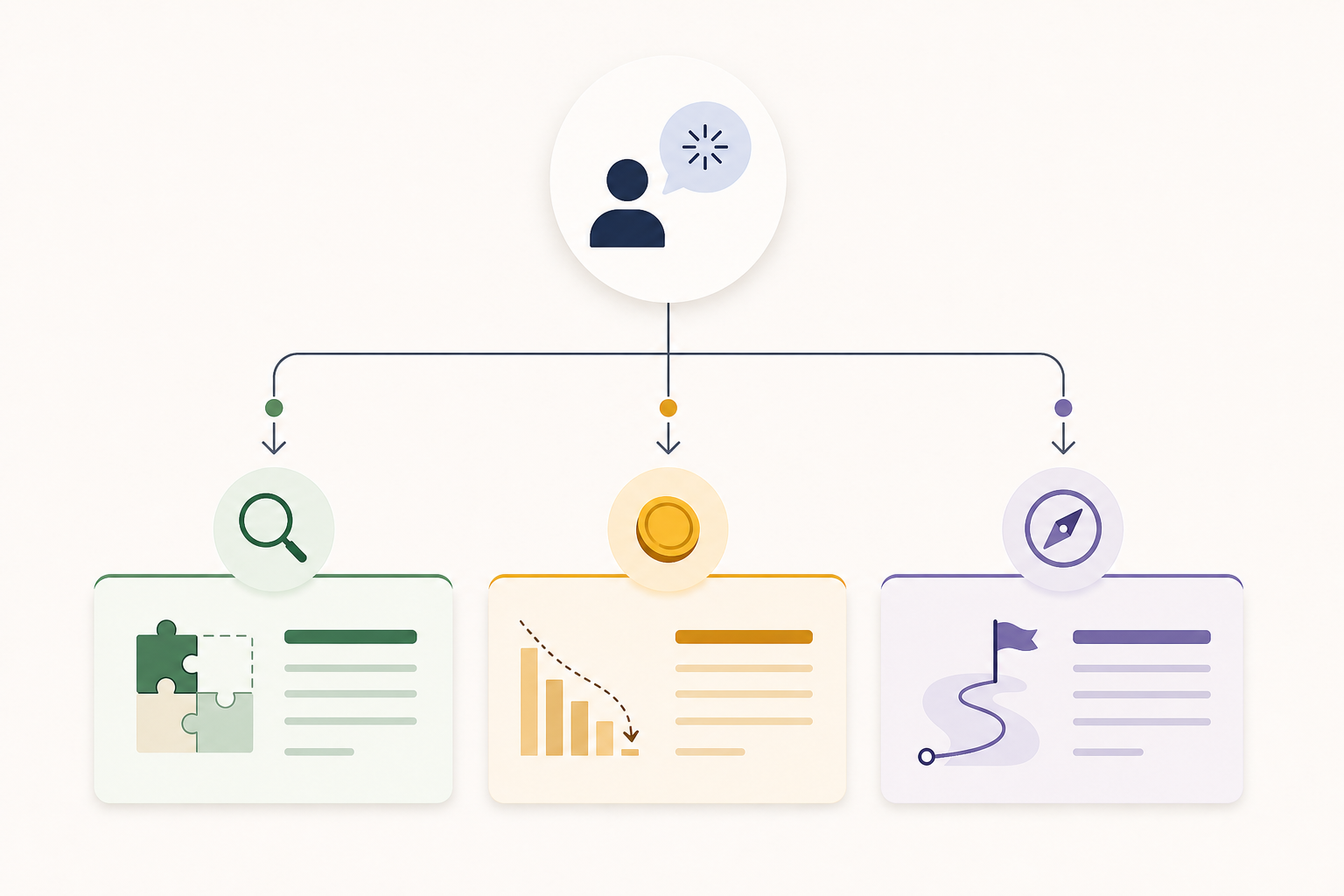
Use this simple method:
- Why it happens: Explain the cause, condition, or setting.
- What it costs: Explain the risk, delay, or trade-off of leaving it unsolved.
- What to do next: Give a first step, checklist, or way to choose.
The founder messaging worksheet also uses this method to turn buyer tensions into topic ideas. It lets you cover an important issue without rewriting the same post in new words.
Worked example: “Our content feels random”
This example is only an illustration. If an audience says, “Our content feels random,” that insight could become several angles:
| Angle type | Possible topic |
|---|---|
| Why it happens | Why content feels random when message inputs are missing |
| What it costs | The cost of rebuilding your topic list every week |
| What to do next | How to turn customer questions into a simple content backlog |
| Objection | Do founders need a content system before they publish more? |
| Process | A weekly review step that keeps content tied to your offer |
| Comparison | Structured planning versus choosing topics as you go |
| Point of view | Why a smaller publishing rhythm can be better than a packed calendar |
Each topic has a different job. One helps a reader grasp the problem. Another helps them weigh an option. A third gives them a useful next step.
Founder stories can work the same way when they include a lesson, choice, or limit. Company history alone is rarely enough. For a separate method, see How To Turn A Founder Story Into A Content Series.
Choose the format after the angle
A checklist, comparison, or myth-busting post is a format. It is not an angle by itself. Start with the buyer tension. Then choose the format that best answers the question.
Useful format choices include:
- Explain: Why does this problem happen?
- Prevent: What should the reader check before this becomes a problem?
- Decide: Which option fits which situation?
- Compare: What are the real trade-offs between two choices?
- Show: What does the process involve, and where are its limits?
- Respond: What concern needs a direct answer?
A format should make the answer easier to use. It should not be the reason you publish the topic.
Map each angle to a reader job
Before you add an idea to the backlog, decide what the reader is trying to do. This keeps useful ideas from appearing at the wrong point in a decision.
| Discovery input | Reader job | Content role |
|---|---|---|
| Trigger or problem | Learn | Explain what is happening and why |
| Objection | Consider | Help the reader judge fit |
| Alternative | Compare | Show real trade-offs without forcing a verdict |
| Proof or process | Decide | Explain what the work involves and what to expect |
| Point of view or boundary | Build trust | Make your judgment and limits clear |
A backlog does not need the same number of posts in every group. A new business may need more learning and trust content. A reader who already knows the problem may need clearer comparison and decision content.
The aim is not to fill every stage of a funnel. The aim is to give every topic a clear purpose.
When a post also needs to introduce your business, begin with the reader’s situation. Describe the offer after that. Related reading: How To Introduce Your Business Through Content (Without Cringe).
Put proof and boundaries before the draft
An angle should be supportable, not just interesting.
Make a small proof bank before you write. This can be a document, folder, or notes system. Keep material you can use with care: confirmed product details, process steps, original examples, relevant experience, and clear limits.
Ask one question before you outline: What evidence will this article use?
If the answer is unclear, narrow the topic or save it for later.
What counts as proof
Proof does not need to be a dramatic case study. Based on the topic, it might be:
- A process you can explain accurately
- A template or checklist you made
- A confirmed product detail
- An original example that is clearly marked as illustrative
- A limit or trade-off you can state plainly
It should not be a guessed result, an invented quote, or a broad promise. Rather than saying, “This guarantees more leads,” explain the process, trade-off, or choice you can support honestly.
Make boundaries useful
Boundaries help the right reader decide faster. For example: “This planning method is for teams that want a steady, reviewed publishing rhythm. It is not for brands that need several reactive posts every day.”
That limit can lead to useful content about pace, approval, and content work. It also lowers the chance of drawing in people your offer cannot serve well.
As a planning recommendation, choose a small group of core themes that fit your business goals and audience interests. Then build angles within those themes. Hatchify’s guide to finding content angles recommends choosing three to five core themes before tailoring angles to them.
Prioritize content angles for publishing
A long list of ideas does not solve a publishing problem. A short, ordered queue does.

The founder messaging worksheet suggests one practical way to sort ideas. Score each angle from 1 to 5 on three factors:
- Buyer impact: Will this help the right reader understand a problem or make a choice?
- Confidence: Can you answer it with facts, process knowledge, or proof you have now?
- Effort: Can you create and review it well in the time you have?
Then calculate:
Buyer impact × confidence ÷ effort
This is a planning tool, not a prediction model. It makes trade-offs easier to see when several ideas all seem worth doing.
Example score
Consider this illustrative topic: “What to prepare before you hire your first marketer.” A founder with a clear process and relevant experience might score it like this:
- Buyer impact: 4
- Confidence: 5
- Effort: 2
- Score: 10
A broad reaction to a trend, with no clear link to the offer, may look different:
- Buyer impact: 2
- Confidence: 2
- Effort: 4
- Score: 1
The higher score does not prove that a post will perform better. In this framework, it means the topic seems more useful to the right buyer, better supported, and more realistic to complete well.
Build a realistic first backlog
Start with eight to ten strong discovery answers. Give each answer the three angles above: why it happens, what it costs, and what to do next. Then choose only work you can review properly.
A practical first-month backlog may include:
- Two learning posts that answer a trigger or problem
- One consideration post that answers a common doubt
- One comparison with real trade-offs
- One process or proof piece that explains how you work
Do not force daily publishing. Pick a pace that leaves time for fact checks and founder review. If picking topics is where work stalls, see How Founders Waste Time Choosing Content Topics.
Move each angle from idea to published content
Planning only helps when an angle moves forward. Use a simple working loop:
- Capture: Record the audience, question, link to the offer, and next step.
- Outline: List the reader’s question, the proof you need, and key sections.
- Draft: Write the useful answer before you polish the opening.
- Review: Check facts, claims, tone, proof, and fit with your discovery notes.
- Approve: Confirm that the article still shows the business accurately.
- Publish and learn: Record questions, replies, objections, and sales-call wording for future discovery.
This loop gives each step an owner and a purpose. It also makes it easier to spot where a draft is stuck. A weak outline may need more proof. A draft that feels too broad may need a clearer reader or problem.
Use a pre-publish checklist
Before you publish, ask:
- Is the reader and their situation clear?
- Does the topic link to a real part of the offer?
- Can we support every factual or customer-related claim?
- Have we removed unsupported numbers, quotes, and promises?
- Does the article give a useful next step?
- Does it state a relevant limit or trade-off where one exists?
If the proof answer is no, do not write around the gap. Change the claim, add evidence, or choose another angle.
Let published content improve discovery
Published content can create the next round of discovery. Save the questions people ask, objections they raise, points they misunderstand, and phrases they repeat in calls or replies.
These signals can show where readers need a clearer explanation. They can also reveal a new decision point. Add those notes to your discovery material, then turn the strongest ones into new angles.
Avoid the mistakes that weaken an angle
Starting with formats instead of buyer tension
A checklist, carousel, or comparison is not useful by default. If it does not start with a real trigger, problem, doubt, or choice, it can drift away from your offer. Start with discovery. Choose the format later.
Treating fresh as the goal
Newness alone does not make a strong content system. A clear angle is more useful than a clever one when it helps the right buyer understand something that matters.
You can revisit a core problem more than once. Just give each post a distinct question, job, or point in the decision process.
Writing claims before finding proof
Do not make a bold promise and then hunt for evidence. Check the proof bank first. If you cannot support a result, write about the process, trade-off, or choice you can explain honestly.
Building a backlog that ignores capacity
A list of 30 topics can feel productive but still create pressure and delays. Sort a manageable queue and choose a pace that allows review. Your backlog should make the next choice easier. It should not create another pile of work.
Turn discovery into a planning habit
The core habit is simple: collect buyer tension, turn each strong input into several questions, check those questions against proof and offer fit, then rank the work you can complete well.
That gives you a content plan based on your real business, not borrowed trends or filler ideas. Keep founder review close to the work. You decide what is accurate, useful, and true to the business.
Over time, this habit can make planning less about waiting for inspiration. It becomes a repeatable way to turn what you already know into content that helps the right people make a decision.