
If you are wondering how founders waste time choosing content topics, the answer is usually simple: they keep debating ideas that are not tied to a buyer, an offer, or a clear business goal. Hours go into trend research, competitor browsing, and rewriting titles—while the publishing schedule slips.
The faster method is to filter ideas against a few practical criteria, choose a small number of topics with a clear purpose, and move them into a visible workflow. This guide explains the traps that create low-impact posts and a decision process founders can use without turning topic planning into another full-time job.
Why topic selection becomes a founder bottleneck
Content competes with product work, sales calls, customer support, and hiring. When topic decisions stay open for too long, the calendar slips, the team starts each month from scratch, and publishing becomes reactive.
The cost is not only a missed post. Slow decisions reduce the feedback you get from prospects: the questions they ask, the objections they have, and the explanations that help them move forward.
Topic picking can also feel safer than publishing. It is easy to keep researching the “best” angle; it is harder to share a clear point of view and see how people respond. As this discussion of founder-led content argues, content needs a clear audience problem and a reason for the reader to continue toward a solution—not simply a founder story (Why Most Founder-Led Content Fails and How to Fix It).
Before building a topic list, define the job content needs to do. It may explain your offer, answer a common objection, help a buyer compare options, or support onboarding. For the wider planning process, see how to develop a content strategy.
The topic-picking traps that produce low-impact posts
Chasing trends that do not fit the offer
A platform update or popular discussion may be interesting, but interest alone is not a reason to publish. If a topic does not help a prospect understand the problem you solve, your approach, or the value of your offer, it belongs in a backlog—not this month’s plan.
Ask: Would the right buyer be more ready to talk to us after reading this? If the answer is unclear, choose another topic.
Writing for everyone
Broad topics often attract broad, low-intent readers. “How to grow a business” can mean very different things to a first-time founder, a marketing lead, and a consultant.
Make each topic specific before approving it:
- Who is the reader?
- What situation are they in?
- What question are they trying to answer?
- What should they do next?
For example, “content ideas for startups” is broad. “How a two-person B2B team can choose blog topics that address sales objections” gives both the reader and writer a useful boundary.
Copying competitors instead of finding your angle
Competitor research can reveal basic expectations, but it cannot provide your expertise, customer context, or point of view. Copying a competitor’s categories often produces topics that do not match your sales process.
Use a minimum viable competitor scan instead. Set a 30-minute timer, review three to five direct competitors, and record only:
- Repeated topic themes.
- Questions they answer poorly or vaguely.
- Buyer questions they appear to miss.
Then stop researching and write one sentence that states your distinct angle. The aim is not to cover every topic competitors cover. It is to make the next useful page for your buyer.
Choosing vanity traffic over qualified attention
A large audience is not always a useful audience. A broad, dramatic topic may gain views while attracting people who will never need your product.
Prioritize subjects that help a qualified buyer make a decision. Strong choices often address a costly problem, a common objection, a practical use case, a comparison between approaches, or a step in implementation.
The aim is not to publish the most clickable idea. It is to publish material that supports a healthy business.
Treating brainstorming as the whole process
A list of 100 ideas is not a content plan. Without a filter, owner, status, and publishing date, ideas become a source of guilt rather than output.
If ideation is the sticking point, AI can help generate blog ideas across a niche and widen the first draft of your list. Then apply business judgment. AI can suggest patterns; it cannot decide which customer problem matters most to your business.
A faster framework for choosing content topics
Use five criteria to score ideas. They force a decision without pretending content performance can be predicted perfectly.
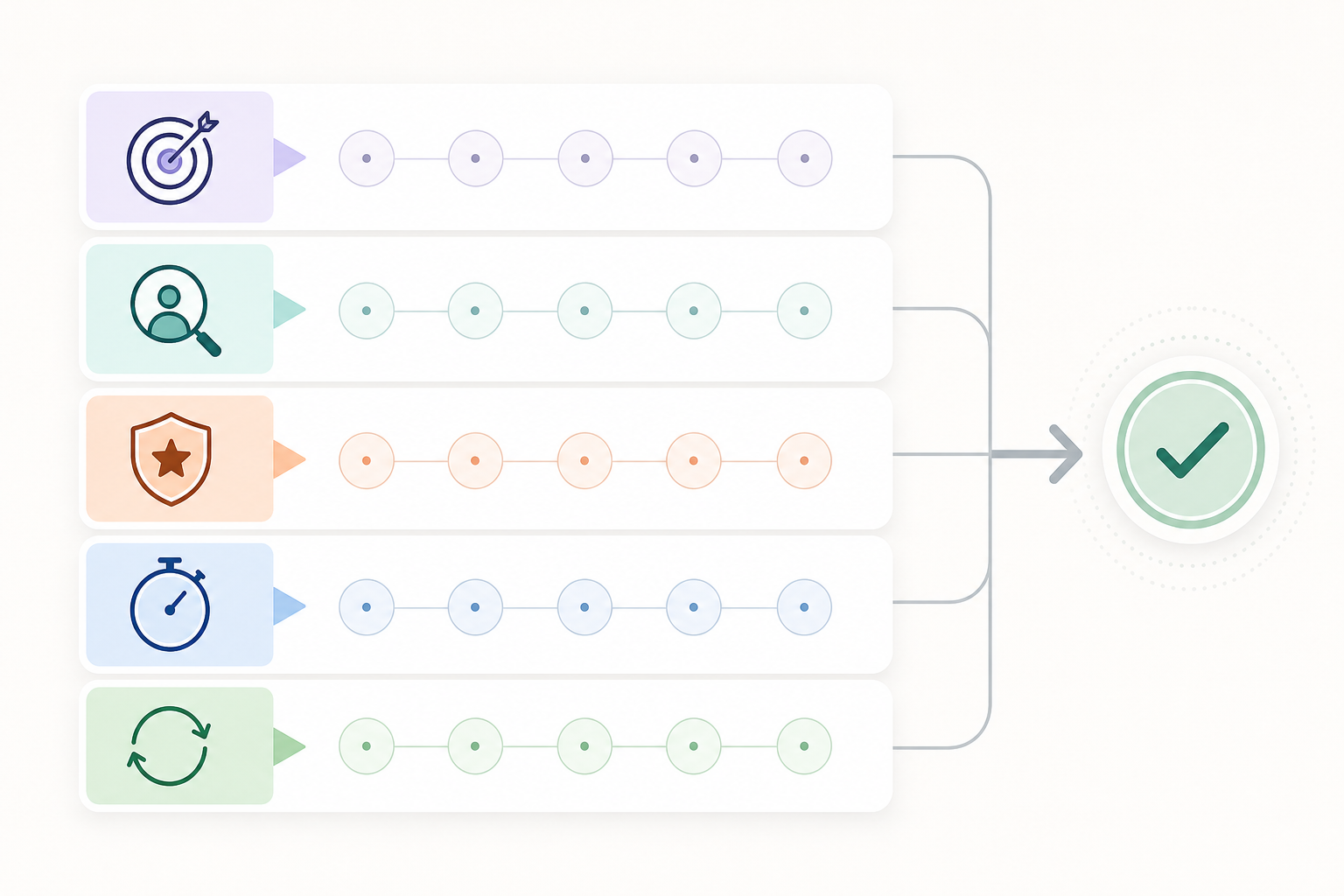
| Criterion | Ask this question | What a strong score looks like |
|---|---|---|
| Relevance | Does this connect to our offer and core problem? | The link to what you sell is clear. |
| Buyer intent | Is the reader trying to solve or understand a real problem? | The topic reflects a question from sales, support, or research. |
| Proof | Can we explain this with real process, examples, or evidence? | You can add useful detail beyond generic advice. |
| Effort | Can we create a solid first version with current resources? | It can be drafted, reviewed, and published without a large project. |
| Reuse | Can this support sales, email, social, or onboarding work? | The core explanation can help in more than one place. |
Score each idea from 1 to 5. Do not overthink the numbers; the point is to compare ideas using the same standard. A topic with a high total but no proof is a warning sign. Gather the evidence first, or choose an idea you can support today.
The 10-minute scoring pass
- List ten possible topics.
- Score each topic on relevance, buyer intent, proof, effort, and reuse.
- Circle the three highest-scoring topics.
- Write a one-sentence reader promise for each.
- Approve only the topic whose promise is clear enough to outline now.
A reader promise might be: “Help a founder with limited time choose a monthly blog cadence they can keep.” That is easier to write and evaluate than a vague idea such as “content consistency.”
Use the 80/20 rule as a prioritization lens
The 80/20 rule is useful here as a reminder, not as a guaranteed result. A small set of topics can have more value than a large, scattered library when it addresses questions close to a purchase or successful use of the product.
Start with the buyer pains, objections, use cases, and comparison questions that matter most. Publish useful variations after those foundations exist. This reduces the urge to chase every new idea.
Match your topics to your startup stage
Startup-stage labels vary, but a practical sequence is idea, validation, build, launch, traction, growth, and scale. You do not need a perfect label; you need to identify the main business risk now.
| Stage | Main content job | Useful topic types |
|---|---|---|
| Idea and validation | Clarify the problem and audience | Problem explainers, customer questions, founder point of view |
| Build and launch | Explain the offer and reduce uncertainty | How it works, pricing context, FAQs, early use cases |
| Traction | Improve conversion and trust | Comparisons, objections, implementation guides, substantiated results |
| Growth and scale | Support adoption and repeatable operations | Role-based guides, onboarding, process documentation |
Early-stage founders often need content that makes the problem and solution easy to understand. Later-stage teams may need content that helps people adopt the product, evaluate alternatives, or get value faster.
Limited time, cash constraints, unclear positioning, and uneven distribution make random topics especially expensive. A small, focused plan is usually more useful than a high-volume calendar.
You may hear that “90% of startups fail.” That figure is often repeated without a clear definition of startup, failure, timeframe, or source. It is not useful for choosing a blog topic. Focus on risks you can address: unclear positioning, weak trust, and a poor path from interest to action.
Turn business discovery into a publishable topic list
Topic selection gets easier when it begins with the business, not the blank page.
Start with four discovery inputs
Write short answers to these questions:
- What event makes a buyer look for help?
- What outcome do they want in the next quarter?
- What concerns make them hesitate?
- Why might they choose your approach over an alternative?
These answers become topic material. A setup concern can become an implementation guide. A pricing objection can become a clear explanation of value and fit. A recurring sales question can become a FAQ or comparison page.
For Content Redefined AI, the starting point is especially important: introduce the business clearly, set content direction, and create a schedule the founder can maintain. The plan should reflect those inputs rather than a generic list of trending keywords.
Choose three to five content pillars
A pillar is a recurring buyer question, not a broad label such as “growth” or “insights.” For many founder-led businesses, useful pillars include:
- Getting started and implementation.
- Use cases for specific customer situations.
- Pricing, value, and return on effort.
- Objections and common concerns.
- Comparisons and alternatives.
Under each pillar, create five rough titles. Rough is enough at this stage. Score the ideas before spending time polishing wording.
Keep one visible workflow
Use one location for every approved idea and draft. A simple status flow works well:
Idea → Approved → Drafting → Editing → Scheduled → Published
Add an owner and a next action to each item. This prevents a good topic from disappearing after a busy week.
A sustainable schedule matters more than an ambitious one. One useful post every two weeks is better than four posts followed by a two-month gap. If calendar administration is taking too much effort, see how to automate a blog content calendar using AI.
A 30-minute founder topic sprint
When you need a plan quickly, run this sprint with sales notes, support questions, and product knowledge nearby.
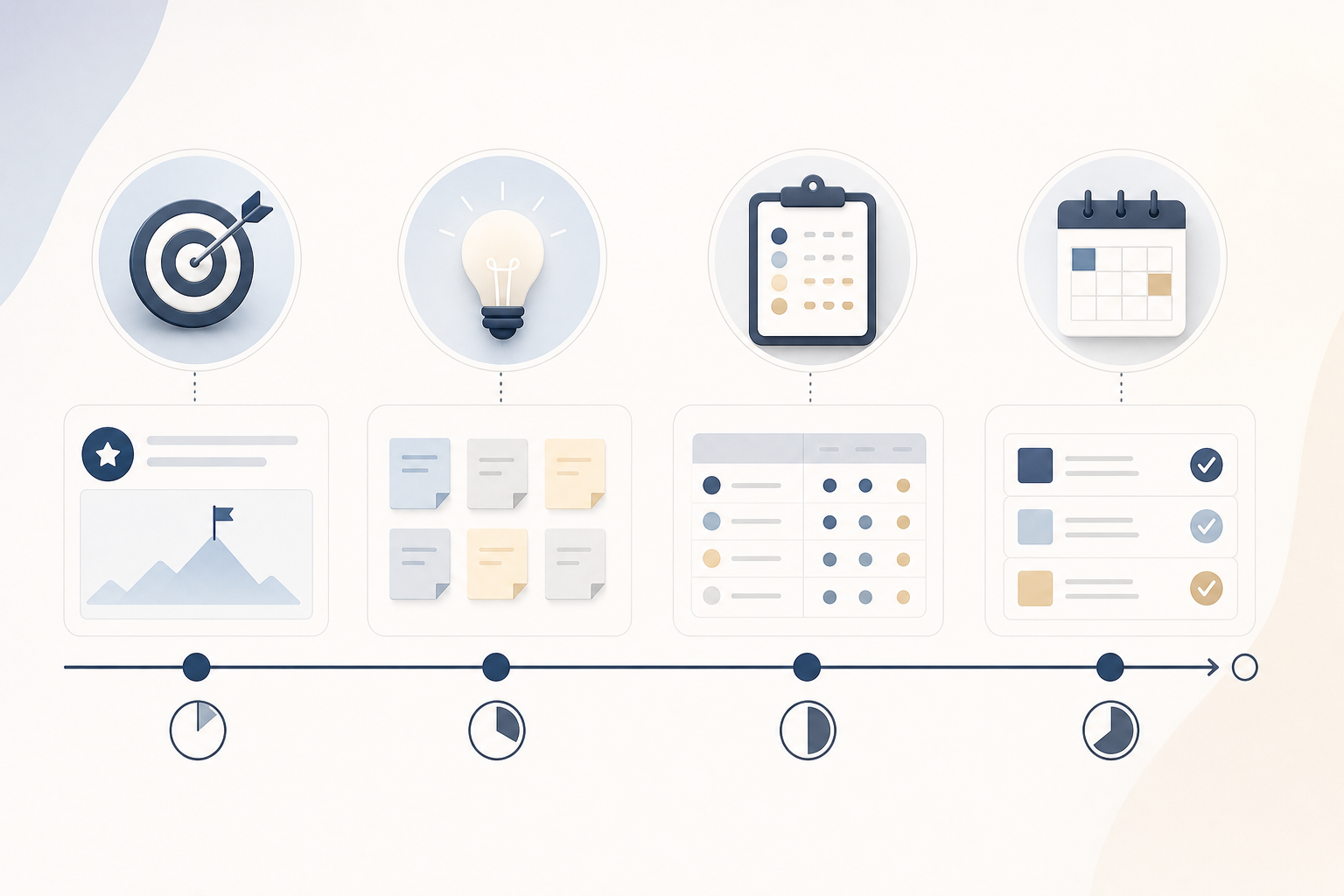
Minutes 1–5: Choose the business goal
Pick one goal for the next few posts: generate qualified conversations, help prospects understand the offer, reduce an objection, or support current customers. Do not try to serve every goal at once.
Minutes 6–15: Create a short list
Write ten ideas from real buyer questions, objections, use cases, and product steps. Avoid polishing titles. Capture the question behind each idea.
Minutes 16–25: Score and select
Use the five criteria: relevance, buyer intent, proof, effort, and reuse. Select the top three. If two topics tie, choose the one you can support with clearer examples or a more direct next step.
Minutes 26–30: Assign dates and next actions
Give each approved topic a date, owner, and first task. The first task might be “collect three sales questions,” “create a short outline,” or “gather screenshots.” This turns a decision into progress.
When drafting begins, use tools to reduce mechanical work, not to remove judgment. A workflow for writing SEO-optimized articles with AI can help turn an approved outline into a draft, but a founder or subject expert should still check the claims, examples, and advice.
Choose fewer topics, with more purpose
How founders waste time choosing content topics is rarely a creativity problem. It is a decision-system problem. The fix is to connect every idea to a buyer, a business goal, proof you can provide, and a realistic publishing workflow.
Start with ten ideas. Score them. Publish the best three on a schedule you can keep. As you learn from sales conversations, customer questions, and published content, improve the next list rather than reopening every decision.
Content Redefined AI offers a structured planning approach designed for founders who want to introduce their business clearly, direct their content, and maintain a consistent publishing schedule without rebuilding the plan every month.