
When a publishing strategy feels impossible without a team, the problem is rarely your ability to write. One post contains many jobs: choosing a topic, finding an angle, checking facts, drafting, editing, formatting, publishing, and deciding what comes next.
You do not need to recreate a marketing department. You need a small operating system that works in ordinary weeks—including weeks with sales calls, customer work, product deadlines, and little spare energy.
Start with a realistic plan: publish one useful core piece at a cadence you can keep for 90 days. Then make the work visible, limited, and repeatable.
Define consistency before you choose a publishing frequency
Consistency is not the same as frequency. A founder who publishes one useful article every other week for a quarter has a stronger system than someone who posts daily for ten days and then stops for six weeks.
A practical definition is simple: your cadence should survive normal business disruption without heroic effort. The goal is not to fill every channel. It is to build a rhythm you can repeat long enough to learn from it.
Start with the smallest cadence that still serves a business purpose. That might be:
- one in-depth article every two weeks;
- one useful newsletter each week; or
- one monthly guide, with a few short posts drawn from it.
Choose one for the next 90 days. Do not change it because one busy week feels disappointing. Review the cadence after the quarter, when you have enough experience to judge the work honestly.
For a closer look at choosing a cadence that can hold up in busy periods, see these implementation steps for a consistent publishing schedule.
Set five constraints before you plan topics
Most founder-led content systems fail because every post begins with too many choices. Constraints remove choices before they become delays.
1. Set a weekly time cap
Decide how much time content may take before you decide what to publish. A fixed cap forces useful trade-offs. If you have 150 minutes, you cannot promise a research-heavy guide, original visuals, five social versions, and several review rounds.
When a topic exceeds the cap, narrow it. Answer one reader question well instead of covering an entire category poorly.
2. Choose one core channel
Pick one place where the complete version of your work lives. This is usually a blog or newsletter. Everything else is optional support.
A short LinkedIn post can point to an article. A newsletter can adapt a blog post. But do not create five separate pieces from scratch each week. More channels mean more formatting, review, and unfinished work.
3. Focus on one audience for a defined window
Choose one reader group for the next 30 to 90 days. You are not making a permanent choice about your market. You are giving your message enough time to become clear.
For example, a founder might spend one quarter helping prospective buyers understand the service, then spend the next helping current customers get more value from it.
4. Write a definition of done
A definition of done prevents a draft from becoming an endless editing project. Keep it short. A publish-ready piece might need:
- one clear reader and one useful outcome;
- the main answer near the start;
- a concrete example, recommendation, or checklist where it helps;
- claims that are supported, qualified, or removed;
- a relevant next step; and
- basic formatting and links checked.
This is a recommendation, not a universal editorial rule. Add requirements for your industry when accuracy, legal review, or product review calls for more care.
5. Limit active drafts
Set a work-in-progress limit. If you work alone, start with one active draft. Do not begin another piece until the current one is published, deliberately paused, or discarded.
This protects you from a common trap: collecting promising starts while nothing reaches the finish line. More ideas do not increase output when the bottleneck is finishing.
A useful constraint card can fit in one note:
| Decision | Your rule |
|---|---|
| Weekly time cap | ___ minutes |
| Core channel | ___ |
| Audience focus | ___ |
| Definition of done | ___ |
| Active draft limit | ___ |
For more guidance on setting boundaries before the work expands, read founder-focused content planning constraints.
Run a minimum viable publishing workflow
A workflow is a clear path from a useful idea to a published piece. It should make the next step obvious, even if the founder owns every stage.
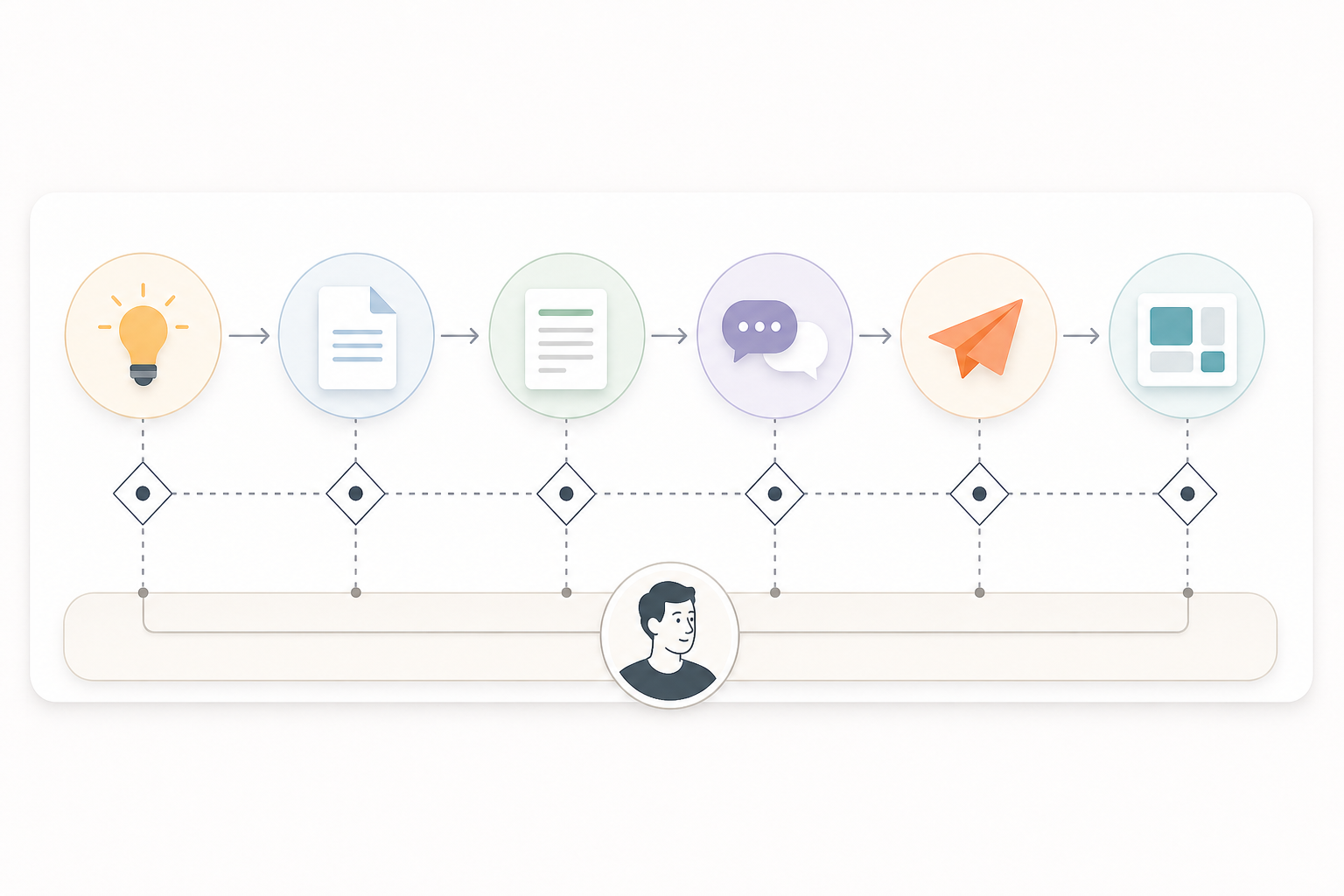
Use this six-stage sequence:
Idea → Brief → Draft → Review → Publish → Repurpose
Each stage needs one small gate. The gate is not bureaucracy; it stops vague work drifting between notes, documents, and your CMS.
Idea: start with a real reader problem
An idea is ready when you can state a customer question, a recurring objection, or a problem you have observed.
Weak idea: “Write about pricing.”
Stronger idea: “Explain what a buyer should compare before choosing a monthly service.”
The stronger version already has a reader, a decision, and a useful outcome.
Brief: make the promise before you draft
A brief can be one paragraph. Include:
- who the piece is for;
- what they are trying to decide or solve;
- the point you want to make;
- what evidence or example you need; and
- the next step that fits the reader.
This is where founder judgment matters most. The founder should set positioning, confirm product facts, review sensitive claims, and decide what the business can honestly promise.
Draft: complete the first pass
Write the whole piece before trying to perfect each sentence. A complete rough draft is easier to improve than a polished introduction with no ending.
Templates can help with repeatable work: brief fields, heading patterns, calls to action, metadata prompts, and editing checks. They should not replace founder review of facts, voice, and promises.
Review: make a clear decision
Review should end in one of two states: approved or changes needed. Avoid a vague “almost done” status.
If you have a reviewer, ask them to check specific things: accuracy, missing context, unclear wording, or unsupported claims. Broad feedback such as “make it better” creates extra loops.
Publish: finish the core job
Publishing includes formatting, title and description checks, links, and a clear next step. A post is not finished because the text exists in a document.
Repurpose: reuse the core insight once
Repurposing is optional, but it can make your effort go further. Pull one useful part from the core piece: a short lesson, a checklist, an objection you answered, or a practical example.
Do not treat repurposing as a second full production project. If it delays the main piece, skip it for now.
Use the handoff test to stop execution drift
Even a good strategy can fail if a draft has no visible next action. For every active piece, answer four questions:
- What is the next step?
- Who owns it?
- When is it due?
- What must be true before it moves forward?
For a solo founder, the owner may always be you. That still matters. It turns an abstract intention into a commitment you can place on the week.
For example:
> Next step: tighten the outline.
> Owner: founder.
> Due: Thursday.
> Ready when: the article answers one buyer question and any claim about outcomes is supported or removed.
If you cannot answer these questions, the issue is operational rather than creative. The piece needs a smaller next step, not another brainstorming session. This guide to the gap between content strategy and execution explores that distinction further.
Allocate founder time: a 150-minute baseline
A publishing strategy for founders without a marketing team needs a budget, not an idealized content day. This 150-minute weekly plan is a practical starting point. Adjust the order to fit your calendar, but protect the sequence.

| Stage | Time | Output |
|---|---|---|
| Decide | 25 minutes | Reader question, angle, and next step |
| Outline and light research | 30 minutes | A tight structure and needed support |
| Draft | 50 minutes | Complete first draft |
| Edit and prepare metadata | 25 minutes | Clear, checked publish-ready version |
| Publish and learn | 20 minutes | Scheduled or live piece and one lesson |
That is 2.5 hours across a week. It is enough for a focused piece when the scope is realistic.
Reserve your own time for decisions only you can make: the strategic angle, audience promise, product details, sensitive claims, and final positioning. Use templates, a light reviewer, or a planning tool for repeatable steps where appropriate.
When to use four to five hours instead
Add time when the subject genuinely needs more care. The extra time might go to:
- checking a primary source;
- gathering a truthful example from your business;
- asking a subject expert to review a technical point;
- improving a complex explanation; or
- adapting the finished work for one secondary channel.
More time should improve the work, not add process for its own sake. If the topic needs more than you can give this week, split it into a narrower piece or move it to a later slot.
For a day-by-day version of this loop, see the founder content planning weekly operating rhythm.
Batch vs. drip: choose the release model that fits your week
Batching and drip publishing are not opposing identities. They solve different problems.
Batching means doing similar tasks together, such as outlining several ideas in one session or editing two drafts in one pass. It reduces context switching.
Drip publishing means releasing work at a steady pace, usually one piece at a time. It protects your publishing rhythm when your schedule changes.
For many founders, a useful option is a hybrid: batch preparation during a calmer block, then drip the finished work on a reliable schedule.
Choose drip when your time and review capacity are tight
Drip is a good default when you have unpredictable weeks, founder-only review, or limited space for deep work. Keep one piece active. Decide, outline, draft, edit, publish, and learn before you start again.
This approach is slower in the short term, but it keeps the process simple and makes bottlenecks easier to spot.
Choose batching when you have protected blocks
Batching works when you can protect a few longer sessions. Batch by task rather than by topic:
- outline several approved ideas;
- draft from those outlines;
- edit with the same definition of done; and
- schedule releases one at a time.
Do not batch so far ahead that your content becomes stale or stops reflecting what buyers are asking. A small queue is enough.
Use a hybrid model when you want both focus and resilience
A hybrid might look like this:
- In a calmer week, outline three articles.
- Draft one or two of them.
- Review and schedule one article every other week.
- Keep the remaining draft as a buffer, not as a demand to publish more often.
This gives you room for disruption without forcing you to produce at high speed. For a deeper decision guide, see batch vs. drip publishing for founders.
Avoid the publishing mistakes that create more work
Choosing an ambitious cadence
A plan that depends on perfect weeks is not a plan you can trust. Reduce frequency before you reduce quality or stop altogether.
Treating a content calendar as a workflow
A calendar tells you when you hoped to publish. It does not tell you what must happen next. Pair each date with a stage, owner, due date, and readiness rule.
Starting new drafts to avoid finishing old ones
New ideas feel easier than revision. A work-in-progress limit makes finishing the default behavior.
Publishing everywhere at once
One core channel and one light support channel are enough at the start. Earn additional channels by proving that the first workflow survives a full quarter.
Letting perfection block a useful answer
Your definition of done should protect accuracy and usefulness. It should not require every piece to become a definitive guide. Publish the clearest useful version you can support, then improve your next piece with what you learn.
Recover when you miss a week
Missing a week does not mean the system has failed. Do not restart the calendar or add extra work to “catch up.”
Instead:
- Keep the same workflow order.
- Move the next unfinished step into the next available slot.
- Shrink the scope if needed.
- Publish the next useful piece at your normal cadence.
- Record what caused the delay and adjust one constraint.
If research took too long, choose a narrower question next time. If review slowed the piece, schedule review earlier. If customer work disrupted the week, consider a wider cadence or build a one-piece buffer.
The point of a publishing system is not to prevent disruption. It is to recover from disruption without losing your direction.
A simple 90-day setup plan
You can build this system without a large tool stack.
Weeks 1–2: set the operating rules
Choose your audience, core channel, time cap, definition of done, and active-draft limit. Write down your workflow stages in one visible place.
Weeks 3–6: prove the smallest cadence
Publish at the smallest useful pace. Watch for friction: unclear briefs, too much research, late review, or too many channels. Fix the process, not just the individual post.
Weeks 7–10: add a small buffer
If the workflow feels stable, batch one or two outlines or drafts. Keep the release cadence the same.
Weeks 11–13: review and decide
Ask:
- Did we publish at the pace we chose?
- Which stage took longer than expected?
- Which topics led to useful sales, customer, or audience conversations?
- What can we template, delegate, or stop doing?
Then choose the next 90-day cadence based on your actual capacity.
Whatever setup you use, keep the system small enough to run and keep founder review close to decisions that require business judgment.
Common questions
What is the minimum viable publishing workflow?
Use six stages: idea, brief, draft, review, publish, and repurpose. Give each stage one clear requirement to move forward. Keep the workflow visible and limit active work so a good idea does not become a forgotten draft.
How should I divide time between planning and writing?
Start with 150 minutes per week: 25 minutes to decide, 30 to outline and gather support, 50 to draft, 25 to edit and prepare metadata, and 20 to publish and record a lesson. Add time only when the topic needs more evidence, review, or care.
How often should a founder publish?
Choose the smallest cadence you can sustain for 90 days. One article every other week is a valid starting point. Consistency means keeping the pace you chose, not matching someone else’s output.
What should I do if I miss a publishing week?
Move the next unfinished step forward and reduce scope if needed. Do not restart the whole plan or try to make up for the missed week with an unrealistic workload.
Is batching or drip publishing better?
Use drip publishing when your calendar and review capacity are unpredictable. Use batching when you have protected blocks for similar tasks. A hybrid model—batch preparation and drip release—often gives founders a useful balance of focus and resilience.