
Delegating content writing is no longer a simple matter of shopping for affordable articles. For agencies serving demanding clients across American, Canadian, and British markets, authenticity and specialist knowledge have become non-negotiable. Outsourcing now means tapping into vetted professionals who excel in SEO, match your clients’ niches, and adapt quickly to changing strategies. Discover how modern approaches combine expert talent and innovative workflow models to keep your clients’ organic growth on track without stretching your budget.
Key Takeaways
| Point | Details |
|---|---|
| Strategic Outsourcing | Outsourcing content writing has become a strategic move that enhances SEO performance with expert knowledge and scalability. |
| Hybrid Models | Many agencies now use a combination of AI tools for efficiency while relying on human expertise for high-quality content creation. |
| Quality and Communication | Regular communication and quality control are crucial to prevent misunderstandings and ensure content meets client standards. |
| Cost Management | Understanding hidden costs and establishing clear benchmarks can help maximize value when outsourcing content writing. |
What Outsource Content Writing Means Today
Outsourcing content writing has evolved far beyond simply hiring someone to write articles. Today, it represents a strategic business decision to combine expert knowledge, scalability, and quality control to fuel your SEO performance. For agencies managing multiple clients with varying demands, outsourcing means gaining access to specialized writers, editors, and SEO strategists without the overhead of full-time staff.
The modern outsourcing model works differently than it did five years ago. Rather than receiving generic, low-quality content, you’re now tapping into networks of vetted professionals who understand your industry, your clients’ niches, and search engine requirements. Expert content creation with scalability delivers research-backed material that drives real organic traffic, not just filler text designed to hit word counts.
What sets modern outsourcing apart is the emphasis on authenticity and specialist knowledge. A freelance writer covering healthcare SEO brings real experience with YMYL (Your Money, Your Life) guidelines. An e-commerce content specialist understands product descriptions that convert. This level of expertise directly translates to better search rankings and higher engagement rates for your clients.
The speed factor matters too. While you’re juggling client calls, strategy meetings, and performance reviews, your outsourced team is researching topics, optimizing metadata, and building internal link structures. This parallelization means your clients get fresh content weekly instead of monthly.
Many agencies now blend approaches, using AI-powered tools for certain tasks while keeping human expertise for complex, high-stakes content. This hybrid model gives you cost efficiency on volume pieces while maintaining quality standards on flagship content that drives major conversions.
Pro tip: Start by outsourcing your lowest-priority content categories first—such as category descriptions or beginner guides—to test your workflow and writer quality before scaling high-value projects to external teams.
Types of Content You Can Outsource
Not all content requires your personal attention. Understanding which types of content to outsource is crucial for maximizing your team’s efficiency while maintaining quality. Different content serves different purposes, and each has its own outsourcing sweet spot based on complexity, expertise requirements, and ROI.
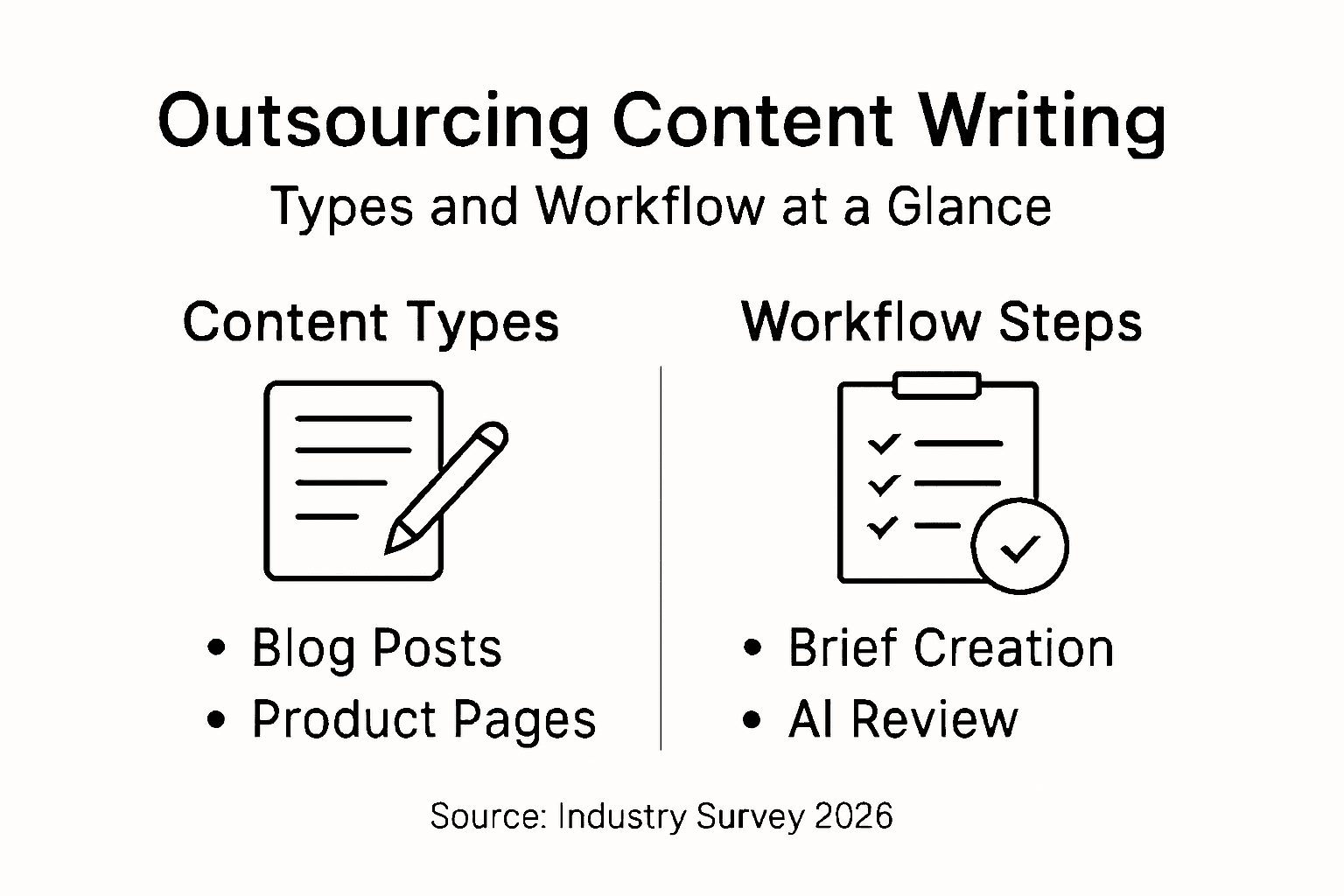
Blog posts and long-form articles are the easiest starting point for outsourcing. These pieces drive organic traffic and don’t require real-time decision-making. A skilled freelancer can research keywords, structure arguments, and optimize for search intent without constant oversight. You review, edit, and publish. The turnaround is fast and the results are measurable.

Product descriptions and category pages deserve outsourcing too, though they need more precision. A comprehensive content strategy helps define exactly what tone, keywords, and messaging these pages need before handing them off. E-commerce specialists understand how to balance SEO optimization with conversion-focused copy, turning descriptions into revenue drivers.
Whitepaper and case study creation is another prime outsourcing candidate. These demand subject matter expertise you may not have in-house. A freelancer researcher can interview your clients, compile data, and structure compelling narratives that demonstrate your solutions in action.
FAQ sections, meta descriptions, title tags, and image alt text represent high-volume, lower-complexity work that absolutely should be outsourced. These tasks multiply across your client roster but require consistent application of simple rules. Freelancers can batch-process these efficiently while you focus on strategy.
Email newsletters and social media captions fall into a gray area. Outsource the drafting and initial optimization, but keep your team engaged in the messaging and brand voice to prevent everything from sounding generic.
Avoid outsourcing highly technical content, thought leadership pieces from your CEO, or anything requiring real-time market awareness without extremely careful vetting.
Pro tip: Create a content tier system where tier-one pieces (cornerstone content, major client work) stay in-house, tier-two content gets outsourced with your direct review, and tier-three content (descriptions, FAQs) goes fully outsourced to maximize speed and cost efficiency.
Here’s a quick comparison of content types and their ideal outsourcing scenarios:
| Content Type | Best Outsourced When | Key Considerations |
|---|---|---|
| Blog Posts & Articles | Routine SEO-driven pieces | Requires basic SEO, brand review |
| Product Descriptions | For large catalogs | Needs accuracy, conversion focus |
| Whitepapers & Case Studies | Lacking in-house subject expertise | Involves research, client interviews |
| FAQs/Meta Descriptions | High-volume, standardized needs | Benefit from templates, quick edits |
| Newsletters/Social Captions | For drafting, not final approval | Review for tone and branding |
How Outsourcing Workflow Functions in 2026
The outsourcing workflow has transformed completely from the old model of sending tasks into a black box and hoping for results. Today’s approach centers on alignment, integration, and continuous feedback. You’re not just hiring writers anymore. You’re building strategic partnerships where outsourced teams function as data connectors, turning research and insights directly into measurable business outcomes.
The process now starts with upfront clarity on business objectives before any work begins. You sit with your outsourced team and map out not just what needs writing, but why it matters for your clients’ rankings, conversions, and market position. This alignment prevents wasted effort and ensures every piece serves a strategic purpose from day one.
AI and automation have reshaped the repetitive components of workflows. Strategic partnerships with providers now emphasize human-in-the-loop approaches where machines handle data processing, keyword research, and initial drafting while humans focus on strategy, quality control, and client-specific nuance. This hybrid model reduces costs while maintaining the expertise factor.
Ongoing communication forms the backbone of successful 2026 workflows. Rather than monthly check-ins, you’re connected to your outsourced team through continuous feedback loops. They share progress, you provide direction, and AI-accelerated analytics show exactly which pieces are performing and why. This transparency eliminates surprises and poor-quality work.
Dedicated staffing models have become standard. Instead of rotating freelancers, agencies now assign specific writers and editors to client accounts. These team members become familiar with brand voice, audience nuance, and performance patterns. They’re not generic contractors anymore. They’re extensions of your agency.
The workflow also includes regular performance reviews tied to actual SEO results. You’re measuring not just article output but keyword rankings, organic traffic increases, and client satisfaction metrics. This data drives process improvements and helps you identify which outsourcing relationships deliver real value.
Pro tip: Implement a tiered review system where tier-one content gets reviewed before publishing, tier-two gets spot-checked weekly, and tier-three content flows directly to clients if quality thresholds are consistently met, freeing your team for strategy instead of line-editing.
Technology and AI in Outsourced Content Writing
AI has fundamentally changed how outsourced content teams operate. What used to require hours of research, drafting, and revisions now happens in minutes. But here’s the reality: AI isn’t replacing your writers. It’s amplifying them. The best outsourcing workflows combine AI efficiency with human judgment to deliver content that ranks and converts.
Modern outsourced teams use AI for the repetitive, high-volume tasks. Keyword research, competitor analysis, content outlines, first drafts, and even editing pass through AI systems first. Natural language processing tools handle text generation, refinement, and translation across multiple languages and formats. This means your outsourced team spends less time on grunt work and more time on strategy and quality control.
The assistive nature of these tools matters. AI assists with text generation, editing, and summarization while your writers maintain oversight and decision-making authority. A writer doesn’t accept what the AI produces blindly. They review it, fact-check it, add voice and nuance, and ensure it aligns with your client’s brand. This collaborative approach reduces errors and speeds up production without sacrificing quality.
Translation and localization have become nearly instant. If your clients operate in multiple markets, your outsourced team can produce content in Spanish, French, German, or Japanese within hours using AI-assisted translation paired with native speaker review. The cost per language drops dramatically while turnaround times shrink.
But challenges remain. AI-generated content can feel flat or generic without human intervention. Ethical concerns about authenticity persist. Search engines increasingly penalize obviously AI-written content that lacks expertise and originality. Your outsourcing partner needs robust quality control processes where humans verify accuracy, check citations, and ensure nothing reads like a robot wrote it.
The best approach blends both worlds: AI handles volume and speed, human writers deliver quality and credibility.
Pro tip: Establish clear quality gates where your outsourced team runs all AI-assisted content through fact-checking, originality verification, and brand voice alignment before submission, catching issues before they reach your clients.
Costs, Risks, and Common Pitfalls to Avoid
Outsourcing content writing saves money, but only if you do it right. Many agencies jump in expecting 50% cost reductions and end up spending twice as much fixing poor-quality work. Understanding the real costs and risks upfront protects your margins and your reputation.
The financial picture is more complex than headline rates suggest. A freelancer charging $25 per article looks cheap until you factor in revision cycles, quality control overhead, and the opportunity cost of your team managing underperformers. Hidden costs pile up quickly: communication delays that extend timelines, compliance issues that require rewrites, and staff turnover that kills continuity. Budget for these when calculating true cost per piece.
Quality control remains the biggest risk. Not every outsourced writer understands your clients’ industries or SEO standards. Poor keyword optimization, factual errors, thin research, and generic writing waste your time and damage client relationships. Quality control issues and communication barriers require clear contracts, rigorous vetting, and ongoing oversight to prevent.
Cultural and language misunderstandings create friction. A writer in a different timezone may misinterpret brand voice or client goals. Non-native English speakers sometimes produce grammatically correct but stylistically awkward copy. Setting clear expectations and establishing transparency through real-time reporting prevents these issues early.
Security and compliance risks deserve serious attention. Your outsourced team touches client data, proprietary strategies, and confidential information. A breach or data leak becomes your liability. Choose partners with robust security credentials and strong confidentiality agreements in writing.
Dependency on external providers creates business risk. What happens when your primary writer disappears? When a team dissolves? Build redundancy into your outsourcing model. Never put all your content production on one person or agency.
The following table summarizes major benefits and potential risks when outsourcing content writing:
| Benefit | Potential Risk | How to Maximize Value |
|---|---|---|
| Access to expertise | Loss of brand tone | Train and vet writers |
| Scalable output | Quality inconsistency | Set clear benchmarks |
| Faster turnaround | Communication delays | Use ongoing feedback loops |
| Lower cost per word | Extra costs for revisions | Pilot projects before scaling |
Pro tip: Start with a pilot project of 5 to 10 articles with a new outsourcing partner before scaling up, establishing clear quality benchmarks and revision limits in the contract to protect yourself from expensive surprises.
Accelerate Your Outsourced Content Writing with AI-Powered SEO Automation
Outsourcing content writing today demands more than just handing off tasks. You need speed, quality, authentic expertise, and a seamless workflow that scales with your business goals. If you want to overcome common pitfalls like quality inconsistency, communication delays, and costly revisions, harnessing the right technology is key. Platforms like Content Redefined empower agencies and marketers to blend AI efficiency with human oversight for consistent, high-impact SEO content tailored to your clients’ unique needs.

Take control of your content production by using our AI content writer, FAQ generator, and SEO automation tools to streamline workflows and maintain brand voice across large volumes of work. Start small by outsourcing routine blog posts or product descriptions and watch how our scalable platform helps you deliver faster turnaround times and measurable SEO results without sacrificing quality. It is time to upgrade your outsourcing strategy with next-generation tools at Content Redefined. Experience accelerated content creation, greater cost efficiency, and real organic traffic growth today.
Ready to boost your organic rankings with AI?
Unlock the power of our AI Content Platform—built for SEO, AI Search, GEO, and AEO.
Create high-quality, optimized content in just a few clicks.
✅ Free account with 5,000 words/month
✅ No credit card required
✅ Stay ahead with AI-powered content marketing
Don’t get left behind. Start for free today.
Try our AI Content Platform todayFrequently Asked Questions
What does it mean to outsource content writing?
Outsourcing content writing involves hiring external writers or teams to create content for your business, allowing you to access specialized expertise and scale your content efforts without the overhead of full-time staff.
How can outsourcing help improve my SEO results?
Outsourced content writing can enhance your SEO by providing focused, high-quality content tailored to your target audience. Specialized writers understand SEO best practices and can create content that drives organic traffic and improves search rankings.
What types of content are best suited for outsourcing?
Common content types suitable for outsourcing include blog posts, product descriptions, whitepapers, FAQs, and metadata. These pieces can be created efficiently by skilled writers, allowing your team to focus on higher-priority projects.
What are the risks associated with outsourcing content writing?
Potential risks include quality inconsistency, communication barriers, and dependency on external providers. It’s important to implement quality control processes, set clear expectations, and establish ongoing communication to mitigate these risks.