
A Content Direction Framework for Founder-Led Marketing
A content direction framework for founder-led marketing is the set of decisions behind your content. It keeps your message clear when new ideas appear, the business changes, and time is short.
It answers five questions:
- Who are we trying to help?
- What problem do we want to be known for solving?
- What belief or point of view should buyers connect with us?
- What topics and claims are out of scope?
- What should each piece of content help the business do?
Without those choices, you can publish often and still confuse buyers. A product update, a hiring lesson, and a reaction to a trend may each be fine on their own. Together, they may not explain why your company matters.
This guide helps you create a direction document in one sitting, then use it for a 90-day direction lock. It works across posts, newsletters, articles, videos, webinars, and sales follow-up.
The goal is not to reject new ideas. It is to publish the ideas that build a message buyers can recognize.
Content direction vs. publishing strategy: what is the difference?
Content direction is your message boundary. It defines the buyer problems you address, the beliefs you repeat, the proof you use, and the topics you leave alone.
Publishing strategy is your delivery plan. It covers channels, formats, cadence, workflow, distribution, and ownership. A content calendar is part of that plan: it shows when a chosen topic will go live.
| Layer | Main question | Example decision |
|---|---|---|
| Content direction | What should we say, and why? | “We help operations leaders reduce costly handoffs, so we will cover workflow friction, buying criteria, and practical trade-offs.” |
| Publishing strategy | Where and how will it ship? | “Publish two LinkedIn posts and one email each week. The founder gives input; an editor shapes drafts.” |
| Content calendar | When will a specific item go live? | “Tuesday: handoff bottlenecks. Thursday: a buyer objection.” |
The content direction vs. publishing strategy difference is simple: direction decides what belongs; strategy decides how it gets delivered. Without direction, a calendar can help you publish unrelated ideas faster.
If planning already feels hard, set direction before you add channels, templates, or posting targets. Read Why Content Planning Feels Overwhelming As A Founder for a closer look at the decision load founders face.
Why founder-led content drifts
Founder-led content has a clear strength: the person closest to customer problems and company decisions can explain them directly. It also has a clear risk. Founders get a steady flow of new inputs.
A sales call raises an objection. A customer asks for a feature. A competitor launches. A peer publishes a popular post. Each can spark a useful idea. But not every useful idea belongs in your current direction.
Novelty bias
The newest idea feels urgent because it is fresh. It can also feel easier to write than a buyer problem you have covered before. Yet repetition is how positioning becomes memorable. If every new thought replaces the last one, buyers never see a clear body of work.
Feedback from the wrong audience
A post may get attention from peers, founders, or marketers without helping a buyer make a decision. HubSpot’s founder-led content guidance advises teams to know the customer rather than write for peers, connect content to business goals, and look beyond surface engagement (HubSpot: How to Build a Founder-Led Content Strategy).
Likes can still show reach or interest. They are not enough to decide whether a topic belongs in your strategy.
Time pressure
When a founder is busy, content can become reactive: “What happened today that I can post about?” That can produce good one-off posts. It rarely creates a clear message over time.
A framework reduces decisions at the moment of publishing. You already know the audience, pillars, proof standards, and risks to check.
Signs your content direction is unclear
When founders say, “We are posting, but it is not working,” the problem is often direction, not effort. You can post on schedule and still make it hard for buyers to understand what you do or why your view matters.
Common signs include:
- Your topics do not support one clear promise. You post about hiring, product features, and broad industry news, but the collection does not show what you stand for.
- Your audience changes with every post. Some posts are for buyers, others for candidates, partners, investors, or anyone who likes business content.
- Your calls to action have no shared purpose. “Book a demo,” “apply,” “subscribe,” and “follow” may all have a place. Used at random, they often show that the content has no stated business goal.
- Most engagement comes from peers. Peer comments can be welcome, but buyer questions, qualified messages, and sales conversations are stronger signs of relevance.
- Drafts go through endless rewrites. The writing may not be the issue. The team may not know who the post is for, what it should achieve, or what belief it should reinforce.
- People say, “This does not sound like us.” That often points to an unclear point of view, not just a tone problem.
- Your pillars change every month. A pillar should be a durable lane tied to a buyer problem. If it changes whenever a new idea arrives, it is a topic list, not direction.
- A trend is your only reason to publish. A trend can be a useful entry point, but it still needs a link to your buyer, position, and evidence.
- Content and sales conversations feel disconnected. You may be writing advanced analysis for non-technical buyers, or basic advice for buyers facing a complex choice.
- A new teammate cannot predict what belongs. If every topic needs founder approval from scratch, the logic is still in your head.
Separate direction problems from execution problems
Direction and workflow issues can look alike, but they need different fixes.
A direction problem means you cannot answer these questions in a stable way: Who is this for? What problem do we own? What do we believe? What action should this help create?
An execution problem means those answers are clear, but drafts stall, deadlines slip, source material disappears, or no one owns review.
Use this quick check:
- If you publish often but results feel random, review direction first.
- If you know what to say but nothing gets finished, improve workflow first.
- If both are true, begin with direction. A faster workflow only speeds up the system you already have.
Audit your last 10 posts
Review 10 recent posts from one channel. Give each post five labels:
- Primary audience: one buyer group, not “everyone.”
- Problem: the pain, decision, or opportunity it addresses.
- Stage: awareness, consideration, or decision.
- Pillar: the strategic lane it fits.
- Business objective: the outcome it should support, such as urgency, objection handling, qualified conversations, activation, or recruiting.
Posts that are hard to label are not automatic failures. They show where your direction needs work.
Once direction is clearer, pair it with a repeatable learning loop through an audience engagement workflow for founder content.
The 7-component founder content direction framework
Strong direction is not “post more” or “be authentic.” It is a written set of choices that helps you stay focused, useful, and safe to publish.

Complete these seven parts in a working document. They do not need to be perfect. They need to guide the next 90 days.
1. Positioning statement
Your positioning statement anchors each post. Name the customer, the outcome, and the approach that makes your company relevant.
Use this template:
> We help [specific customer] achieve [specific outcome] through [approach or point of difference].
For example: “We help founder-led B2B teams build a more consistent publishing system by turning expert input into a clear weekly plan.”
This is a decision tool, not necessarily customer-facing copy. If a draft does not support the customer, outcome, or approach, give it a new angle or place it in the idea parking lot.
2. ICP, decision-makers, and trigger moments
Founders often write for other founders because that audience feels familiar. Peer visibility may help, but it can pull attention away from buyers.
Document:
- Ideal customer profile: industry, company size, maturity, current process, and constraints.
- Decision-makers: the buyer, influencers, and people who can block the deal.
- Trigger moments: what makes them search, question their process, request a demo, or act.
- Language to mirror: real questions and objections from sales, onboarding, support, and research.
Use real customer input when you can. Sales notes, demo questions, support tickets, and lost-deal reasons are usually more useful than broad assumptions.
3. Three to five content pillars
Pillars are durable lanes. They are not a list of every topic you could cover. Three is a useful starting point.
Industry pillar: context and category change. Explain what is changing, what risks are emerging, and what good practice looks like. Use it when buyers do not yet see the problem as urgent.
ICP pillar: problems, objections, and buying criteria. Address the questions buyers ask before changing a process or choosing a vendor. This is often your most direct commercial pillar.
Individual pillar: founder principles, lessons, and trade-offs. Make your company’s thinking memorable. This should not become a diary. Use it to show how you make decisions and what you believe should be done differently.
For a founder-led content planning business, the ICP pillar might cover unclear ownership, inconsistent content, and planning choices. The industry pillar could cover changing expectations for founder expertise. The individual pillar could explain the principles behind a more disciplined planning process.
If you get attention but few relevant conversations, publish more ICP-focused content. If buyers do not see the cost of the problem, strengthen industry context. If your content sounds like every competitor’s, add more real principles and decision context.
After you define pillars, turn them into a sustainable routine with a founder content planning weekly operating rhythm.
4. Narrative threads
Pillars define broad subject areas. Narrative threads create continuity across them. They help readers recognize your thinking over time.
Choose three to five threads, such as:
- Origin: what you saw before starting the company and why it mattered.
- Method: how you approach a recurring customer problem.
- Trade-offs: choices you make and what you choose not to optimize for.
- Lessons: mistakes, changes, or decisions that shaped your view.
- Standards: what good looks like in your category and why.
You do not need to disclose confidential details to create a credible narrative. Explain the reasoning behind a decision, not private customer information.
5. A business objective for each pillar
Every pillar needs a job. Without one, it is easy to chase reach without knowing whether content helps the business.
| Pillar | Possible business objective | Useful content outcome |
|---|---|---|
| Industry | Create urgency and problem awareness | A buyer sees a cost or risk in the current approach. |
| ICP | Clarify buying criteria and handle objections | A prospect enters a sales conversation better informed. |
| Individual | Build trust in founder judgment | A buyer understands the company’s principles and trade-offs. |
Not every post must drive a direct conversion. A clear point of view can build trust. An objection-handling post can make the next sales conversation easier. Name the intended outcome before publishing.
6. Proof and credibility assets
A framework needs evidence, not just opinions. List what you can safely use and who must approve it.
Possible proof includes:
- Approved customer stories or anonymized patterns.
- Product demonstrations and process walkthroughs.
- Original research or internal data that has been checked and cleared.
- Screenshots or artifacts you have permission to publish.
- Checklists, templates, and diagrams that show your approach.
- Carefully framed lessons from your own decisions.
Each pillar should have at least one kind of proof. Not every post needs a case study. But a strong claim should have an answer when a buyer asks, “Why should I believe this?”
7. Boundaries and review triggers
This final part says what not to publish and when extra review is needed. It protects both focus and trust.
Set three types of boundaries:
- Topic boundaries: subjects outside your pillars or unrelated to the primary buyer.
- Audience boundaries: content for groups you are not trying to reach through this channel.
- Claim boundaries: outcomes, comparisons, product statements, legal matters, and customer references that need evidence or approval.
Also list review triggers. Common examples include pricing, product availability, security statements, regulated advice, competitor claims, customer results, partner references, and confidential information.
Guardrails that prevent off-topic posts
The best guardrails do not limit creativity. They give it a useful container.
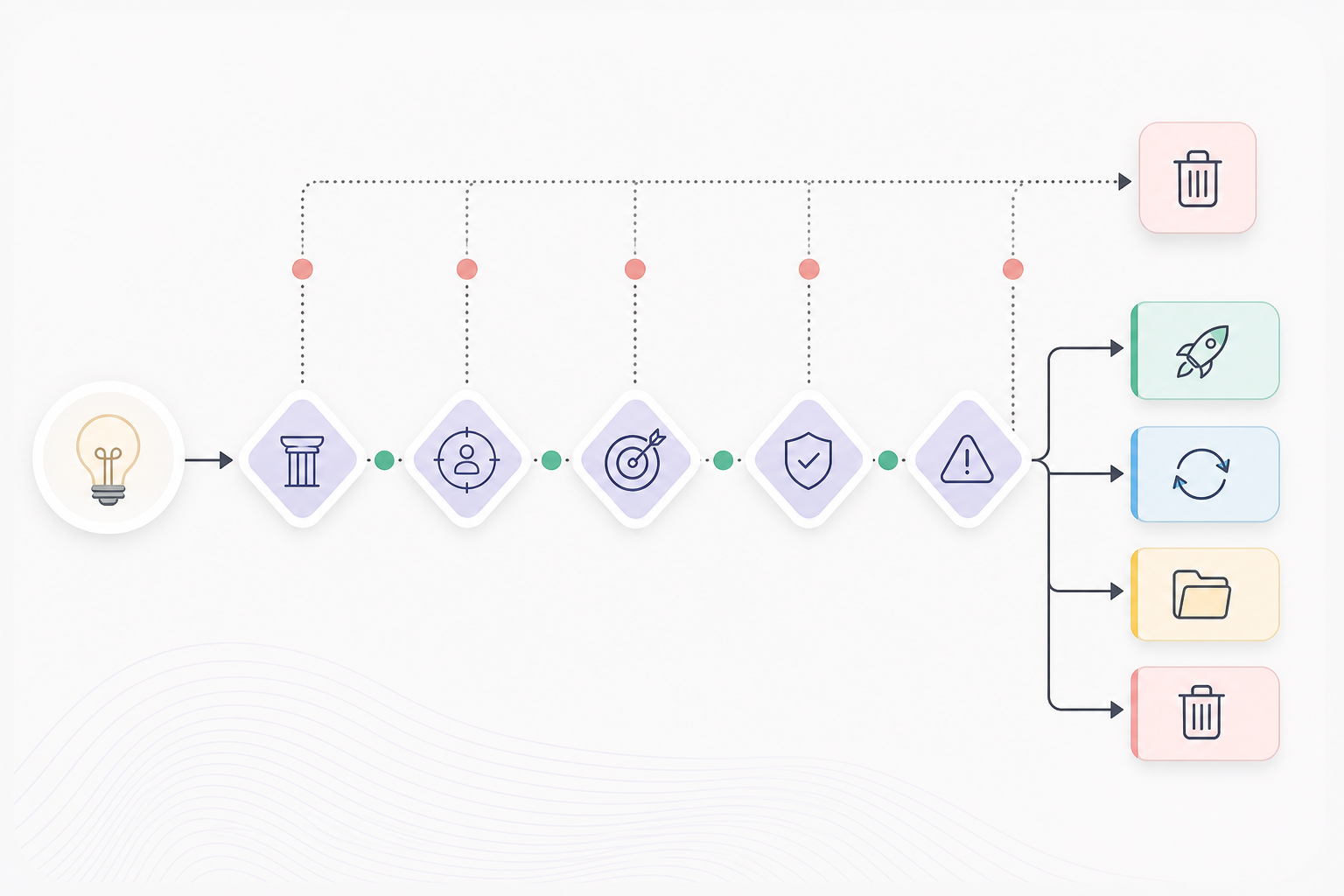
Use an idea parking lot
When content direction keeps changing with new ideas, do not stop capturing ideas. Give them a place to wait before they change your calendar.
Your parking lot can be a note, spreadsheet, project board, or document. For each idea, record:
- The trigger: a call, objection, product decision, article, or observation.
- The raw thought: what happened or what you noticed.
- The buyer takeaway: the lesson that may matter.
- The possible pillar: where it fits, if it fits.
- The proof available: an approved example, asset, or clear line of reasoning.
If you cannot assign a pillar, do not force the idea into the next slot. Revisit it in the monthly review. It may become a future angle, internal sales material, or nothing at all.
Apply the five-part post filter
Before drafting, ask five questions:
- Pillar fit: Does this belong to a documented lane?
- ICP relevance: Will the primary buyer find it useful or clarifying?
- Objective: What business outcome should it support?
- Proof: Can we support the main claim with approved evidence, sound reasoning, or an honest qualification?
- Risk: Does it mention confidential information, customer results, regulated issues, product commitments, or third parties that need review?
Then choose one action:
- Publish when the idea fits, serves the buyer, has a purpose, and passes proof and risk checks.
- Repurpose when it is useful but not right for the main channel. It may become a sales talk track or internal note.
- Park when it may matter later but does not support the current direction.
- Discard when it lacks buyer value, proof, or a safe way to communicate it.
These content direction guardrails help prevent off-topic posts without asking founders to reject every interesting thought.
Keep claim boundaries clear
Founder content can build trust quickly because readers assume the founder has direct knowledge. That also makes unsupported claims more risky.
Use simple rules:
- Do not state customer outcomes without permission and context.
- Do not imply an endorsement, partnership, or relationship that is not public and approved for mention.
- Do not make product, pricing, security, legal, or compliance claims unless the right owner has confirmed them.
- Separate a personal observation from a broadly proven fact.
- When evidence is limited, explain what you observed, what you do not know, and what the reader should check for their own case.
A safer pattern is: “Here is the decision we made, the trade-off we saw, and the principle we would use again.” It can still be specific without overclaiming.
Turn direction into a weekly founder workflow
Direction is the decision layer. A weekly workflow makes it usable. The aim is not to create extra founder work. It is to capture insights from work already happening and turn them into a few strong pieces.
Capture instead of inventing
Good founder content often begins in daily work:
- A repeated question from a sales call.
- An objection that slowed a decision.
- A confusing part of onboarding.
- A product trade-off.
- A support issue that exposes a common misunderstanding.
- A leadership decision that illustrates a buyer-relevant principle.
When you explain something twice, you may have a topic. When a deal stalls, ask what the buyer needed to understand earlier. When a customer succeeds or struggles, look for an approved general lesson rather than a confidential story.
Use this capture template:
> Trigger: What happened?
> Context: Why did it matter?
> Point of view: What do we believe or recommend?
> Proof: What supports this?
> Reader action: What can they check or do next?
A notes app, voice memo, private team channel, or CRM snippet can work. What matters is one trusted inbox. If you work alone, keep the system small. See Content Planning System For A Founder With No Team for a related approach.
Shape insights with a repeatable post structure
A simple structure helps you move faster without making every post sound the same:
- Hook: Name a specific situation or decision.
- Context: Explain why it matters now.
- Analysis: Share the insight, trade-off, or decision rule.
- Next step: Give the reader a practical action or question.
For example:
- Hook: “If your content plan changes every week, the problem may not be creativity.”
- Context: “Founders get fresh ideas from calls, launches, and industry news every day.”
- Analysis: “Publishing each new idea at once stops your audience from learning what you stand for.”
- Next step: “Create a parking lot and require every idea to map to a pillar before it reaches the calendar.”
Delegate without losing authenticity
Ghostwriting and editing can help founders publish more steadily, but the process needs real founder input. A writer should not invent experiences, customer observations, or opinions.
Set clear roles:
- Founder: provides raw notes, voice memos, decisions, examples, and final judgment on sensitive claims.
- Editor or writer: asks for context, builds the argument, removes repetition, flags unsupported statements, and maintains the direction document.
- Subject-matter reviewer: checks factual, product, legal, or customer claims when needed.
- Founder: approves the final message before it goes live.
AI can help with outlines, edits, and idea organization. It cannot provide firsthand insight or confirm a claim. The direction document keeps any support aligned with the company’s real message.
If you are assessing support for this work, What To Look For In A Founder Content Planning Platform outlines useful questions to ask.
How to keep direction stable for 90 days
Stable direction does not mean repeating the same post. It means holding core choices long enough to learn what reaches the right buyers.
Create a 90-day direction lock
For one quarter, keep these elements steady:
- Positioning statement.
- Primary ICP and buyer decision-makers.
- Three to five content pillars.
- Narrative threads.
- Claim boundaries and review triggers.
Keep testing these elements:
- Hooks and entry points.
- Formats, such as posts, emails, short videos, or articles.
- Examples and proof assets.
- Calls to action.
- Distribution choices.
For example, if your message is that fragmented planning creates inconsistent content, do not abandon it after one weak post. Test the cost of reactive posting, the founder’s decision load, the effect on buyer trust, or the value of a simple weekly system. The message stays stable; the expression changes.
Break the lock only for a material business change. If your ICP, product, or position changes, update the document on purpose. Record what changed, what remains true, and what is now out of scope.
Measure signals that show buyer learning
Do not use likes as the only steering signal. Track signs that content is reaching and helping the intended audience.
Weekly leading signals may include:
- Saves or bookmarks.
- Replies from likely buyers.
- Questions that show a relevant problem.
- Qualified direct messages.
- Email signups or replies.
Monthly outcome signals may include:
- Prospects referring to a post or framework in a sales conversation.
- Repeated objections becoming easier to address.
- Better inbound questions.
- Content that sales, customer success, or partners can use in real conversations.
Do not claim that a single post caused a purchase unless your attribution supports that conclusion. Content often helps over a longer buying process. Ask instead: did this help the right buyer become more informed, more confident, or more willing to continue the conversation?
Run a monthly iteration review
At the end of each month, review the system without rebuilding the strategy from scratch.
Ask:
- Which topics led to the most useful buyer conversations in each pillar?
- What questions or objections kept coming up?
- Which proof assets helped most, and where were you short on evidence?
- Which posts attracted the wrong audience or caused confusion?
- What one improvement can you make inside each pillar next month?
Useful changes might include adding a concrete example to every framework post, naming the target reader in the opening line, or ending objection posts with a diagnostic question.
For help deciding whether a more structured system is needed, see How To Decide If You Need A Founder-Focused Content Platform.
A practical next step
Open a document and write the seven components: positioning, ICP, pillars, narrative threads, objectives, proof assets, and boundaries. Then review your last 10 posts against it.
Do not fix every gap at once. Choose one primary buyer, three durable pillars, and a 90-day direction lock. Capture new ideas, but require pillar fit, relevance, objective, proof, and risk checks before an idea reaches the calendar.
That is the core of a useful content direction framework for founder-led marketing: fewer reactive choices, a clearer message for buyers, and a publishing system that can hold steady during a busy week.
FAQ
How many content pillars should a founder have?
Three is a strong default. It gives you enough range without losing focus. Add a fourth or fifth only when it has a clear buyer purpose, a defined owner, and enough proof or examples to support it.
What should I do when a new idea does not fit a pillar?
Put it in the idea parking lot instead of forcing it into the current calendar. During your monthly review, decide whether it could become a future angle, internal material, or a separate initiative.
Can a founder use a ghostwriter or AI and still sound authentic?
Yes, if the founder provides the raw material and approves the final draft. The founder should supply the argument, examples, trade-offs, and factual context. A writer or AI can organize and refine those inputs, but should not invent experiences, customer outcomes, or opinions.
What should trigger extra review before publishing?
Use extra review for customer references, product capabilities, pricing, performance claims, competitor comparisons, legal or regulated topics, security statements, partnership references, and confidential details. If a claim cannot be supported, remove it or reframe the post around an approved general principle.
Does stable direction mean I cannot respond to industry news?
No. Industry news can be useful when it helps your ICP understand a relevant problem, decision, or risk. The test is whether it supports your positioning and gives buyers a useful point of view, rather than borrowing attention from a trend.