
To define done for content drafts, decide what must be true before a piece moves forward—and make those checks quick to verify. A strong definition stops a draft from sitting in “almost finished” for weeks while you revisit the same sentences.
For a founder, “done” should protect three things: the reader’s experience, the accuracy of the post, and your publishing schedule. It is not a demand for perfect writing. It is a clear decision rule: if the required checks pass, the draft moves to review or publication.
In agile work, a Definition of Done is a shared, auditable standard for completed work. That same idea is useful for content because it turns quality from a vague feeling into a repeatable check (AgileHour’s guide to the Definition of Done).
What “done” means at each content stage
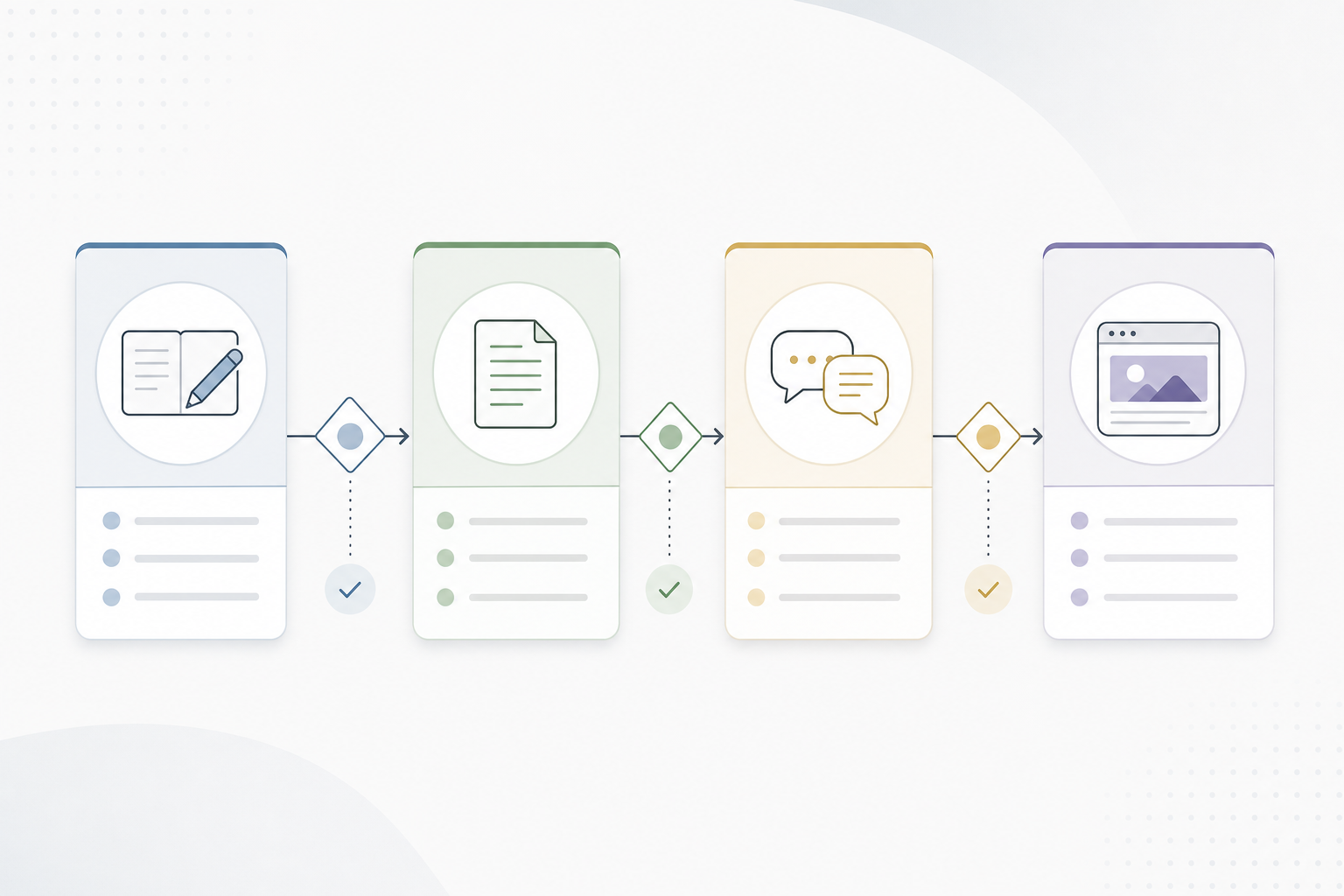
Many publishing delays happen because “draft done,” “approved,” and “published” mean different things to different people. Give each state a distinct meaning.
| State | Meaning | Decision to make |
|---|---|---|
| Ready to write | The topic, reader, angle, and needed source material are clear. | Start the draft. |
| Draft done | The piece meets the brief and is ready for review. | Send it on without more polishing. |
| Review done | Required feedback and fact checks are complete. | Approve it for publication. |
| Publish done | The post is live, formatted, linked, and recorded for later review. | Move to the next planned piece. |
A draft does not need final approval to be draft done. That distinction matters. If you expect a first draft to be flawless, you will either write too slowly or avoid shipping work to the person who can improve it.
Definition of Ready, acceptance criteria, and Definition of Done
These terms solve different problems:
- Definition of Ready (DoR): what you need before writing begins. For a blog post, this may be the target reader, the question to answer, the desired outcome, and approved sources for factual claims.
- Acceptance criteria: what this specific piece must include. For example: “Explain the trade-off between batch and drip publishing” or “Include a copy-and-paste checklist.”
- Definition of Done (DoD): the quality and release checks that apply whenever this type of content moves ahead. For example: claims checked, headings clear, links reviewed, and next step included.
Think of the DoR as the starting gate, acceptance criteria as the brief, and the DoD as the exit gate.
Why “almost done” is expensive
An unfinished draft keeps taking attention. Each reopen means you must remember the reader, the argument, the sources, and the choices you already made. That hidden work is one reason a content calendar can slip even when plenty of drafts exist.
A defined finish line helps you protect the time set aside for publishing. If consistency is currently the struggle, start with the wider system in Why Founders Struggle With Consistent Publishing. A checklist cannot fix an overloaded calendar, but it can remove needless debate at the last stage.
How to define done for content drafts
Use a small base checklist for every article. Each item should be observable: a reviewer should be able to answer yes or no without a long discussion.
Base Definition of Done for a content draft
Copy this list into your brief, task board, or editorial document.
Reader and brief
- The opening states the reader’s problem and the practical outcome of the post.
- The draft answers the main question in the brief, rather than drifting into a related topic.
- Each major section moves the reader toward that answer.
- At least one useful action, example, template, or decision rule is included.
- The recommendation fits the intended audience and stage of awareness.
Accuracy and trust
- Factual claims have been checked against suitable sources, or they have been removed or clearly framed as opinion.
- Product details, dates, prices, legal claims, and performance claims have an identified owner for review when relevant.
- Links support the statement beside them.
- The draft does not expose private information or make promises the business cannot support.
- Any first-hand experience is described honestly rather than implied.
Structure and publishing
- The title and headings clearly describe the content.
- Paragraphs are easy to scan, and terms are used consistently.
- Internal links lead to a useful next step for the reader.
- External links, images, and calls to action have been checked where used.
- The final proofread fixes errors and confusing wording; it does not reopen settled strategy.
This is a draft-level DoD. Your publish-level DoD may add CMS formatting, image permissions, metadata, and final approval.
Make every check fast to verify
Vague standards invite rewrites. Replace phrases such as “high quality,” “fully optimized,” or “make it compelling” with evidence you can see.
| Vague instruction | Faster, observable check |
|---|---|
| Make it useful | Include one action the reader can take today. |
| Improve SEO | State the topic in the title, opening, and relevant headings naturally. |
| Check quality | Confirm claims, links, structure, and proofread status. |
| Make it on-brand | Use the agreed audience, point of view, and voice notes from the brief. |
The goal is not to reduce editorial judgment. It is to save judgment for the decisions that need it: the argument, the evidence, and the reader’s needs.
Use risk buckets, not a giant checklist
Not every post needs every possible review. Add checks based on the risk of the piece.
- Accuracy risk: research-led posts, comparisons, and product claims need source review.
- Trust risk: sensitive topics need careful language and, where appropriate, specialist review.
- Brand risk: opinionated posts or major announcements may need a voice and messaging check.
- Publishability risk: posts with many links, embeds, or assets need a final functional review.
Keep low-risk posts lean. A simple founder update should not require the same process as a regulated industry guide.
Use a base DoD plus content-type extensions
One standard for every piece is easier to maintain. But a single checklist will not catch the special risks of every format. Use a base DoD, then add a short extension when the content type requires it.
Blog post extension
For an educational blog post, add:
- The search intent is clear and answered early.
- The post includes a concrete example, framework, or checklist.
- The reader has a relevant next step after the conclusion.
For planning help before the draft stage, What To Look For in a Founder Content Planning Platform explains the decisions a planning system should make easier: what to say, what matters, and what to publish next.
Product update extension
For a product update, add:
- What changed is clear.
- Who the change is for is clear.
- Important limits or availability details are confirmed before publication.
- The call to action matches what a reader can actually do next.
Do not fill gaps with assumptions. If a detail has not been confirmed, hold that part of the post or state only what is known.
Comparison or decision-guide extension
For a commercial comparison, add:
- The evaluation criteria appear before the verdict.
- Each material product claim has a source or is clearly limited.
- Unknown pricing, integrations, or availability are treated as unknown, not as product weaknesses.
- The article does not imply hands-on testing unless testing took place.
Opinion or founder-letter extension
For a point-of-view piece, add:
- The central claim is stated plainly.
- The post distinguishes a recommendation from a universal fact.
- A practical implication helps the reader decide what to do.
These extensions stop you from reinventing quality rules for each draft while keeping the base process light.
Stop perfectionism loops without lowering the bar
Perfectionism often grows in the space between “this could be better” and “this is ready enough for its purpose.” The answer is not careless publishing. It is a system that separates necessary fixes from optional polish.
Timebox the stages, not the quality
Set a realistic time limit for drafting, substantive review, and final edit. Then use one rule:
Fix now when the issue affects understanding, accuracy, reader trust, or a key brand message. Defer it when it is only a preference.
For example, fix an unsupported claim today. Fix a confusing heading today. Save a hunt for a cleverer metaphor or a fourth example for a later update unless it is essential to the brief.
A timebox is useful only when paired with the DoD. Otherwise, it can become a reason to rush past real errors.
Edit in two passes
Two passes reduce the urge to rewrite everything at once.
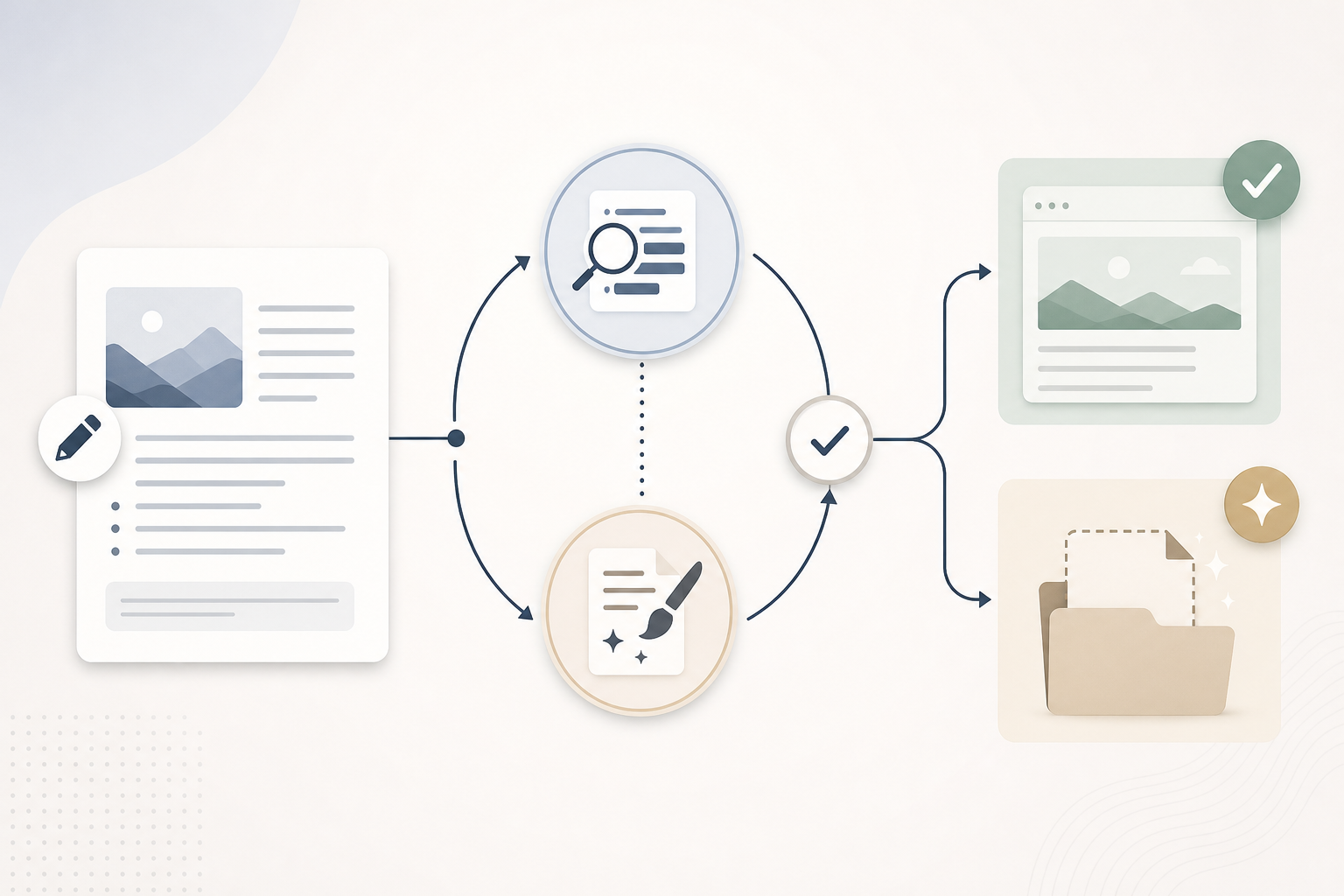
- Substance pass: Check the argument, search intent, accuracy, examples, and gaps in the brief.
- Surface pass: Tighten sentences, improve flow, correct grammar, and check formatting.
Do not change the argument during the surface pass unless you find a genuine problem. If you rewrite the opening for the third time, return to the brief and ask which DoD item is failing. If none is failing, stop editing.
Track drafts that reopen
For six to twelve weeks, record when a completed draft returns to editing. Use a short reason label:
- unclear argument
- missing source or fact check
- voice mismatch
- scope change
- stakeholder feedback
- publishing issue
The point is not to judge yourself or a writer. It is to find the weak point in the system. Repeated voice issues suggest you need clearer voice notes before drafting. Repeated scope changes suggest the brief needs stronger acceptance criteria.
This also helps you choose a cadence you can sustain. Batch vs. drip publishing for founders is a useful next read if your workflow needs to balance protected writing time with regular publication.
Allow exceptions, then learn from them
Break the timebox for genuine risk: a material factual correction, a sensitive claim, a legal review, or a major change in business messaging. Record what caused the exception and decide whether one small checklist item would prevent it next time.
Do not add a new rule after every unusual event. A DoD that takes too long to run will be ignored.
A simple founder workflow for each draft
You may be the strategist, writer, editor, and final reviewer. Those are still separate jobs, even when one person does them. Naming the role helps you avoid switching between them every five minutes.
Before writing: act as the strategist
Write a short brief:
- Who is this for?
- What question are they trying to answer?
- What should they understand or do after reading?
- What proof, examples, or sources are needed?
- What is outside the scope?
This is the best place to prevent a late-stage rewrite. If the answer is not clear before writing, no amount of sentence-level editing will solve the problem.
During drafting: act as the writer
Draft toward the acceptance criteria. Leave a visible note when you need a fact, source, example, or approval. Do not interrupt every paragraph to solve a minor wording issue.
A structured planning process can make these choices easier to repeat. Content Redefined AI is designed to help founders introduce their business, direct their content, and maintain a consistent publishing schedule. The useful test for any process is simple: does it make the next content decision clearer without adding another layer of admin?
Before handoff or publication: act as the reviewer
Run the base DoD once, in order. Mark a check as pass, fix, or needs approval. If every required check passes, move the piece forward.
A final line in the task can help: “Published because all required checks passed; optional improvements go to the update list.” That gives future you permission not to reopen the draft for taste alone.
Put the checklist into a repeatable publishing rhythm
A Definition of Done works best as part of a simple operating rhythm:
- Plan topics and briefs.
- Confirm each piece is ready to write.
- Draft against the acceptance criteria.
- Review with the base DoD and any relevant extension.
- Publish, then record improvement ideas separately.
- Review reopened drafts and update the system only when a pattern appears.
This rhythm keeps planning, drafting, and publishing from blending into one endless task. If you are running content alone, a content planning system for a founder with no team can help you reduce the number of decisions that compete for your attention each week.
The useful standard is not “would I change one more line?” It is “does this draft meet its purpose, protect trust, and have a clear next step?” When the answer is yes, ship it.
Common questions about defining done for content drafts
How detailed should a content Definition of Done be?
Keep it short enough to use for every relevant draft. Start with eight to fifteen checks across reader value, accuracy, structure, and publishability. If a rule needs a meeting to interpret, make it more concrete or remove it.
Should every content type use the same DoD?
Use one base DoD, then add small extensions for formats with extra risk or requirements. This gives you consistency without forcing a product announcement, opinion piece, and research guide through the exact same review.
What changes when AI helps create a draft?
The finish line stays the same. AI-assisted text still needs a human owner to check claims, sources, links, relevance, and brand fit. Treat generated material as input to review, not proof that a statement is correct or ready to publish.
When should a draft go back into progress?
Reopen it when a required DoD item fails: the answer is unclear, a material claim lacks support, a key source changes, or the post no longer matches the approved brief. Do not reopen it only because you have found a different way to phrase a sentence.