
When a new customer question, internal project, or sales objection changes this week’s content plan, it can feel like responsiveness. But when content direction keeps changing with new ideas, you reopen the same decisions: who the content is for, what it should say, what proof it needs, and what to publish next.
That is idea whiplash. It is usually a decision-load problem, not a lack of creativity or discipline.
The answer is not to reject good ideas. It is to give them a place to go, then decide which deserve attention now. This founder-friendly 30-day system uses a temporary direction, clear themes, a two-lane backlog, and a short brief before anything reaches the calendar.
Idea whiplash is reactive switching, not healthy adaptation
A content plan should adapt when the business changes. A new offer, a move into a new market, or evidence that your message misses the mark may justify a real shift.
Reactive switching is different. It happens when a fresh idea replaces committed work before you have learned from the original plan. The backlog grows, drafts stall, and each post starts from zero.
A deliberate pivot has three qualities:
- A reason: something meaningful changed in the business, audience, or goal.
- A scope: you decide whether to adjust a tactic, a theme, or the wider direction.
- A measure: you define what to review before deciding whether the change worked.
Forbes recommends determining the size and type of a content pivot first. Entering a new market may require a larger change; improving engagement may call for a narrower adjustment. A new idea alone is not a business case for a pivot.
Signs your content direction is unclear
You may not need a new strategy. You may need a clearer decision layer before content reaches the calendar.
Your idea list is full, but little gets published
You collect useful topics from customer conversations, product work, and sales calls, yet the calendar slips. Ideas have been captured, but not turned into defined pieces.
“Thoughts on AI” or “marketing tips” is not enough to draft from. It leaves too many decisions open when writing begins.
Every post seems useful, but the collection says nothing clear
A post can help on its own and still weaken the whole body of content. If one post covers a trend, the next shares company culture, and the next explains a product detail, a potential buyer may not learn what your business helps with.
Ask: after reading five recent posts, could a reader describe your point of view and the problems you solve? If not, the topics may lack a shared direction.
Scheduled dates carry vague labels
A calendar date is not a content decision. If “customer story” or “SEO post” is all an item contains, the difficult work has simply been deferred.
Planning becomes heavy when topic, angle, format, channel, CTA, date, and follow-up are all undecided. For related reading, see why content planning feels overwhelming as a founder.
Content direction vs. publishing strategy
Founders often try to solve a direction problem with a better cadence, or a production problem with a new direction. They are related, but different.
| Decision layer | Main question | Examples |
|---|---|---|
| Content direction | What do we want to be known for, by whom, and why? | Audience, problem territory, point of view, proof |
| Publishing strategy | How will we reliably turn that direction into content? | Cadence, channels, workflow, review process, buffer |
Content direction is the lane
Content direction defines the audience you are trying to help, the problems you can credibly address, and the evidence or experience you can bring to them.
For example, a founder might choose: “Help operations leaders at small service firms reduce messy project handoffs.” That can support many pieces without becoming a random list of operations topics.
Document this on one page: audience, problem, proof, and CTA. The document does not need to be permanent. Its job is to make the next month of decisions easier.
Publishing strategy is the shipping system
Publishing strategy covers practical execution: how often you publish, who reviews, where work lives, and what happens when a draft gets stuck.
You might batch outlines once a month and publish weekly. Or work in a steady drip, using a fixed weekly slot to turn one approved idea into a finished piece. A clear direction with a weak shipping system creates unfinished work; a smooth system with no direction creates disconnected posts. Related reading: batch versus drip publishing for founders.
The behaviors that create idea whiplash
Treating every idea as urgent
A prospect asks a sharp question, or a sales objection reveals a gap. These can be valuable inputs, but they should enter a queue before replacing planned work.
If a new idea can only succeed by displacing a scheduled piece, ask what evidence makes it more important than the current priority.
Planning dates before defining the piece
When a calendar is filled with dates first, writing time becomes a strategy meeting. You still need to decide the reader, promise, proof, format, and CTA. Under that pressure, a new and easier idea can look more attractive than finishing the planned one.
Name pieces with the reader and outcome. “A five-minute handoff check for agency operations leads” is easier to write than “handoffs.”
Letting the latest input set the whole agenda
Sales calls, support tickets, onboarding questions, and customer feedback should inform your plan. They should not automatically become your plan.
Create a repeatable way to collect these signals and review them weekly. The latest conversation can then become an input for the parking lot or a future planning review, rather than an interruption to current work.
Running too many content jobs at once
A blog, newsletter, video, social posts, and lead magnet can all be useful. But each becomes a separate production system if you treat it that way.
Start with one core piece. Once it is clear and complete, extract a shorter insight or practical step for another channel. Repurposing should reduce work, not multiply it.
A 30-day content direction framework for founder-led marketing
You do not need a major overhaul to regain control. Use a temporary operating system for the next 30 days.
1. Set a three-part filter
Choose:
- One audience segment you want to reach now
- One problem you can credibly help solve
- One business priority the content should support
For example:
> Audience: operations managers at small agencies
> Problem: project handoffs break during busy periods
> Priority: start conversations about implementation support
This is a short-term filter, not a permanent brand statement. When a new idea appears, ask whether it helps this audience with this problem in support of this priority. If not, save it for later.
2. Pick three or four themes
Themes connect individual pieces to your direction. For the agency example, themes might include finding the cause of broken handoffs, simple process fixes, decisions to make before adding tools, and lessons from internal workflow improvements.
Themes make duplicates easier to spot. They also show whether an idea extends the direction or pulls you away from it.
3. Turn topics into named pieces
Before an idea earns a calendar slot, make it specific:
Reader + situation + promise + format
For example: “Three questions to ask before buying another project tool” — practical article.
Named pieces make scope visible and easier to finish.
4. Schedule to real capacity
Plan for a month that includes client work, sales, hiring, and unexpected issues—not an ideal month. Choose a cadence you can sustain and define a fallback, such as a shorter FAQ or an already-approved topic, when a larger draft stalls.
For a related diagnosis, see why content calendars can fail after two weeks.
Guardrails that prevent off-topic posts without killing creativity
Use a two-lane backlog
Keep only two lists:
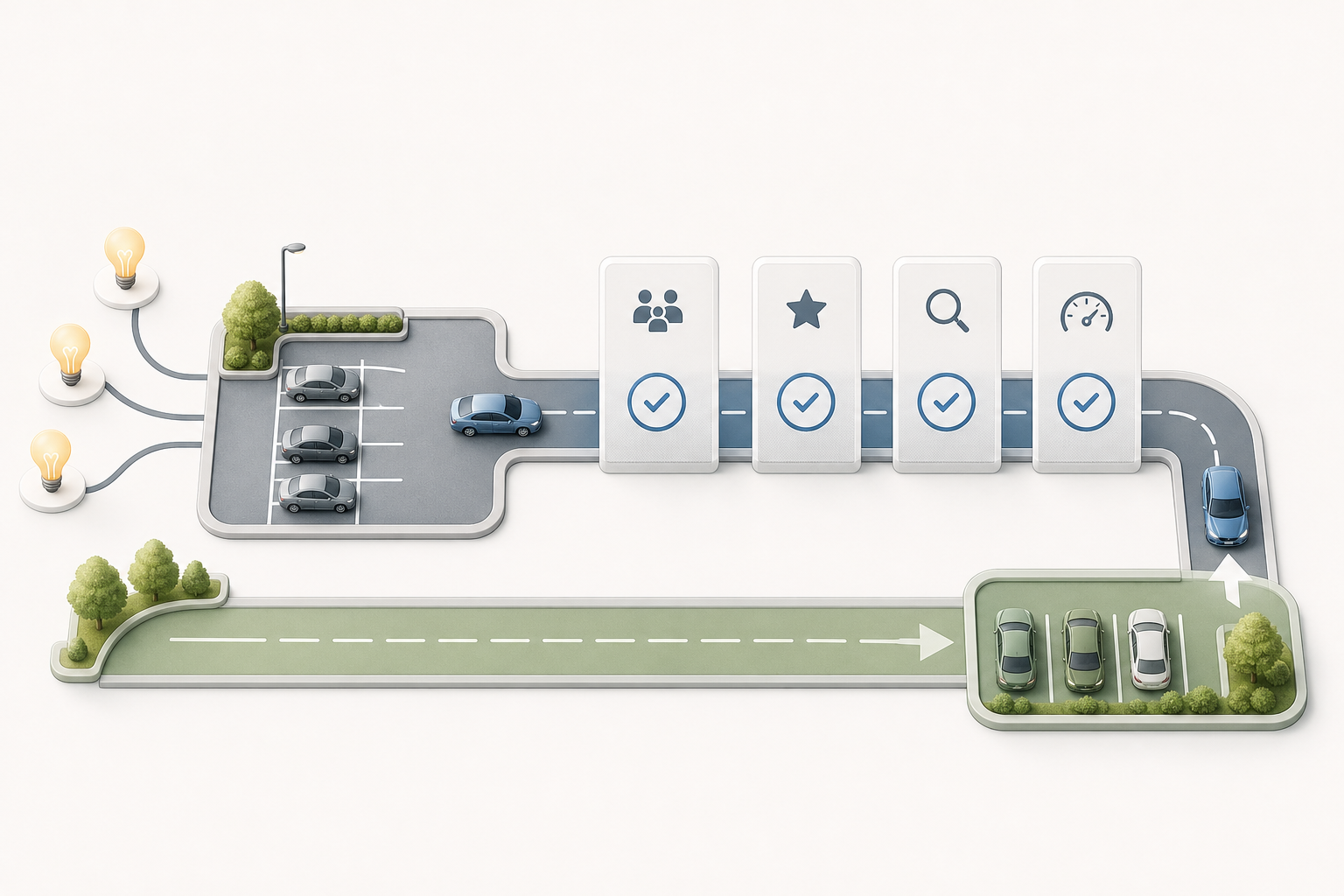
- Committed this month: pieces that passed the filter and have a brief
- Parking lot: ideas worth revisiting but not allowed to interrupt current work
Every new idea goes to the parking lot first. Review that list at a set weekly or monthly time. This removes the false choice between chasing every idea and losing it forever.
Score ideas before promoting them
Give each idea 0 to 2 points for these questions:
- Does it fit the chosen audience?
- Does it support the current business priority?
- Do we have proof, a useful example, or a credible point of view?
- Can we complete it with the time available?
A low score is not a rejection. The idea may need a narrower scope, stronger evidence, or more time.
Require a minimum viable brief
No brief, no calendar slot. Keep it short:
- Who is this for, and what situation are they in?
- What single promise will the piece make?
- What proof, example, or process supports that promise?
- What is out of scope?
- What should the reader do next?
This prevents a vague topic from becoming a vague draft.
Audit before you overhaul
One practical principle is to audit existing and scheduled content before you overhaul everything, then make the smallest change that fits the new context. In a LinkedIn article about adapting messaging during major context shifts, the guidance similarly recommends reviewing existing and upcoming content for contextual fit rather than assuming a complete overhaul is necessary.
Check whether your language, examples, offers, and calls to action still fit. Then make the smallest change that addresses the problem.
When to pivot content direction—and when to stay the course
Consider a pivot when you are entering a meaningfully different market, your offer or positioning has changed, the audience has changed, or your content no longer reflects the problems you solve. Review performance against your own goals and KPIs to understand what to keep or change.
Stay the course when the issue is mainly execution: the audience and offer remain the same, you have not published enough focused work to learn from, or vague briefs and slow review are stalling drafts.
If you pivot, write down what remains stable. You might keep the audience while testing a new theme, or keep the core problem while changing the format or CTA. A scoped change preserves what you have learned instead of resetting everything.
Start with one protected month
The next good idea does not have to become the next published piece. Put it in the parking lot, return to the current filter, and finish the work you chose.
For the next 30 days, protect one audience, one problem, one business priority, and a small set of themes. Require a brief before a topic reaches the calendar. Review new ideas deliberately, not in the moment.
That gives your content time to become recognizable—and gives you a fair basis for deciding what needs to change and what simply needs a chance to work.