
Drafts pile up and never get published when there is no clear path from rough idea to scheduled post. The issue is rarely a lack of ideas or effort. More often, key decisions—who the post is for, what proof it needs, who approves it, and what counts as done—are left until the end.
For a founder, the answer is not a larger content calendar or a longer writing session. It is a small workflow that makes stalled work visible, limits work in progress, and gives every draft a real finish line.
Why good drafts get stuck
A draft can be useful and well written yet still fail to ship. Most first drafts need later decisions—review, fact checks, links, metadata, formatting, and a publish date—before they become published work.
When those jobs sit inside one vague status called “almost done,” reopening the document can feel easier than deciding what happens next. Finishing is a different job from starting a draft. Treat it as its own stage, with explicit checks and a named owner.
The most common bottlenecks
Look at where work stops rather than judging the quality of the writing. These patterns point to different fixes:
- The topic is still fuzzy. The draft has words, but no settled reader question or point of view.
- The finish line is unclear. “Tighten this” and “make it better” never produce a decision.
- Stages are blended. A draft, an approved article, and a scheduled post are treated as the same thing.
- No one owns the next move. Feedback is requested, but no person is responsible for resolving it.
- Claims need checking late in the process. A promising post stalls because evidence, product details, or examples cannot be verified quickly.
- Polish expands to fill the time available. Editing becomes a rewrite loop.
- Publishing tasks are deferred. The copy is ready, but formatting, links, metadata, and scheduling remain undone.
These are operating problems. They need operating rules.
Make the workflow visible before adding more content
A calendar that only shows deadlines cannot tell you why a post missed its date. Add a status for the work itself. A visible workflow helps you see whether the constraint is topic selection, drafting, review, or publishing setup.
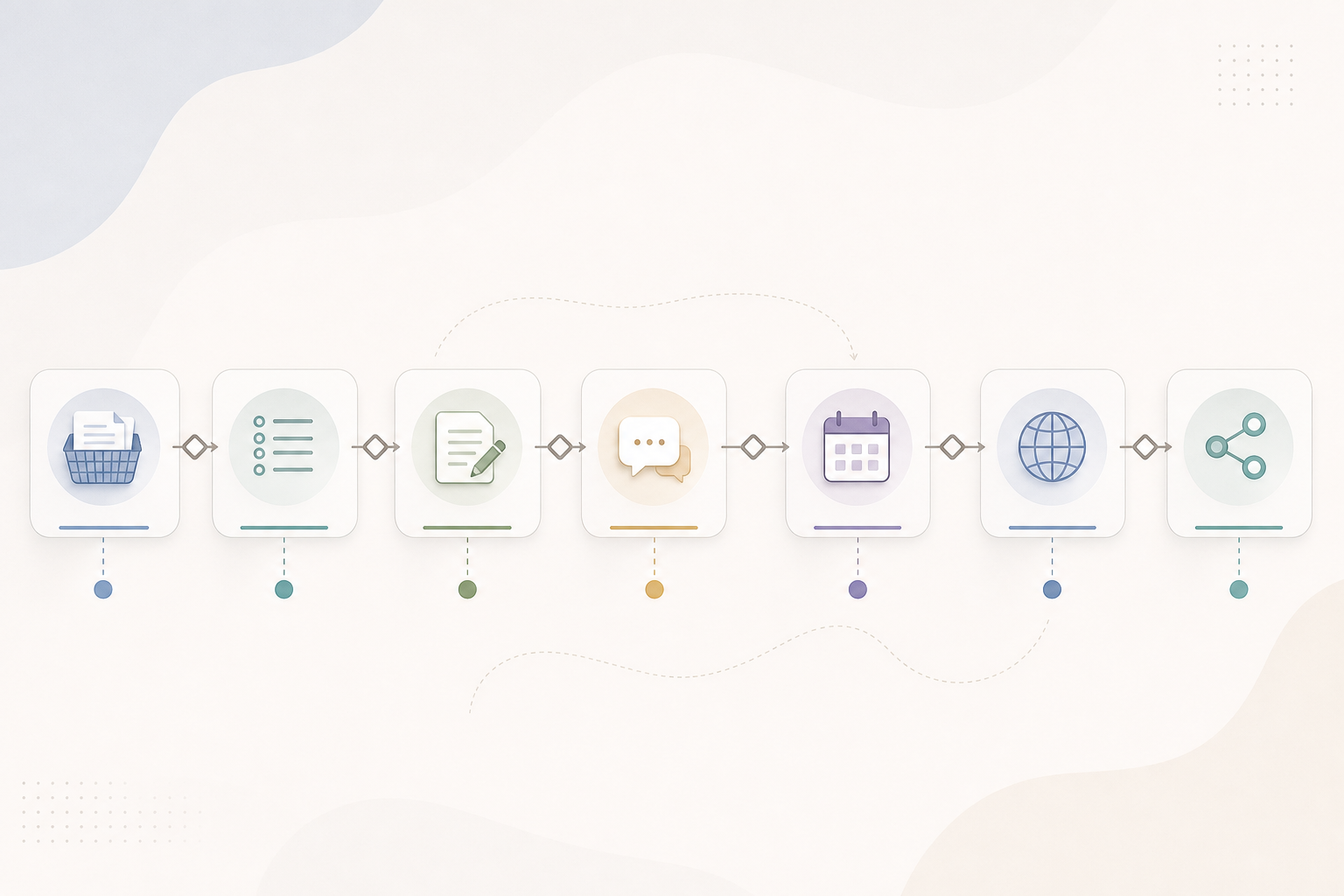
A useful starting ladder is outlined in this guide to why content calendars fail after two weeks: Captured → Outlined → Drafted → In review → Scheduled → Published → Repurposed.
| Stage | What it means | Decision needed to move forward |
|---|---|---|
| Captured | A raw idea, note, question, or observation | Is this worth developing now? |
| Outlined | The reader, angle, and section flow are clear | Is there enough direction to draft? |
| Drafted | A complete first version exists | Does it meet the draft standard? |
| In review | Accuracy, fit, and clarity are being checked | Revise, approve, or reduce scope? |
| Scheduled | The post is prepared and has a date | Is the publishing package complete? |
| Published | The post is live | What should be learned or reused? |
Keep the ladder simple. Its job is not to create more administration. Its job is to expose the next decision.
Give every post one owner
Even on a small team, each post needs one person responsible for moving it forward. That person does not need to write every word or approve every claim. They do need to resolve open questions, request the right review, and update the status.
If you are the only approver, make that constraint explicit. Reserve a short, recurring review slot instead of allowing approval to compete with every other task in your week.
Separate drafting from approval and publication
“Draft done” should not mean “published.” It should mean the writing is ready for review or final publishing tasks. “Review done” means the required decisions have been made. “Published” means the piece is live or scheduled in the system you use.
That distinction removes a common source of delay: everyone assumes someone else is handling the final step.
Set a Definition of Done without demanding perfection
A Definition of Done is a short, observable list of what must be true before a draft moves ahead. It replaces the vague feeling that a post might need “one more pass” with a clear decision rule.
The goal is not perfect writing. It is a piece that is useful to the intended reader, accurate enough to stand behind, and ready for its next stage. See the founder checklist for defining done on content drafts for a fuller explanation.
A practical Draft Done checklist
Use yes-or-no checks that you can complete quickly:
- The opening states the reader’s problem and the outcome of the post.
- The article answers one main question and does not drift into unrelated topics.
- The structure supports the answer in a logical order.
- The reader receives at least one concrete action, example, or decision rule.
- Factual claims have suitable support, have been removed, or are clearly framed as opinion.
- Product details, dates, prices, legal statements, and performance claims have an appropriate person assigned to verify them when needed.
- Links support the nearby point.
- The draft does not reveal private information or make promises the business cannot support.
- The title and headings match what the article actually delivers.
If the checklist passes, move the piece forward. Do not send it back to the start because a sentence could be more elegant.
Handle uncertain claims early
Unverified claims are a common hidden reason drafts stall late. Build one of these choices into the drafting stage:
- Find a suitable source and cite it.
- Remove the claim if it is not needed.
- Frame it honestly as an opinion, observation, or example rather than a fact.
For example, replace “This approach always increases conversions” with “This approach may reduce confusion for buyers when the next step is unclear.” The second version names a possible benefit without making a promise you cannot prove.
Edit in two passes
A two-pass edit reduces the urge to rewrite everything at once.
Substance pass: Check the reader question, logic, missing steps, accuracy, and scope.
Surface pass: Improve clarity, grammar, flow, formatting, and headings.
During the surface pass, change the argument only if you find a real accuracy or comprehension issue. Save optional polish for a later update.
Use a 150-minute weekly rhythm to ship one piece
Founders do not need a full-time editorial operation to publish consistently. They need a repeatable loop with one output at each step: decide, outline, draft, edit, publish, and learn.

The founder content planning weekly operating rhythm offers a minimum viable schedule totaling 150 minutes, or 2.5 hours, across the week. Adjust the time when a subject needs deeper research or expert review, but keep the sequence.
| Day | Time | Output |
|---|---|---|
| Monday | 25 minutes | A brief: business goal, reader, question, angle, and next step |
| Tuesday | 30 minutes | A tight outline and only the support needed for the article |
| Wednesday | 50 minutes | A complete first draft |
| Thursday | 25 minutes | An edit, links, and metadata |
| Friday | 20 minutes | A published or scheduled post and one lesson for next week |
This is a starting point, not a rule that every topic must fit into 150 minutes. A technical, regulated, or research-heavy subject may need a longer review cycle. The important part is that the work still has defined stages and an explicit next move.
Decide before you draft
A five-line brief prevents major decisions from landing halfway through the article:
- What business priority does this support?
- Who is the reader?
- What question are they trying to answer?
- What is the useful angle or promise?
- What should they do next?
Lock the reader, question, promised outcome, and call to action before you draft. Those decisions make a post easier to finish because you are not trying to discover its purpose on the page.
Use a recovery rule for disrupted weeks
Missed days are normal. The recovery rule is simple: move the next unfinished step forward; do not restart the entire plan.
If drafting does not happen on Wednesday, draft on Thursday, do the essential edit on Friday, and schedule the post for the next available date. A delayed post is still progress. Restarting the month usually creates another backlog.
Do not use a missed session as a reason to skip source checks, required approval, or a necessary substantive edit. Instead, reduce optional polish, narrow the piece, or move the publication date.
Publish at a cadence you can protect
Weekly is a useful starting rhythm, not a universal requirement. If your subject matter needs more research, a twice-monthly schedule may be more honest and sustainable. Choose a cadence that leaves room for review and publishing tasks, not just writing.
A smaller cadence with a reliable finish line is more useful than an ambitious schedule that regularly leaves work in draft status.
Clear your existing backlog with four decisions
Do not try to finish every old draft. A large backlog often contains duplicates, outdated ideas, and pieces that no longer fit your offer. Gather the drafts in one place, add the intended reader question beside each, and make one decision per item.
Finish
Choose drafts that answer a current reader question and need limited work. Give each one the smallest shippable version: one clear point, one useful action or example, accurate claims, and one relevant next step.
Before you finish it, check whether the original angle is still current. If the post relies on an old product detail, statistic, or policy, verify it again or remove it. A nearly complete draft is not a reason to retain a claim you cannot support.
Combine
Merge drafts that address the same question. Three partial posts about one objection can become one better article. Combining also reduces the number of approvals and publishing tasks in flight.
Choose one primary reader question when you combine drafts. Keep only the material that helps answer it. Otherwise, several unfinished drafts can become one oversized draft with the same finishing problem.
Downgrade
Not every idea needs to become a full article. A narrow observation may work better as a short founder note, checklist, FAQ answer, or newsletter section.
Downgrading is not failure. It is a scope decision: match the format to the value of the idea rather than forcing every note through a long-form process.
Delete or archive
Archive a draft when it no longer supports your current audience, offer, or message. Keeping it in an active backlog creates false obligations and makes priority harder to see.
If you are unsure whether to archive something, ask one question: would you deliberately choose to start this topic today? If not, remove it from active work. You can retain the idea elsewhere without allowing it to compete with current priorities.
Set a work-in-progress limit
After triage, limit active work. Try one primary draft and one next-up outline. Before starting a third item, publish, combine, downgrade, or archive one of the existing items.
A work-in-progress limit matters even more when you use AI writing tools. AI can help with a defined task such as outlining, drafting, or rewriting. But it can also produce more near-finished material than you can review. Use it inside a workflow with clear stages and a Definition of Done. Do not let faster drafting become a faster way to build a backlog.
Put the system in place this week
Start with one post, not a full content overhaul.
- Create the status ladder in the tool you already use.
- Assign one owner to the post.
- Adopt a short Draft Done checklist.
- Choose one backlog item to finish, combine, downgrade, or archive.
- Block the next five steps in your calendar and publish or schedule the completed post.
- Record where the work slowed down, then improve that stage next week.
As you repeat the process, look for the stage where work repeatedly waits. If many pieces are drafted but none enter review, protect approval time. If outlines do not become drafts, reduce the size of the brief or choose more focused topics. If approved posts are never scheduled, make publishing setup a required step rather than an assumed one.
A better system does not remove founder judgment. It gives that judgment a defined place, so your best ideas do not remain trapped in drafts.