
Content planning without a niche feels scattered because every idea seems plausible. You may know your market broadly, but not yet know the audience, problem, and message you want to repeat.
You do not need to declare a permanent niche before you publish. You do need enough focus to make the next decision easier. This guide shows how to set temporary constraints, choose useful themes, and run a weekly planning rhythm that can adapt as you learn.
Why fuzzy positioning makes content feel random
A content plan breaks down when three questions remain open at the same time:
- Who is this for?
- What problem are we helping them solve?
- Why should they hear this from us?
When those answers change with every post, each new idea becomes a fresh debate. One week you write for all small businesses. The next, you address agencies. Then you publish a general productivity tip because it feels easy to create. None of those topics may be bad, but together they do not give readers a clear reason to return.
That is why content planning can feel overwhelming for a founder: you are doing positioning, editorial selection, and production at once.
Broad content can also become vague. A small-business content guide from Rising Tide Society makes the same useful point: trying to speak to everyone can make posts generic and forgettable. Its suggested starting point is the overlap between what you know, what you care about, and what your audience needs help with (read the framework).
The answer is not to force a label that no longer fits in six months. Treat your current focus as a working hypothesis: a set of rules you will use long enough to learn from.
Narrow your focus without making a permanent commitment
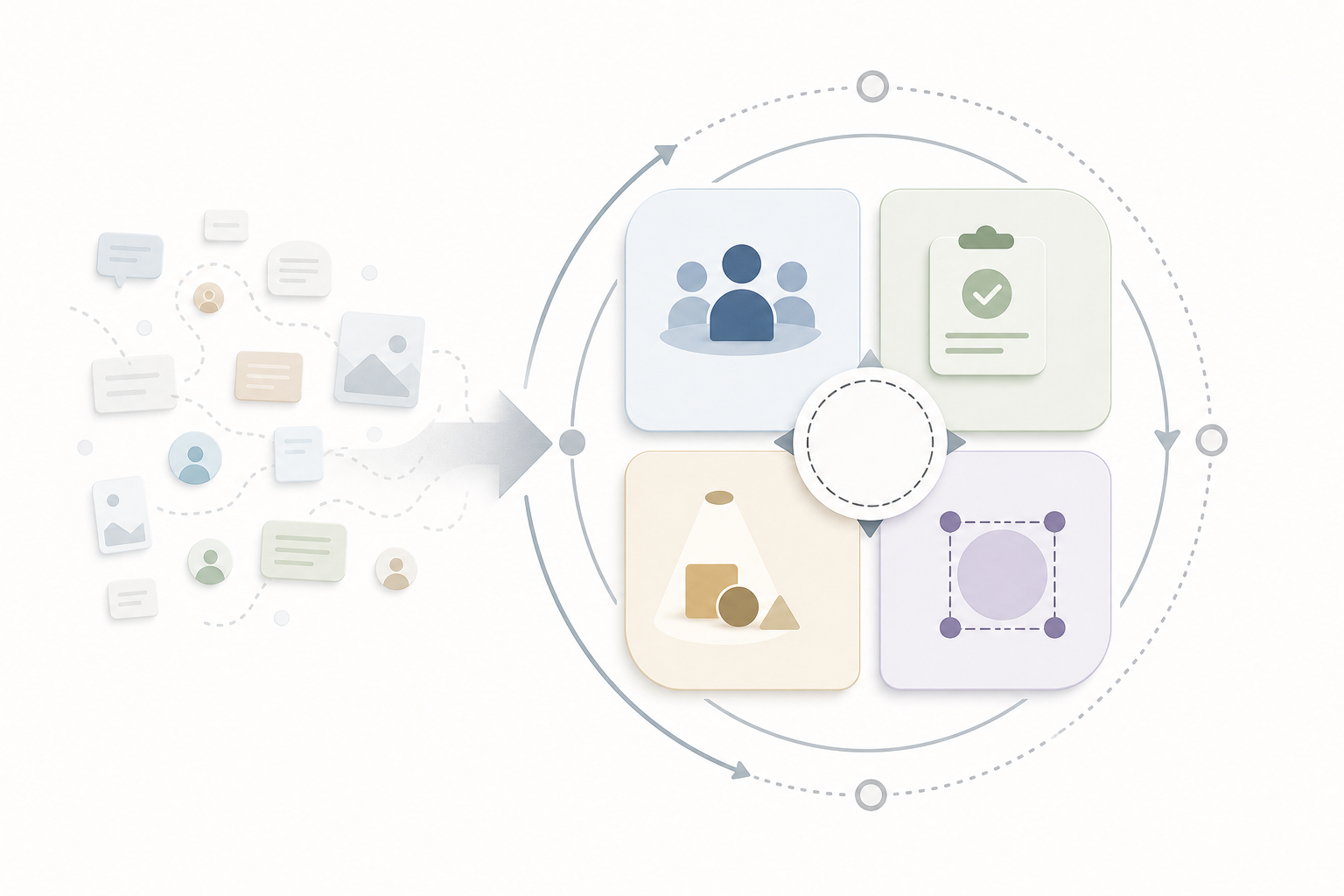
Set a 30- to 90-day focus window. During that window, choose one audience segment, one job they need done, two to four credible angles, and one boundary. Review the choices at the end of the window rather than reopening them every week.
Choose one audience and one job
Start with a specific group that is close enough to your current offer that you can speak to its daily problems.
Use this sentence:
We help [who] do [job] so they can [outcome].
For example: “We help service-business founders turn custom work into clearer packages so they can sell with fewer proposal revisions.”
This is not a full positioning statement. It is a content filter. A topic belongs in the plan if it helps that person make progress on that job.
If “small business owners” is your answer, go one level deeper. Which type of owner? At what stage? What are they trying to do this quarter? The goal is not false precision. It is a useful decision rule.
Pick two to four credible angles
Your angles are the repeatable views you can bring to the chosen job. Keep an angle only if it passes three tests:
- You can support it. You have direct experience, clear evidence, or a well-bounded perspective.
- You want to return to it. You can discuss it more than once without stretching for ideas.
- Your audience needs it. It helps them make a decision, avoid a problem, or complete a task.
For the packaging example, credible angles might include scope boundaries, pricing logic, client onboarding, and proposal-to-package changes.
Do not choose an angle only because it is trending. Trends may offer a timely hook, but they are a weak foundation if they have no connection to your expertise or offer.
Define what you will not cover yet
A boundary prevents every interesting idea from entering the calendar. It can be simple:
> For the next 30 days, we will not publish general leadership advice, broad marketing news, or topics outside our selected audience and job.
Keep rejected ideas in a parking lot. Parking is not the same as discarding. It gives you a place to save a good idea without letting it interrupt the current experiment.
For more ways to reduce decision overload, see these founder-focused content planning constraints.
Four content themes that work while you are exploring
You do not need ten pillars. Start with two to four themes that let you teach, test, and learn. The following four work well because they create useful content without requiring you to claim perfect certainty about your niche.
Problem content: name the friction clearly
Describe a painful situation, its constraints, and the tradeoff involved. This helps readers recognize themselves and gives you language for future planning.
Examples:
- The hidden cost of custom proposals for a small service firm
- Why a team of one struggles to keep client delivery organized
- The tradeoff between a fast launch and a well-tested process
End with a practical decision rule. For example: “If revisions are eating into delivery time, standardize the scope before you redesign the proposal.”
Decision content: help buyers choose
Decision content explains how to evaluate options. It can attract people who are close to action without making inflated promises.
Examples:
- When a fixed package is a better fit than a custom quote
- Questions to ask before hiring a specialist
- What to compare when choosing a planning system
Be careful with comparison posts. Only compare products, prices, or features you can verify. If you cannot verify a detail, explain the decision criteria instead.
Process content: show how you work
Process content turns your operating principles into practical guidance. It is often easier to sustain than broad thought leadership because it comes from work you already do.
Examples:
- A checklist for approving a new client project
- The questions we ask before changing scope
- How we decide whether a content idea is ready to publish
A process post should include the conditions that shape your method. Explain what the process is designed for, where it may not fit, and what remains a judgment call.
Proof and limitation content: share what can be assessed
Useful proof does not require a dramatic case study. You can share an original example, a lesson from a changed process, or an honest limitation.
Examples:
- What changed after we simplified our intake process
- A lesson from a launch that needed more customer context
- Who should not use our approach yet
Avoid turning assumptions into evidence. If a claim needs data, a source, or a direct example, add it before publishing. If you cannot support it, narrow or remove it.
Use a rolling plan instead of a brittle calendar
A large quarterly calendar can look reassuring, but it often fails after a launch, a busy sales week, or a change in the offer. A rolling plan is smaller and easier to recover.
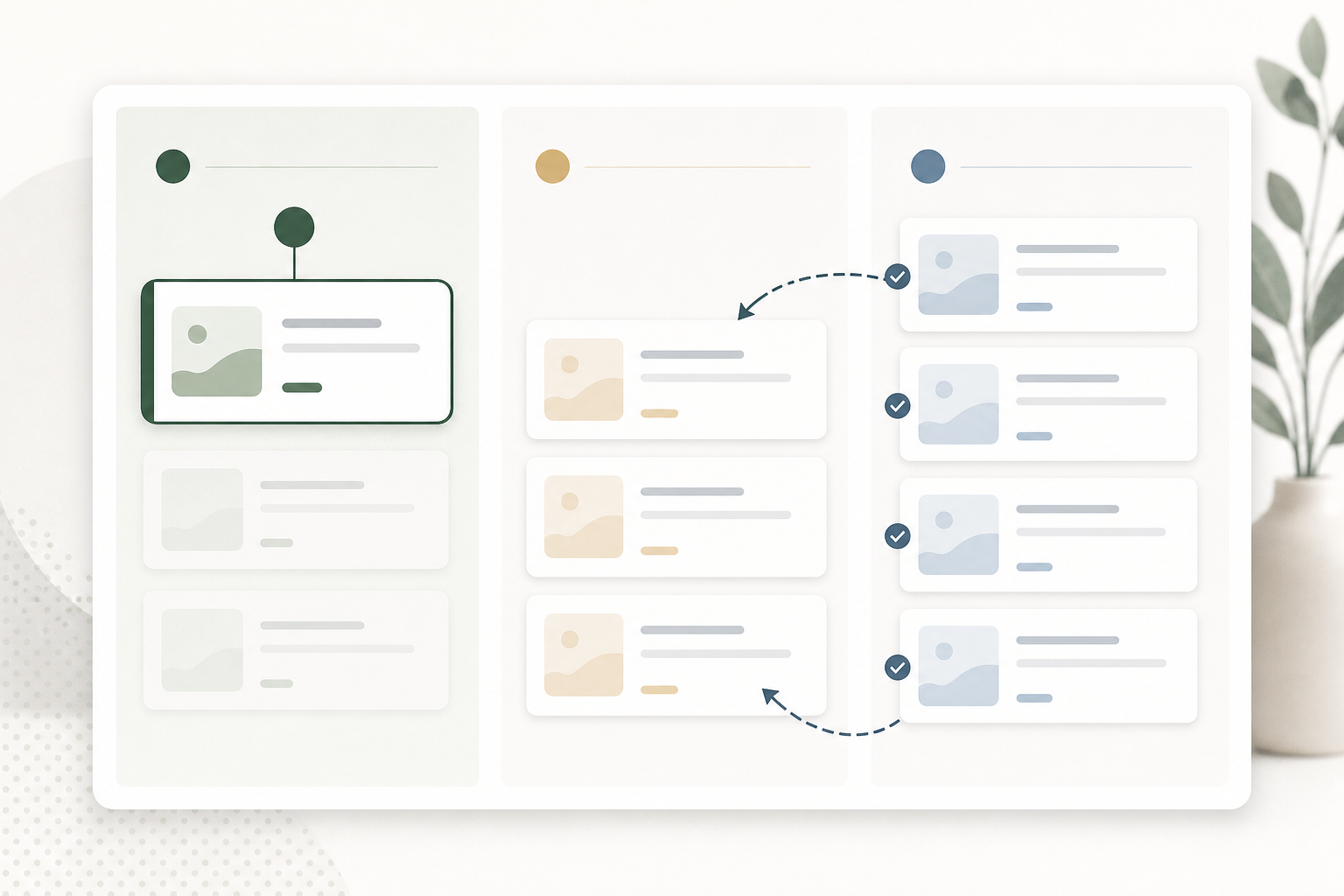
Keep three simple lists:
| List | What belongs there | Suggested size |
|---|---|---|
| Now | One item being drafted or edited | 1 |
| Next | Approved topics that meet your current constraints | 3–5 |
| Later | Ideas to revisit, research, or park | As needed |
This structure answers “what is next?” without pretending you can predict every priority months ahead.
Use a two-minute approval gate
Before a topic enters the Next list, ask:
- Is it for the audience we chose for this window?
- Does it help that audience do the job we named?
- Does it fit one of our credible angles?
- Can we add a real example, evidence, or useful point of view?
- Is there a sensible next step for the reader?
If the answer to any of the first three questions is no, park the idea. If the fourth answer is no, narrow the topic or do more research. This gate prevents a clever headline or a passing trend from taking over the plan.
A content planning system for a founder with no team should reduce the number of decisions required in a busy week. Your system does not need to hold every idea. It needs to keep the right next item visible.
Review what you know, not what merely sounds convincing
AI can help organize research, suggest an outline, and prepare a first draft. It cannot confirm that a fluent sentence is true, current, or representative of your business.
Before you publish AI-assisted work, check:
- factual claims, numbers, and product details;
- whether sources actually support the statement being made;
- examples that only you can provide, such as operating context or a real limitation;
- whether the article says more than a generic summary.
A smaller publishing pace is valid if it gives you time to make each piece accurate and useful. Consistency is a sustainable practice, not a maximum-volume target.
A weekly operating rhythm that survives busy weeks
A founder content planning weekly operating rhythm works best when it is short, repeatable, and forgiving. Use the same order each week so you are not rebuilding your process from scratch.
Here is a 75-minute default schedule:
- Propose — 10 minutes: Add up to three candidate topics from customer conversations, sales questions, support issues, or your parking lot.
- Approve — 5 minutes: Run the decision gate and choose one topic.
- Draft — 40 minutes: Write the core path: problem, framework, example, and next step.
- Edit — 15 minutes: Remove vague claims, verify facts, and add one detail grounded in your experience.
- Schedule — 5 minutes: Set a realistic date, or leave the piece in progress with a clear next action.
You can spread these blocks across the week. The important part is the sequence, not the exact day.
For a more detailed cadence, see the founder content planning weekly operating rhythm.
When weekly planning is better than monthly planning
Choose weekly planning when your offer is changing, you are testing a new audience, or you need to respond to what you are learning in sales conversations. Weekly planning gives you room to adjust before a long calendar becomes obsolete.
Choose a monthly planning layer when your offer, capacity, and formats are stable. Even then, keep only a small number of items fully approved. The rest should remain flexible.
What to do after a missed week
Do not rebuild the whole calendar. Use a 10-minute reset:
- Confirm the current audience, job, and boundary.
- Choose the easiest approved item that is still useful.
- Reduce the scope if needed: one clear post is better than an unfinished campaign.
- Move the remaining queue forward and continue.
Publishing every other week may be a better fit than forcing a weekly pace you cannot maintain. A plan that resumes after disruption is more valuable than a perfect plan that collapses.
Common founder content planning mistakes
Covering every topic “just in case”
This feels safe because it avoids excluding potential buyers. In practice, it makes it harder for readers to understand what you are known for.
Do instead: choose one audience and job for a defined test window, then park the rest.
Planning around formats before decisions
Starting with “we need reels” or “we need a newsletter” puts packaging before purpose. Formats can change. The reader’s problem and decision should lead.
Do instead: write, “My audience is trying to ___ and deciding ___.” Then choose the format that best answers that question.
Making broad claims without evidence
A vague claim may sound confident but does little to build trust. This is especially risky when AI has supplied polished wording without business context.
Do instead: add a source, a truthful example, a clear limitation, or a more modest claim.
Chasing early traffic as the only signal
Search and trust can take time. Early traffic alone may not tell you whether a topic is helping the right audience.
Do instead: review a mix of signals: relevant replies, sales questions, qualified visits to key pages, and patterns in the topics people ask you to explain. Do not treat any one signal as proof on its own.
Start with one focused month
For the next 30 days, choose one audience, one job, two to four credible angles, and one boundary. Build a short queue, use the approval gate, and publish at a pace you can review properly.
At the end of the month, ask what felt natural to explain, what drew useful conversations, and what you could support with real experience. Keep the parts that held up. Change the parts that did not.
That is how a fuzzy niche becomes clearer: not through a permanent declaration, but through a disciplined cycle of focused publishing and honest learning.