
When audience engagement is inconsistent across posts, it does not automatically mean the content is poor.
A useful post can receive little visible response because timing, distribution, audience fit, format, and message clarity all affect what happens after publishing. Engagement also has different baselines on different platforms. One post is a data point, not a verdict on your strategy.
The goal is not identical results from every post. No founder controls every feed, viewing session, or competing demand on an audience’s time. The practical goal is to reduce avoidable randomness: keep key inputs steady, capture useful feedback, and review patterns over time.
For founder-led marketing, engagement matters when it helps answer practical questions:
- What problems does our audience keep raising?
- Which explanations lead to better questions?
- Which topics create qualified clicks or sales conversations?
- Where are people still unsure about buying?
- What should we publish next?
This guide explains why responses swing, what to keep consistent, and how to turn feedback into a repeatable planning loop.
Define engagement before trying to improve it
Engagement can include views, likes, comments, shares, saves, replies, and relevant clicks. These actions are not equal. A like and a detailed question about your service tell you very different things.

A simple tiered view helps you focus on signals that can inform your next decision.
| Engagement tier | What it can include | What it may tell you | What to do next |
|---|---|---|---|
| Attention | Views, reach, impressions, time on page | People had a chance to see the content | Check whether distribution changed; do not treat reach alone as proof of relevance |
| Resonance | Saves, shares, thoughtful comments | The idea was useful enough to keep, share, or discuss | Look for themes, examples, and framing worth repeating |
| Intent | Relevant clicks, replies, requests for detail | Someone may want a next step | Make sure the CTA and destination answer the next likely question |
| Buying friction | Questions about fit, setup, cost, risk, or timing | A potential buyer may be stuck on a decision | Turn the question into sales material or future content |
A practical assessment goes beyond likes and pays attention to actions that require more effort, such as saves, shares, and comments. Socialinsider’s guide to audience engagement makes the same distinction between passive reactions and active signals.
For a founder, buying-friction signals are often the most useful. A post with modest reach that brings two clear implementation questions may be more valuable than a widely seen post with generic likes.
What causes engagement volatility across posts?
Some variation is normal. Other swings come from inputs that change without anyone noticing. A repeatable process cannot remove all uncertainty, but it can make results easier to interpret.
Algorithms and audience expectations evolve over time, and platform benchmarks differ, so compare posts against recent performance on the same platform before cross-platform comparisons.
For founder content, the weak point is often one of five areas:
- The message is unclear.
- The topic does not meet a live need.
- The format does not fit the question.
- Distribution and follow-up stop at publishing.
- Feedback never reaches the next content plan.
The message is unclear
Founders have deep knowledge of their market and offer. Readers often do not share that context. A post can be accurate but still be hard to act on if people cannot quickly see who it is for, why it matters, or what they should do with it.
Before drafting, write a one-sentence reader promise. For example:
> An agency owner who is unsure how to price a discovery call will learn how to define the scope and explain the fee.
This gives the post an audience, a problem, and a clear outcome. If you cannot write that sentence, the idea may need focus before it needs a stronger opening.
When reviewing a post, use response patterns as prompts for investigation rather than firm diagnoses:
- Did the post get attention but little relevant action?
- Did it attract quick reactions but few substantive replies?
- Did a small number of readers leave unusually thoughtful comments?
- Did questions reveal that readers interpreted the offer differently from how you intended?
Then revisit the audience, decision, proof, and next step. Often, naming the audience and the decision more plainly is enough to make a post easier to understand.
The topic misses a live need
Founder updates can be interesting, but they may not help a reader make a decision today. A launch announcement or weekly lesson becomes more useful when it connects to a problem the audience already feels.
Start with decision-shaped content. This can include buy-versus-build questions, hire-versus-outsource choices, process changes, implementation-risk trade-offs, and questions about whether a solution fits a company’s stage.
Questions from calls, emails, comments, and sales conversations can reveal where people are stuck. They help separate a topic that is merely true from one that is useful now.
Keep a list of decision moments in your audience’s own words. If several prospects ask, “How much founder time does this take?”, you have a prompt for content about workload, roles, expectations, and fit.
If your audience is still too broad, clarify the problems, language, and decisions that matter to them before choosing topics. Understanding your audience for content marketing is useful related reading.
The format does not match the question
A short post and a detailed guide do different jobs.
A quick point of view, one mistake, or one useful example can work in a short post. A decision with trade-offs, limits, and edge cases may need a guide, email, walkthrough, or direct conversation.
Match the format to the depth of the question:
- Use a short post for one idea, one example, and one takeaway.
- Use a visual sequence when the reader needs to compare steps or choices.
- Use an email when direct follow-up is useful.
- Use a long-form guide when the topic needs definitions, steps, caveats, and decision criteria.
- Use a walkthrough when seeing the process makes the answer clearer.
For example, “Three signs your onboarding process is too complex” may work as a short post. “How to redesign onboarding for a service business with several stakeholders” likely needs a deeper resource.
Distribution ends when you publish
Publishing is not the same as distribution. If you post and move on, you lose an opportunity to learn from the response.
A simple follow-up habit can include:
- Replying to early comments with a useful answer.
- Looking for the question behind a comment, not just the words used.
- Returning to a useful idea later with a new example or clarification.
- Following up through appropriate channels you already use.
- Giving someone clear ownership for replies if the founder cannot handle them.
Distribution will not rescue an unclear message. But uneven follow-up can make it harder to distinguish a topic problem from a distribution problem.
Feedback disappears before planning
Useful signals arrive in many places: comments, calls, emails, demos, and support threads. If no one captures them, next week’s content may be chosen from memory or urgency. That makes it harder to build a consistent learning loop.
Close the loop: capture feedback, group it, decide whether it needs a public answer, and add it to the upcoming content queue. Related reading (optional): Audience engagement loop for consistent content ideas.
Why the same content performs differently on different platforms
Engagement baselines vary by platform, so the same content can reasonably get different results depending on where it appears. Socialinsider’s audience-engagement analysis notes that platform-level engagement rates are not interchangeable.
Do not start a cross-platform review by asking which channel got more likes. Ask:
- What does normal performance look like for our account on this platform?
- Which action matters most on this platform for our goal?
- Did the audience receive enough context and a clear next step?
- Are we comparing similar types of posts?
Use the same broad engagement tiers across channels, but judge each channel against its own baseline. Attention can show a change in distribution. Resonance can show which ideas people value. Intent and buying-friction signals can show whether the right people are moving toward a decision.
Keep a short context note for each post: platform, format, pillar, CTA, and whether you followed up. That makes results easier to interpret later.
What should be consistent in every post?
Do not standardize every word or format. That would make your content repetitive. Standardize the foundations so that variation is deliberate and easier to learn from.
Keep the audience and intent clear
Each post should have one main audience segment and one main job. It cannot serve every buyer, customer, peer, investor, and job seeker at once.
Define the segment in practical terms, such as “owner of a 10–50-person agency” or “operations lead at a service firm.” Then choose the post’s job:
- clarify a problem;
- teach a process;
- compare options;
- reduce perceived risk;
- answer an objection; or
- invite a qualified next step.
A post for an early-stage reader may explain the category. A post for an active buyer may help them weigh trade-offs. Both can fit the same pillar, but they should not make the same promise.
Keep a small set of content pillars stable
Choose three to five pillars tied to problems you want to be known for solving. A pillar is not a format, such as video, or a broad theme, such as motivation. It is a recurring audience problem.
Examples include:
- pricing and packages;
- onboarding and time to value;
- operational risk;
- implementation and change management;
- results and proof; and
- decision criteria and fit.
Tag each piece with one pillar. Keep pillars stable long enough to see a pattern. Socialinsider recommends using your own performance data to identify themes that consistently generate stronger engagement with your specific audience rather than guessing.
Do not turn every popular topic into a pillar. A topic can attract attention from people you do not want to serve. A good pillar supports both audience value and business direction.
Keep proof standards consistent
Readers learn what to expect from you. If one post makes a sweeping claim and the next offers a careful process, trust is harder to build.
Choose a clear proof type for each post:
- Example: A realistic scenario with relevant limits.
- Data: A source-backed fact with context.
- Customer story: Only with permission and accurate detail.
- Process: The steps or decision rules you use.
- Expert view: An opinion clearly presented as an opinion, not a universal fact.
Do not invent case studies, metrics, or certainty. A clear process and an honest limitation are often more persuasive than a vague promise.
Keep the CTA and next step simple
A post can be useful without a CTA. But if you want it to move someone forward, make the next step clear.
Choose one action:
- reply with a specific constraint;
- read a related guide;
- join an email list;
- request more information; or
- share the post with a colleague.
The CTA should follow from the post. A complex decision may call for a guide or conversation. A short educational post may only need a question that invites useful replies.
Keep distribution ownership and follow-up clear
Before publishing, decide where the content will appear, who will answer replies, and what useful follow-up looks like.
Use this checklist:
- Audience: Who is this for?
- Intent: What should it help them understand, decide, or do?
- Pillar: Which recurring problem does it address?
- Format: Is this the right depth for the question?
- Proof: What example, process, or source supports the point?
- CTA: What is one sensible next step?
- Distribution: Where else, if anywhere, will it appear?
- Follow-up: Who will review and answer meaningful responses?
Use the checklist for several weeks before changing it. The aim is enough consistency to compare results, not a rigid template.
Build a founder engagement workflow
A practical audience engagement workflow for founder content can be simple:
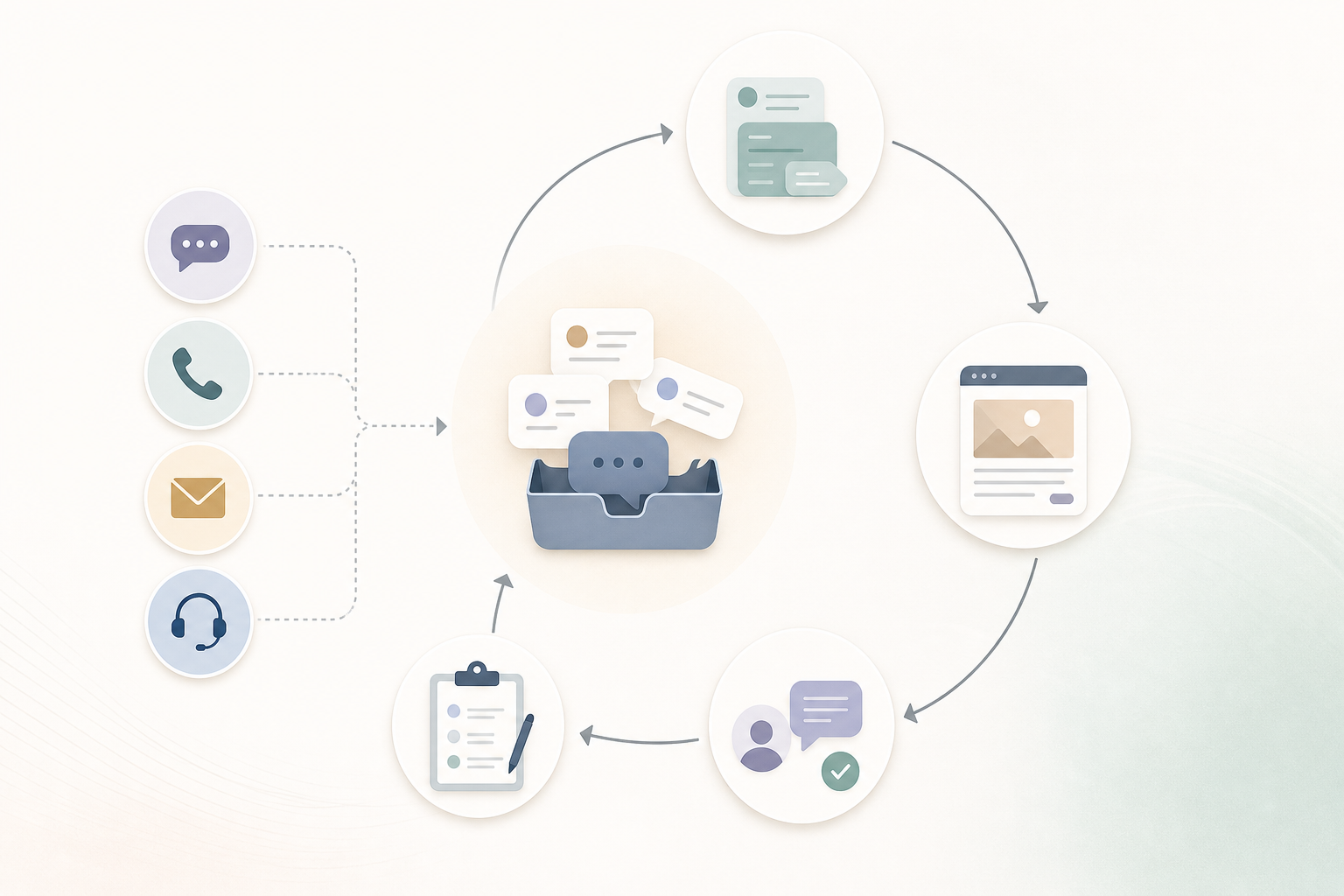
> Collect signals → group them into themes → decide what they mean → publish an answer → follow up → review the pattern.
This makes engagement useful after publishing. Each response can become an input for future content, sales material, positioning, or customer education. For a related operating model, see Audience engagement workflow for founder content.
Create an Engagement Inbox
Use a spreadsheet, notes app, CRM view, or shared document. The tool matters less than having one place to record useful signals while they are fresh.
For each entry, capture:
- Source: Comment, email, sales call, support thread, or direct message.
- Audience context: Role, company type, use case, or stage of evaluation.
- Exact wording: The question, objection, or phrase used.
- Pillar: The problem it belongs to.
- Intent label: Learn, evaluate, compare, validate, or solve.
- Suggested next action: Social post, guide, FAQ, sales follow-up, product explanation, or no action.
Remove names, private details, and sensitive commercial information. Preserve the pattern and language, not personal data.
For example, three questions about the time a founder must commit during onboarding may belong under Onboarding and Evaluate. That is a useful prompt for a clear piece about workload, roles, and expectations.
Use a lightweight weekly scorecard
Do not build reporting that takes longer to maintain than to learn from. For many founder teams, five to seven measures are enough.
Track a mix of numbers and context:
- meaningful comments or replies;
- saves and shares where available;
- clicks to one or two important pages;
- qualified questions;
- repeated objections or points of confusion; and
- a short note in the audience’s own words.
The note matters. Numbers show that something happened; the language shows what to address next.
Do not judge a post by one metric. A low-reach post that surfaces a recurring implementation concern may matter more than a high-reach post with only passive reactions.
Turn the inbox into a 30-day idea queue
Once a week, review the Inbox and scorecard. Choose one repeated question, one high-intent objection, or one pillar that keeps producing useful signals. Then choose the clearest format for the answer.
A manageable monthly rhythm could be:
- Pick one pillar each week.
- Publish two or three short answers, such as an FAQ, objection, comparison, or misconception.
- Create one deeper asset, such as a checklist, guide, or walkthrough.
- Review feedback and add new signals to the right pillar.
One insight can support several pieces without becoming repetitive. An implementation pillar might include a short post about a setup mistake, another about team roles, and a deeper guide to the full process.
If you use drafting tools, keep inputs grounded in real audience questions and maintain editorial review before publishing.
How long should you evaluate performance before changing strategy?
Do not change a pillar or strategy after one quiet post or one quiet week. Too many factors can affect a single result.
Use two review windows instead.
Weekly: make small operational changes
Use the weekly review to spot immediate patterns and prepare the next pieces. Ask:
- Did a question or objection appear more than once?
- Did a post get attention but fail to drive relevant action?
- Did useful replies point to a deeper resource?
- Did we follow through on distribution and responses?
Make small changes: clarify the CTA, add an example, try a better-fitting format, or answer the same question from another angle. Keep most of the system steady.
Periodically: decide what to keep, change, or retire
Set aside time to review patterns over a longer window rather than judging every post in isolation. In its guide, Socialinsider shares an example of using quarterly benchmarks to understand audience response over time. Your review cadence should fit your publishing volume and the amount of evidence you have.
Review results by pillar, format, audience segment, and signal quality. Ask:
- Which pillars repeatedly lead to saves, detailed replies, qualified clicks, or buying questions?
- Which topics get broad attention but little business relevance?
- Which formats fit the questions your audience asks?
- Which objections remain unclear despite repeated content?
- Which messages belong on your website, in sales material, or in onboarding?
If you want clearer learnings, change one major element at a time—such as topic, format, CTA, platform, or follow-up—instead of several at once.
A final troubleshooting guide
Before rebuilding your calendar, check these nine points:
- Message clarity: Can someone tell who the post is for and why it matters?
- Live need: Does the topic help with a real decision, objection, or confusion?
- Format fit: Does the format give the question enough depth?
- Pillar consistency: Does the post support a problem you want to be known for solving?
- Proof standard: Is the claim supported by an example, process, or source?
- CTA: Is there one logical next step?
- Distribution: Did you do more than press publish?
- Feedback capture: Did the response enter your planning system?
- Measurement window: Are you reviewing a pattern rather than one post?
When audience engagement is inconsistent across posts, the answer is rarely to chase every platform change or force every post to go viral. A better next step is operational: clarify the audience and intent, repeat a small set of useful pillars, use reliable proof, follow up after publishing, and turn feedback into the next helpful answer.
That will not make every post perform the same way. It will give you a steadier way to learn what your audience needs and a more reliable source of content ideas than guesswork.