
The publishing strategy mistakes founders make are rarely about laziness or a lack of ideas. They are usually operating problems: unclear direction, too many decisions at once, stalled reviews, and a cadence built for an unusually calm week.
For founder-led marketing content—blog posts, newsletters, and social posts—the goal is not to publish as often as possible. It is to create a small system that moves useful work from idea to publication when sales, product work, hiring, and customer needs compete for attention.
A reliable schedule does not guarantee traffic, leads, rankings, or engagement. Those outcomes also depend on the audience, topic, quality, distribution, and offer. What a publishing system can do is make useful work easier to finish, review, publish, and improve.
Find the real cause of schedule slippage
A missed publishing date can look like a writing problem. In practice, the delay often began earlier. The topic was too broad. The brief lacked a clear purpose. No one owned the next step. Or several half-finished pieces were competing for the same small block of time.
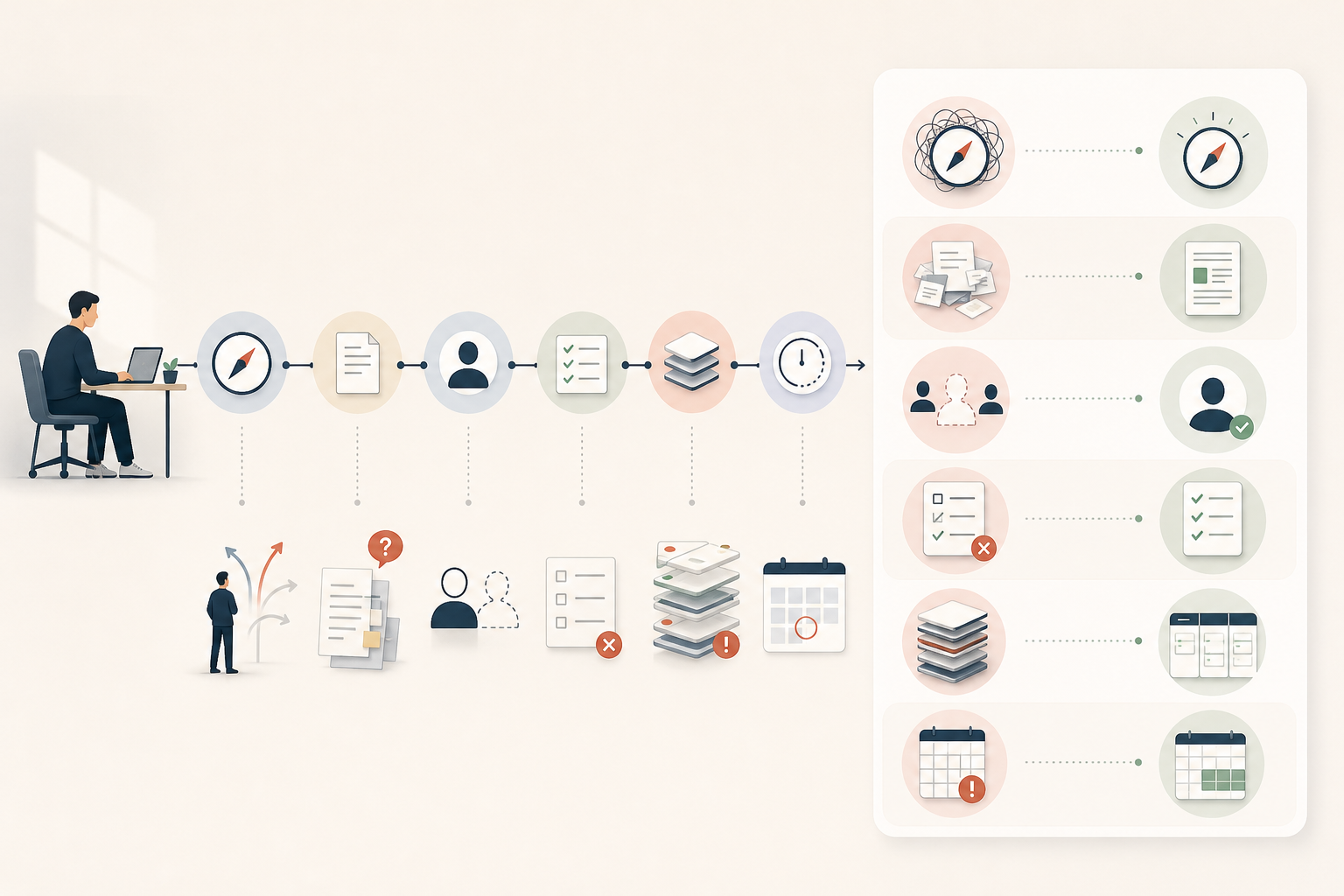
This is why publishing strategy feels impossible without a team for many founders. One person may be asked to choose topics, research, write, check facts, approve the work, format it, and promote it. A few operating decisions can remove much of that decision load.
| Failure point | What it looks like | Operating choice that prevents repeat delays |
|---|---|---|
| Unclear direction | Every topic starts with a new debate | Set 3–5 content pillars and topic boundaries |
| Unclear brief | Drafting begins before the reader or purpose is known | Define the reader, problem, and job before writing |
| No owner | A draft sits in a document or message thread | Name one directly responsible individual for each piece |
| Vague finish line | New expectations appear during review | Define “ready to publish” before drafting |
| Too much active work | Many drafts exist, but nothing ships | Set a work-in-progress limit |
| No buffer | One busy week breaks the schedule | Build a small reserve, then release steadily |
Founders often lose publishing time to competing priorities and last-minute choices, not a lack of commitment. For a fuller look at those pressures, read why founders struggle with consistent publishing.
Mistake 1: Treating more content as a strategy
“Post more” is an output goal, not a strategy. It does not tell you which topic deserves attention, who needs the piece, or what the piece should help the reader do.
That gap creates a familiar pattern. You open a blank document, then return to bigger questions: Is this for prospects or existing customers? Should it answer an objection or explain a process? Is it a newsletter, article, or sales follow-up? The writing session becomes a planning session, and the deadline slips.
The fix: make three decisions before drafting
Put three short answers at the top of every brief:
- Reader: Who is this for? Name a specific buyer, customer type, or role.
- Problem: What one question, obstacle, or decision does this piece address?
- Job: What should it do? Teach, clarify a point of view, handle an objection, or support a sales conversation?
For example:
- Reader: An operations lead at a growing service business
- Problem: New-client onboarding feels chaotic
- Job: Explain how to map handoffs before buying more software
- Next step: Review the current onboarding process
This is enough direction to create an outline without turning every draft into a new strategy meeting. Lead with the reader’s problem and what you can help them do, rather than treating founder content as a personal broadcast.
Mistake 2: Keeping content direction too broad
When every subject seems relevant, choosing one can feel risky. The result is often more saved ideas, more research tabs, and fewer published pieces.
Broad direction makes each task harder. It forces you to decide what belongs every time you plan, write, review, or publish. It also makes it easy to chase topics that sound interesting but do not serve your audience or current business goals.
The fix: choose 3–5 pillars and clear boundaries
Content pillars are recurring areas where your business has a useful perspective. They are not a list of every service, feature, or trend you could mention.
A service business might choose pillars such as:
- Buyer mistakes before hiring help
- How the company’s process works
- Trade-offs customers should understand
- Questions that recur in sales and onboarding
Then add boundaries. You may decide not to cover breaking news, broad industry commentary, or research-heavy subjects that cannot be completed during a normal work week. A boundary is not a missed opportunity. It protects the work you have chosen to do.
Build pillars from real conversations. Review recent sales calls, proposals, support questions, and onboarding notes. Group repeated questions into plain-language themes. If a topic does not fit a pillar, add it to a backlog instead of forcing it into this month’s plan.
Mistake 3: Letting drafts move through an ownerless workflow
A sound content plan can still fail when the route from idea to publication has no clear owner. A contractor may wait for founder feedback. The founder may assume the piece is being edited. The publishing date passes, and nobody has made a deliberate decision to move the work forward.
Review is a common bottleneck. It becomes slow when feedback is vague, approvals are scattered, or the person expected to resolve a question is not clear.
The fix: assign a DRI and define the finish line
Give each piece one directly responsible individual, often called a DRI. This person does not need to write every word or approve every claim. They are responsible for moving the piece to its next stage and raising a blocker early.
For a small business, responsibilities might look like this:
- A writer owns the first draft.
- The founder owns factual review and final approval.
- An editor or coordinator owns formatting, scheduling, and release.
If one person fills all three roles, the distinction still matters. It shows what kind of task is holding the work up.
Define “ready to publish” before drafting starts. Keep the checklist brief:
- The reader, problem, and core point are clear.
- Important claims have been checked.
- The piece gives the reader a useful next step.
- The title, description, links, and formatting are complete.
- The release and distribution owner are known.
This turns review into a focused decision rather than an open-ended rewrite request. For more on ownership, handoffs, and stalled execution, see why content strategy exists but execution fails.
Limit work in progress
A large idea backlog is not necessarily a problem. A large backlog of active drafts is. It splits attention, hides the true bottleneck, and creates the feeling that content is always in motion even when nothing is ready to publish.
Set a simple work-in-progress limit. A founder-led operation might allow only:
- One piece in brief
- One piece in draft
- One piece in review or scheduling
Do not start another article until one leaves the system. You may have fewer projects open at once, but you will have more finished work.
Mistake 4: Choosing a cadence for your best week
A schedule that works only when the calendar is calm is not a sustainable schedule. It is a short burst of output.
Frequency is how often you publish. Consistency is whether you can keep publishing at the pace you chose. A practical standard is a cadence you can maintain for 90 days through normal disruption, without heroic effort.
The fix: choose a minimum viable cadence
Your minimum viable cadence is the smallest useful rhythm you can protect during a normal busy period. Choose it based on the time available for planning, writing, review, and approval—not on ambition alone.
If you are the only reviewer, one useful article a month may be the right starting point. If editing support is reliable, a more frequent newsletter or article schedule may be possible. Every planned item needs enough time to be researched, reviewed, approved, and published. A draft alone is not finished work.
A slower rhythm that survives a full quarter is more useful than an intense plan that disappears after two weeks. Use these implementation steps for a consistent publishing schedule to set a pace around the time you actually have.
Create a fallback mode for busy weeks
A missed week is a cue to simplify, not to double your workload. Decide in advance what your smallest useful publishing unit will be when capacity drops.
That might be:
- A concise answer to a common buyer question
- A short note that addresses a recurring objection
- A practical checklist drawn from onboarding or sales conversations
- A newsletter that points readers to an existing useful article
Fallback mode prevents one difficult week from becoming a full stop. When capacity returns, use the next planning session to decide whether the buffer, scope, or cadence needs to change.
Mistake 5: Treating batch vs. drip as a personality test
The publishing strategy for founders batch vs drip decision is calendar design, not a test of discipline.
Batching groups similar work into focused sessions. You might outline several pieces at once, then draft or review them in later blocks.
Drip publishing releases content at a steady pace. It can keep content close to current customer questions, but it becomes fragile if each piece is created just before its release date.
Why both approaches can break down
Batching fails when it creates a folder of drafts with no named owner, review date, or planned release. Those drafts are not a buffer. They are unfinished work waiting for another decision.
Drip publishing fails when there is no cushion. A launch, customer issue, or week of travel interrupts the process, and the entire schedule has to restart from zero.
The practical choice: batch a buffer, then drip release
For many founders without a marketing team, a hybrid approach is more practical. Batch enough work to create a small, near-ready buffer. Then release it on a dependable schedule.
Try this routine:
- Hold one monthly planning session to choose topics and move upcoming pieces to a reviewable stage.
- Protect a short weekly slot to review, finalize, schedule, and share the next item.
- Count a piece as buffer only when it has a clear angle, a named owner, and a scheduled review or publish date.
If review remains the bottleneck, do not respond by creating more drafts. Fix ownership and the definition of done first. Read batch vs. drip publishing for founders for a closer look at the trade-offs.
Build a founder-friendly publishing system this week
You do not need a large marketing department to create a dependable publishing process. You need a few decisions that reduce repeat work before a deadline arrives.
Set up the system in four moves
- Choose 3–5 content pillars. Base them on recurring customer questions, buyer concerns, and real trade-offs.
- Pick a minimum viable cadence. Make it sustainable for the next 90 days, including busy periods.
- Create one visible workflow. Use simple stages: idea, brief, draft, ready for review, scheduled, published.
- Set ownership and limits. Name a DRI, define “ready to publish,” and cap active work.
Add a modest distribution routine once the publishing process is stable. Send useful articles to your newsletter, share a focused perspective where buyers already pay attention, and give sales context for when to use the piece. Distribution creates more chances to learn from the market; it does not make growth automatic.
Review the system once a month
At the end of each month, ask:
- Which topics led to useful customer or sales conversations?
- Where did work wait the longest?
- Which questions kept repeating?
- What should be removed from next month’s plan?
Use the answers to improve the brief, workflow, and cadence—not simply to add more output. If you are deciding whether to keep managing the process yourself or add more structure, see Make or Buy a Content Planning System for SMB Founders.
A useful founder publishing strategy makes key decisions before deadline pressure arrives. Each piece has a purpose, a path, an owner, and a realistic release date. That is how content becomes a repeatable part of business communication rather than work reserved for spare time.