
Business discovery questions founders avoid answering often sit behind vague positioning, scattered ideas, and inconsistent publishing. They can feel risky because they force choices: who you serve, what you do not solve, why someone would pay, and when another option is a better fit.
You do not need a large research project to start. Review customer conversations, sales calls, support notes, lost deals, and the workarounds people describe. Then use the patterns to make your message and content more useful.
What is a discovery question?
A discovery question uncovers facts about a customer’s real situation: what happened, what they tried, who was involved, and what changed. It is not a question designed to win approval for an idea.

Instead of asking, “Would you use this?”, ask, “Tell me about the last time you tried to solve this problem.” The first invites a prediction. The second gives you a real event to understand.
This approach is commonly associated with The Mom Test: focus on past behaviour rather than imagined future behaviour. This guide to good and bad customer discovery interview questions makes a similar distinction between hypothetical questions and questions grounded in experience.
Discovery versus qualification
Discovery and qualification have different jobs:
- Discovery reveals problems, language, alternatives, risks, and desired outcomes.
- Qualification checks practical fit, including timing, stakeholders, budget, and constraints.
A founder can do both in one conversation, but context should come first. Qualification may help you decide whether to pursue an opportunity; discovery gives you the insight to improve your positioning, offer, and content.
10 business discovery questions founders often skip
These questions are difficult because honest answers may challenge a feature, audience, price, or growth plan. That is usually a reason to ask them, not avoid them.
1. What happened the last time this problem appeared?
Ask:
> “Walk me through the last time this happened. What did you do first?”
Listen for the trigger, workaround, people involved, and consequence of delay. Repeated answers can inform practical articles, checklists, and problem-focused explainers.
2. What do people do instead of choosing us?
Your competition may be a spreadsheet, an internal process, a freelancer, another product, or doing nothing.
Ask:
> “How are you handling this today?”
This creates the basis for honest comparison content. Explain trade-offs between manual work, outside help, software, and staying with the current process rather than claiming your option is always best.
3. What makes the problem urgent now?
People rarely start searching at random. A deadline, missed target, customer complaint, new hire, or process failure may have changed the priority.
Ask:
> “What changed that made this worth looking at now?”
Recurring triggers should influence what you publish. If prospects look for help after a team change or before a renewal, create guidance for that moment.
4. What outcome are customers actually paying for?
“Save time” is often too broad. The meaningful outcome may be fewer errors, a faster launch, less founder involvement, clearer decisions, or reduced risk.
Ask:
> “If this works well, what is different in three months?”
Use the answer in outcome-led messaging and content. Do not turn a hoped-for outcome into an unsupported promise; describe your process and evidence accurately.
5. What would make the price feel worthwhile?
Avoiding price does not remove it from the buyer’s decision.
Ask:
> “When this is a priority, what makes the investment feel justified?”
The answer may reveal whether people value reduced workload, greater confidence, a clearer process, or another form of risk reduction. It can shape scope explanations, pricing context, and cost-of-inaction content without inventing savings figures.
6. Why would someone choose a competitor—or choose no one?
You may lose when a buyer needs a larger suite, a lower-touch option, a bigger brand, or a service you do not provide.
Ask:
> “What would make another option a better fit?”
Turn recurring answers into clear “who this is for” and “who this is not for” guidance. Good-fit content saves time for everyone.
7. What is genuinely hard to copy?
Features change quickly. Your difference may be a process, specialist knowledge, customer experience, or how your service fits a workflow.
Ask internally:
> “If a competitor copied our feature list, why would a customer still choose us?”
The answer can support founder point-of-view content and process explainers. “Better service” is not yet a useful distinction; explain what customers experience differently.
8. Who is involved in the decision?
The user, buyer, approver, and person responsible for implementation may have different concerns.
Ask:
> “Who else will weigh in, and what will they need to feel comfortable?”
This can guide stakeholder-specific content. An operations lead may want a manageable process, while a finance lead may need clarity on cost and risk.
9. What objections appear before a buyer says no?
Objections are not simply barriers to overcome. They show where the decision feels unclear, risky, or poorly timed.
Ask:
> “What is behind that concern?”
Keep an objection log with the customer’s exact words, the context, and the response that helped—or did not. Those notes can become FAQs, comparison pages, and content briefs. SalesDaily’s examples of questions to avoid are also a useful reminder that a poorly framed conversation can feel like an interrogation.
10. What proof would help someone feel safe?
A buyer may need a clear process, transparent terms, an example, a security answer, or a low-risk next step.
Ask:
> “What would you need to see to feel confident moving ahead?”
Create assets around what people actually request. If you do not have customer stories or quantified results, do not imply that you do. A clear account of your process and boundaries can still build confidence.
How to avoid leading questions
The goal is to understand reality, not lead someone to your preferred conclusion. Ask about what people did, not what they think they might do.
| Avoid this | Ask this instead |
|---|---|
| Would you use a tool like this? | What did you use the last time you had this problem? |
| Do you like this idea? | What part of the current process frustrates you most? |
| How much would you pay? | What did solving this cost in time, budget, or effort last time? |
| Is this a priority? | Where does this sit among the work you need to handle this month? |
Use simple follow-ups: “What happened next?”, “Can you give me an example?”, and “Why did that matter?” Do not describe your solution before you understand the situation. If there is a genuine fit, ask permission before shifting into a sales conversation.
Turn discovery answers into content direction
Discovery only becomes valuable when it changes what you publish. Move useful notes from calls into a simple, repeatable content workflow.
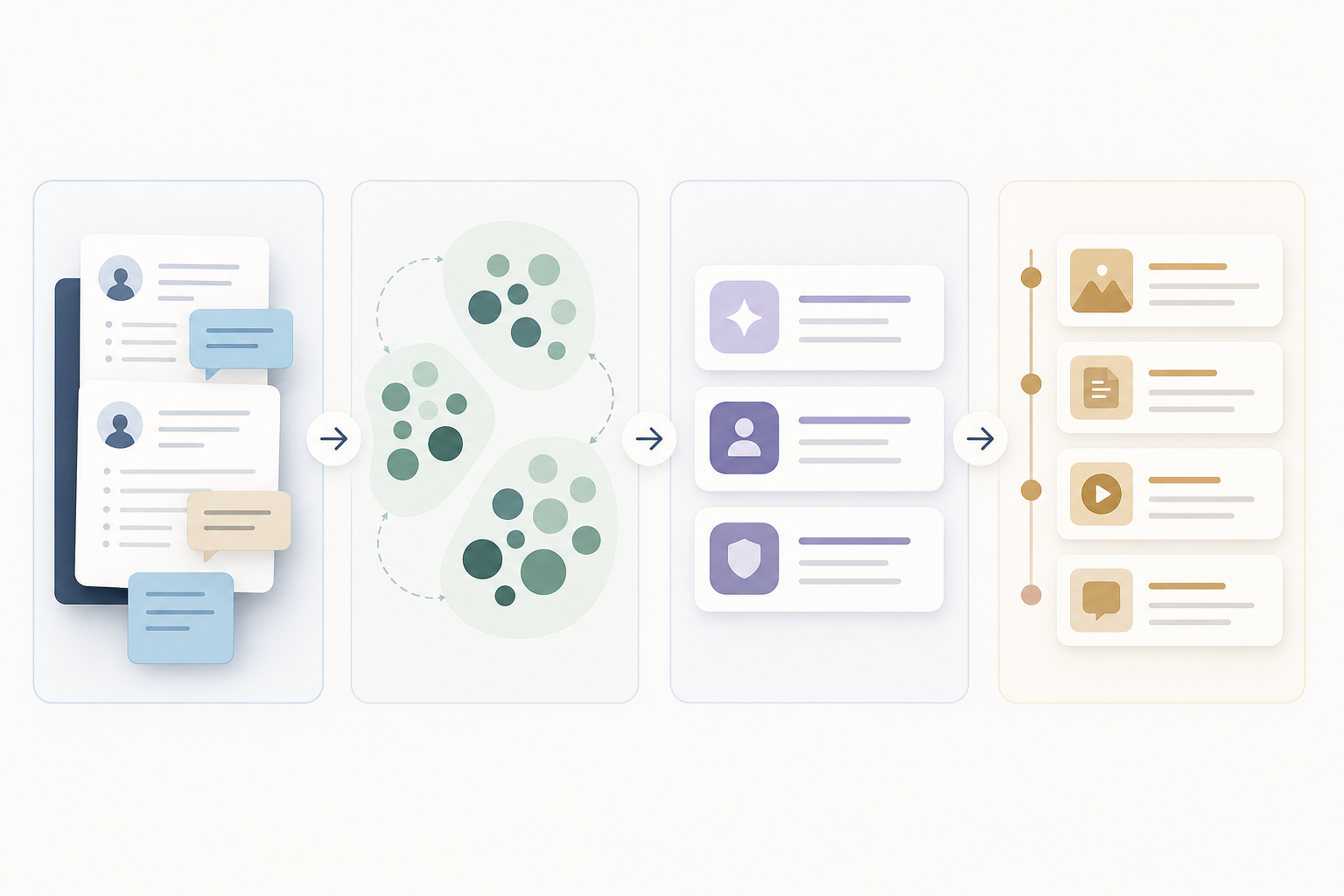
Sort insights into four messaging pillars
Use these four buckets:
- Problem: What is going wrong, and what does it cost?
- Promise: What meaningful outcome does the customer want?
- Proof: What would make that outcome believable?
- Process: How does the work happen, and what reduces risk?
A repeated problem can become an educational article. A desired outcome can become a positioning theme. A proof request may become an FAQ or method explainer. A process concern can become a guide to what happens after sign-up.
For a broader planning framework, read how to develop a content strategy. Each piece should earn its place by answering a real buyer question.
Build a backlog from three inputs
Label each useful note as one of the following:
- Trigger: the event that starts a search
- Objection: the concern that slows a decision
- Comparison: the alternative a buyer is considering
Then match it to a format. A trigger can become a timely guide; an objection can become an FAQ or process explainer; a comparison can become an honest decision guide.
Use the language you hear in interviews as input for keyword research for content creation. Keywords can refine customer insight, but they should not replace it.
Use a practical notes-to-publishing workflow
- Capture call notes in one place.
- Highlight repeated phrases, events, objections, and desired outcomes.
- Turn the strongest patterns into short outlines.
- Prioritise by urgency, relevance to your best-fit customer, and business value.
- Publish on a realistic cadence and update the backlog as you learn.
Content Redefined AI provides a structured method for founders to introduce their business, direct their content, and maintain a consistent publishing schedule. That structure can help turn discovery notes into a focused draft queue rather than an ever-growing idea list.
Keep AI-assisted drafts grounded
AI can help organise an outline or develop a first draft, but it cannot supply customer truth. Give it approved claims, real customer language, examples, and clear limits. Review output for generic wording and unsupported promises before publishing.
For useful safeguards, see mistakes to avoid when using AI for content writing.
Discovery calls, sales calls, and the 2-2-2 rule
A discovery call is primarily for learning. A sales conversation may include discovery, but it also tests fit and agrees on next steps. Once you understand the context, use light qualification questions about timing, stakeholders, current tools, and relevant constraints.
What does the 2-2-2 rule in sales mean?
There is no single universal definition of the 2-2-2 rule in sales. Teams use the label for different meeting and follow-up habits. Define the behaviour before adopting it: who sends the recap, when the next step is set, and what happens when there is no response.
The useful principle is a clear next step, a concise written recap, and a follow-up rhythm that does not pressure or confuse the buyer.
How discovery changes as you grow
At early traction, focus on the buyer who reaches value fastest and the use cases that are a poor fit. At growth, review lost deals, churn, implementation issues, and recurring objections. In larger teams, maintain shared messaging pillars and approved evidence so sales, marketing, and leadership do not describe the business differently.
A regular review of recent conversations and losses is enough to keep the content backlog tied to what buyers actually need.
FAQ
What are five good discovery questions to ask?
Start with these:
- What happened the last time you had this problem?
- What have you tried so far?
- What made this important now?
- Who else is affected by the decision?
- What would you need to see to feel confident moving forward?
What questions should I ask a small business owner in an interview?
Ask who their best-fit customer is, what limits growth, how they solve the problem today, which channels produce useful leads, what customers ask before buying, and what they would stop doing if they had more time. Ask for examples rather than broad opinions.
What is the difference between qualification and discovery?
Discovery uncovers context, problems, alternatives, and desired outcomes. Qualification checks practical fit, including timing, stakeholders, budget, and constraints. Discovery improves your messaging; qualification helps determine whether a sales process makes sense.
The business discovery questions founders avoid answering are often the questions that lead to a sharper choice. Ask them with curiosity, capture the language people use, and let the answers shape clearer content.