
A business discovery worksheet for founder messaging turns what you know about your business into content inputs you can use. It helps you name your audience, offer, proof, and limits before you start filling a content calendar.
Complete the worksheet first. Then use the topic map to build a 30-day plan that fits your time and stays true to your business.
Business discovery gives messaging substance
Business discovery gathers the facts behind your message: who you serve, what they need, how your offer works, and what you can support with proof. Brand messaging is how you share those facts on your site, in sales calls, and in content.
Discovery is the source material. Messaging is the public version of it.
Without that source material, it is easy to fall back on vague claims such as “we help businesses grow.” That does not tell a buyer if you understand their problem. It also gives you little to write about.
A clearer starting point is: “We help owner-led accounting firms reduce messy month-end handoffs.” It names an audience and a problem. It also points to useful topics, such as month-end steps, team roles, and common handoff errors.
If you have the answers in your head but have not put them on paper, start with these business discovery questions founders often avoid answering. You do not need a perfect brand guide. You need clear choices you can use again.
The founder messaging worksheet
Write a first draft in plain language. Do not try to make it sound like an ad. Use real words from calls, emails, reviews, and support chats when you can. Never add quotes, numbers, or results you cannot back up.
1. Business snapshot
This section gives every future topic a clear filter.
- We help:
[specific audience] - They are dealing with:
[a costly or frustrating problem] - So they can:
[desired result] - We help through:
[your product, service, or method] - We are not for:
[an audience, use case, or expectation that does not fit] - This matters now because:
[a trigger, risk, or change]
Ask: could the right buyer see their own situation in this answer? If not, make the audience or problem more specific.
2. Audience, triggers, and customer words
Strong founder messaging reflects the moment a buyer starts to look for help.
- Main buyer or user:
[role, business type, and key limit] - They start looking when:
[event or trigger] - Their current approach is:
[DIY method, tool, service, or no action] - They want to avoid:
[risk, work, delay, or doubt] - Success means:
[their words] - Words they use:
[exact phrases, where possible] - Questions they ask before buying:
[list them]
For example, “I hired my first marketer and do not know what to give them” is more useful than “they need content help.” It can lead to posts on briefs, handoffs, review, and priorities.
3. Problem, result, and method
Show the link between the buyer’s current state and your offer. Do not make broad promises.
- Before working with us, they face:
[current state] - This leads to:
[lost time, risk, confusion, or missed chances] - Afterward, they can:
[a real capability or better state] - Our method is:
[process, skill, or approach] - They still need to provide:
[input, choice, setup, or sign-off] - We do not promise:
[a limit or boundary]
“We make content easier” is broad. “We start with written audience, offer, and proof inputs, then use them to guide a content plan” tells buyers what happens.
4. Proof and trust
Proof is not only big metrics or polished case studies. Record the evidence you can explain with care.
- Examples we can show:
[approved story, sample, demo, or process document] - Relevant experience:
[roles, training, or direct knowledge] - A repeatable process:
[steps or framework] - A limit we share openly:
[where the offer may not fit] - Claims we can support:
[specific statements] - Claims we should avoid:
[guarantees, broad praise, or unproven results]
This becomes a proof bank for content. It helps you keep drafts honest and stops weak claims from entering the work later.
5. Differences, alternatives, and point of view
Buyers compare you with more than direct rivals. They may compare your offer with doing it themselves, hiring a freelancer, making an internal hire, using a tool, or doing nothing.
- Alternatives buyers weigh:
[DIY, agency, tool, hire, and so on] - Our approach differs because:
[focus, method, skill, or service model] - We choose not to do:
[a common practice you reject] - We believe:
[a clear point of view] - That matters because:
[why the buyer should care]
Do not say you are “better” without naming the difference. A useful point of view includes a trade-off. For example, a smaller content rhythm may be wiser than a high-volume plan if it is easier to review and keep going.
6. Offer map and content limits
Your content should lead to an offer with clear fit and scope.
- Core offer:
[what the buyer gets] - Best fit:
[who gains most from it] - What they need first:
[what they must provide or be ready to do] - First useful result:
[what they will have or know] - Next step:
[subscribe, book a call, request details, or another accurate action] - Topics we will not cover:
[out-of-scope subjects] - Promises we will not make:
[clear boundaries]
Limits protect your message. They make it easier to say no to off-topic ideas when work gets busy.
Turn worksheet answers into topic ideas
The worksheet matters only if it changes what you publish. Start with answers that show buyer tension: triggers, problems, doubts, alternatives, proof, and your point of view.
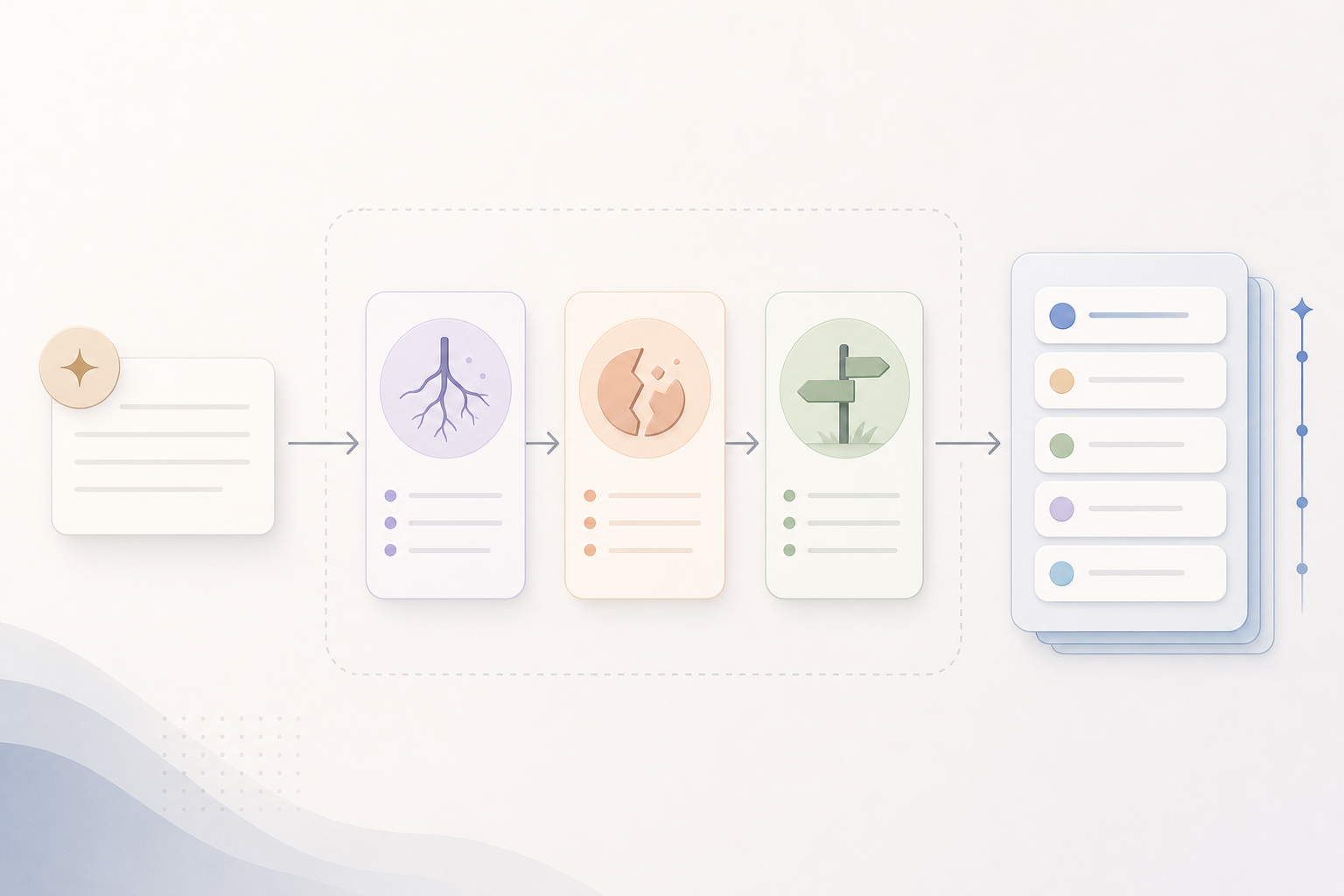
Give each strong answer three angles
For every useful answer, write three angles:
- Why it happens: Explain the cause or context.
- What it costs: Show what can go wrong when it stays unresolved.
- What to do next: Give a first step, guide, or choice framework.
If an audience says, “Our content feels random,” you could write:
- Why content feels random when message inputs are missing
- The cost of changing topics every week
- How to turn customer questions into a content plan
Repeat this with eight to 10 worksheet answers. You will have a focused topic backlog.
Match topics to the reader’s need
A good plan helps readers learn, weigh options, and take the next step.
| Worksheet input | Content job | Example topic |
|---|---|---|
| Buyer trigger | Learn | What to prepare before you hire a marketer |
| Problem | Learn | Why your content plan stalls after the first week |
| Objection | Consider | Do founders need a content system before they publish more? |
| Alternative | Compare | Structured planning versus ad hoc posting |
| Proof or process | Decide | What a founder content review process looks like |
| Point of view | Build trust | Why a smaller publishing rhythm can be the better choice |
A comparison should show real trade-offs, not force a choice. Our guide to founder-focused content planning versus ad hoc posting can help you decide if more structure is worth the added work.
Prioritize the backlog
Give each idea a score from 1 to 5 for:
- Buyer impact: Will it help the right person understand or act?
- Confidence: Can you answer it with facts and proof you have now?
- Effort: Can you create and check it well in the time you have?
Use this simple formula:
Buyer impact × confidence ÷ effort
Start with the high scores. These are the topics most likely to be useful, honest, and realistic to publish.
Build a 30-day content plan you can keep
Being consistent does not mean posting each day. It means choosing a pace you can repeat without weakening the message.
If time is tight, start with one detailed post a week. Add a short supporting post only after that rhythm feels stable. A small plan that goes live is better than a full calendar that becomes a backlog.
Choose three or four content pillars
Use the worksheet to create pillars that reflect your business, not generic marketing labels. For example:
- The people and situations your offer is made for
- The problem and its real effects
- Your method, process, or point of view
- Proof, lessons, and common doubts
Each pillar gives readers a reason to trust you. Together, they stop the plan from turning into a list of unrelated posts.
Use this four-week plan
| Week | Pillar | Main post | Supporting post | CTA |
|---|---|---|---|---|
| 1 | Audience | Who this offer is for—and who it is not for | Three signs the timing is right | Invite readers to assess fit |
| 2 | Problem | The real cost of [problem] |
The common mistake that keeps it going | Give a practical next step |
| 3 | Method | How we handle [problem] |
Why we do not use [common approach] |
Explain the relevant offer |
| 4 | Proof | What the process looks like in practice | A lesson or common doubt from the process | Invite a fitting conversation or subscription |
Replace the brackets with words from your worksheet. Clear inputs lead to clear content.
For a simple process, use this founder content planning weekly operating rhythm. It shows a way to choose, draft, review, and publish without making content an endless side job.
Keep drafts moving with a light workflow
A light workflow stops good ideas from becoming lost documents.
- Capture: Note the audience, topic, and next step.
- Outline: List the question, proof needed, and key sections.
- Draft: Write the useful answer before you polish the opening.
- Review: Check facts, customer claims, tone, and fit with the worksheet.
- Approve: Make sure the message still reflects the business.
- Publish and learn: Share the post where buyers spend time. Record the questions and replies you get.
If planning feels too hard, you may not lack ideas. You may have too many choices, unclear ownership, or no set review point. Read why content planning feels overwhelming for founders for a closer look at those issues.
Worked example: from discovery to 12 topics
Consider a fictional business, BrightOak Bookkeeping. It offers monthly bookkeeping and review calls for owners of service firms.
Its worksheet might say:
- Audience: Service-business owners who are behind on their books or unsure what they can pay themselves.
- Trigger: Tax time is near, cash is unclear, or the owner has outgrown spreadsheets.
- Problem: Records are incomplete, so money choices feel risky.
- Point of view: Clean books can lower stress and support better choices.
- Proof: An approved anonymous chart-of-accounts example, a review-call agenda, and a process checklist.
- Boundary: It does not give legal or tax advice.
Those answers can lead to content with a clear job:
| Input | Topic idea | Intent |
|---|---|---|
| Trigger | What to prepare when you have fallen behind on bookkeeping | Learn |
| Problem | Cash flow versus profit in plain English | Learn |
| Problem | How incomplete books make owner-pay choices harder | Learn |
| Objection | Is my business too small for a bookkeeper? | Consider |
| Alternative | Bookkeeper versus CPA: different roles, different work | Consider |
| Objection | What access does a bookkeeper actually need? | Consider |
| Process | What happens in a monthly bookkeeping review | Decide |
| Proof | A bookkeeping cleanup checklist: what it covers | Decide |
| Point of view | Why “I will do it later” adds pressure at tax time | Build trust |
| Boundary | What a bookkeeper can help with—and when to ask a tax professional | Learn |
| Audience | Three signs spreadsheets are no longer enough | Consider |
| Offer | What to expect in the first month of monthly bookkeeping | Decide |
None of these topics needs inflated claims. Each answers a question tied to the business and can help the right reader judge fit.
Keep the worksheet current as your business changes
Review your business discovery worksheet for founder messaging each quarter. Review it sooner if your audience, offer, method, or position changes. A short monthly check-in can also capture new questions, doubts, and phrases from sales or customer talks.
When inputs change, update the plan. You do not need to rewrite every post. Start with pages that make old claims, describe an old offer, or draw the wrong audience.
If you have little or no marketing help, a content planning system for a founder with no team can help you turn this worksheet into a repeatable habit.
Content Redefined AI gives founders a structured way to introduce their business, guide their content, and keep a publishing schedule moving. Start with honest inputs, choose the next useful topic, and update the plan as your business changes.