
Launching content does not require a perfect brand story or a library of case studies. To introduce your business with a 5-post sequence, publish five clear ideas that explain who you help, the problem you solve, how you work, and what to do next.
This plan is for founders who need a useful starting point and a direction they can maintain. Publish one post a week, note the questions people ask, and use the strongest themes in future emails, articles, and sales conversations.
A practical guide from Bira on first LinkedIn posts similarly recommends making the business name, offer, and location clear where relevant. This sequence builds on that foundation with problem, process, proof, and an invitation.
Start with one clear message
Before drafting, write one sentence that anchors the series:
> We help [specific people] achieve [useful outcome] through [your approach].
For example: “We help busy founders create a realistic content plan through guided prompts and a clear publishing rhythm.” This is not final copy for every channel. It is a decision-making tool that keeps your posts connected.
Choose one goal for the series: help the right people understand your offer, start useful conversations, build trust, or establish the subjects you will keep discussing. If the sentence is difficult to write, start with these business discovery questions for founders. Clear content follows clear choices about audience, offer, and point of view.
The 5-post business introduction sequence
Each post has one job. Do not try to explain the whole business in every caption.
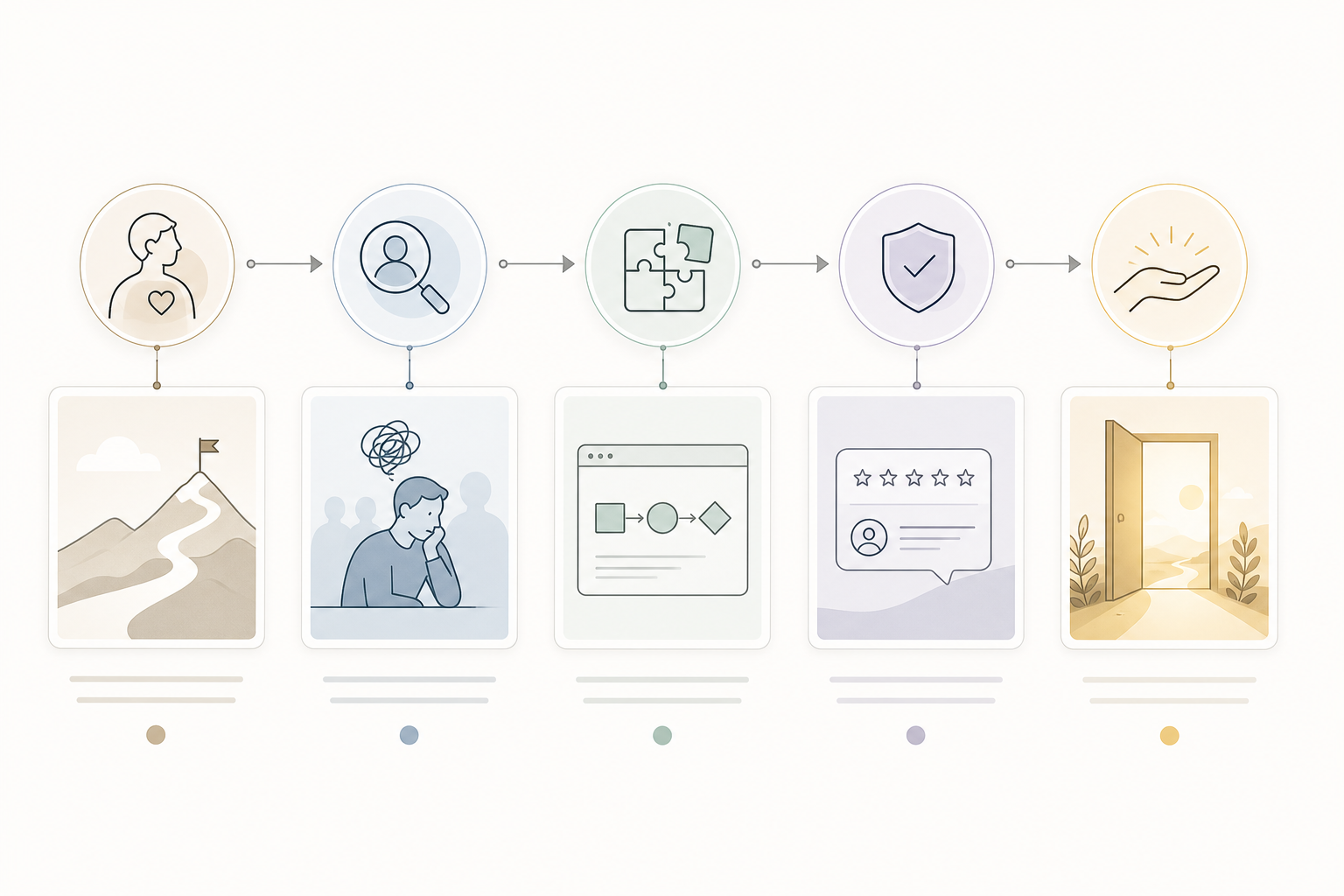
| Post | Purpose | Simple call to action |
|---|---|---|
| 1. Your reason for starting | Introduce the founder and the problem that matters | Follow for the rest of the series |
| 2. The customer problem | Help readers recognise a problem you solve | Ask where they get stuck |
| 3. Your approach | Explain how you work in plain language | Invite a reply or question |
| 4. Your proof and principles | Build trust with evidence, lessons, or standards | Ask what buyers look for |
| 5. The invitation | Explain the next step for suitable customers | Invite an enquiry or subscription |
Post 1: Why this business exists
Start with the pattern, moment, or frustration that led you to build the business. This is a founder story, but it should serve the reader: name the problem you saw and who it affected.
Prompt: “I started this business after repeatedly seeing [problem]. People deserved a better way to [outcome].”
Include the problem in everyday language, who it affects, what you believe should be different, and a brief introduction to the business. One honest moment is enough; this is not an autobiography.
Example: “I kept meeting founders with strong expertise but no workable way to turn it into regular content. They did not need more ideas. They needed a simple plan they could follow when work got busy.”
CTA: “Over the next few weeks, I’ll share the approach behind our work. What makes this problem difficult in your business?”
Post 2: Name the problem you solve
Describe the customer’s situation without exaggerating it. The cost might be wasted time, confusing choices, inconsistent quality, missed enquiries, or a slow process.
Prompt: “The issue is not usually [common assumption]. It is [deeper problem].”
Use a simple structure: describe a familiar situation, explain what goes wrong, share the consequence, and offer one helpful reframe.
For a content-planning business: “A missed posting week is rarely a motivation problem. It is often a planning problem: the topics, proof, and next steps were never decided in advance.”
Use language your audience uses. Understanding your audience for content marketing can help you identify the questions and outcomes worth reflecting.
CTA: “Which part of this feels most familiar to you?”
Post 3: Explain your method
Show how you work without revealing every operational detail. Give readers a useful view of the path from problem to outcome.
Prompt: “Our approach has three parts: first we [step], then we [step], and finally we [step].”
A consultant might explain discovery, recommendations, and implementation support. A retailer might explain how products are selected and how customers are helped to choose. A software business might explain setup, adoption, and review.
State a boundary when it helps buyers self-select: “We are a better fit for founders who can set aside one hour a week than for teams seeking fully outsourced publishing.” A clear boundary makes an offer easier to assess.
CTA: “Which of these steps would be most useful to see in more detail?”
Post 4: Share proof without hype
Proof does not have to mean large revenue figures or polished case studies. An early-stage business can share process proof, values proof, partner proof, or a lesson from real work.
Choose evidence you can stand behind:
- A permissioned customer comment or case example
- A before-and-after process improvement
- A sample of work with sensitive details removed
- A credential, standard, or quality check
- A lesson from a project or product decision
Be precise about what evidence shows. A customer comment supports that customer’s experience; it does not prove every customer will get the same result.
Prompt: “Here is one standard we use to keep our work useful: [standard]. It matters because [reason].”
CTA: “When you choose a provider in this area, what gives you confidence?”
Post 5: Make a clear, low-pressure invitation
Explain who the offer is for, what they should do, and what happens next. Remove uncertainty rather than adding pressure.
Prompt: “If you are [audience] and need help with [problem], here is the best next step.”
You might invite readers to book a conversation, request a quote, join an email list, visit a service page, or subscribe to a monthly planning service. Keep the promise specific and realistic.
For Content Redefined AI, the invitation can speak to founders who want a structured way to choose topics, introduce their business clearly, and maintain a publishing rhythm. Focus on the planning problem the service helps address rather than promising reach, leads, or rankings.
CTA: “If a clearer monthly content plan would help, explore whether a monthly subscription is the right fit for your business.”
Adapt the sequence to your niche
The structure stays the same. What changes is the proof, detail, and questions your buyers need answered.

Service businesses: lead with process and fit
Service buyers need confidence that you understand their situation and have a reliable way of working. Make Posts 2 and 3 practical: explain the problem, your project stages, and what you need from clients. In Post 4, use a permissioned lesson, testimonial, or process example. In Post 5, clarify who is and is not a good fit.
Retail and ecommerce: show selection and trust
Introduce the shop, product category, and location where useful. Then show how you choose products, respond to customer needs, or work with suppliers.
Tag a supplier, collaborator, or brand only when their contribution is central to the post and you have their approval. A tag should add context for readers, not simply seek attention. Instead of posting a generic product photo, explain why an item earned shelf space or what customer need it answers.
B2B and SaaS: focus on use cases and decisions
Name the job your product or service helps with instead of making broad claims about transformation. Explain a delayed handoff, confusing reporting task, or planning gap, then show your approach at a high level. Use Post 4 to address a genuine decision criterion, such as adoption effort or review requirements. Do not claim security, integrations, or outcomes unless you can support them publicly.
Local and community businesses: make relationships visible
Show how community knowledge and consistent service appear in practice: a partnership, training standard, event, or customer-care decision. Get permission before sharing an employee’s, customer’s, or collaborator’s image, story, or name.
Publish consistently without making content a burden
For most founders, one post a week for five weeks is a more sustainable starting point than daily posting. Batch the sequence in one working session, then review drafts with fresh eyes.
Before scheduling, check that the first line is clear, the post has one main idea, it includes a real example or supported proof point, and the CTA suits the post.
If you miss a week, do not restart the sequence or apologise at length. Publish the next post when it is ready and return to your normal cadence. This 48-hour reset for a missed posting schedule offers a practical recovery plan.
Can Facebook and Instagram posts work on LinkedIn?
Yes, but they usually need a different frame. Keep the core story and add the business lesson. An Instagram post about packing orders could become a LinkedIn post about a process change that reduced packing mistakes. A customer photo could become an email about the buying question that customer needed answered.
Use one source idea in three ways:
- LinkedIn: a concise insight, story, and question
- Email: a more personal note with one direct invitation
- Blog: a fuller explanation with steps, examples, and related links
This is repurposing, not copying. Adjust the opening, level of detail, and call to action for the channel.
Treat engagement as part of the sequence
Set aside a short window after each post to respond to genuine comments and learn what people want to know next. Reply with a useful answer, ask a relevant follow-up question when appropriate, and save repeated questions for future content. Follow up privately only when someone has invited a conversation or requested more information.
For a repeatable routine, see this audience engagement workflow for founder content. Track more than likes: direct questions, replies from relevant people, profile visits, and referral-style conversations can all indicate that your business is becoming easier to understand.
What to do after the fifth post
When you introduce your business with a 5-post sequence, you also create a bank of future themes: the problem, your method, proof, principles, and customer questions. Continue with the theme that generated the most useful conversations.
Expand Post 3 into an article, turn Post 4 into a customer-story series, or answer the common question from Post 2. Content Redefined AI is designed to help founders plan around their business, audience, and publishing schedule. Start with these five posts, review what you learn, and use that evidence to shape the next month.