
A founder content planning weekly operating rhythm is a small, repeatable loop for choosing a topic, making the piece, publishing it, and learning what to do next. It gives content a place in a busy week without turning you into a full-time publisher.
If content planning feels overwhelming as a founder, the problem is rarely a lack of ideas. It is the number of decisions hidden inside every post: what to say, who it is for, what proof to use, and when to finish it. A weekly rhythm reduces those decisions by giving each step a home.
The goal is simple: connect one business priority to one useful piece of content, then ship it at a pace you can sustain.
What an operating rhythm means for founder content
A schedule tells you that a draft is due on Wednesday. An operating rhythm tells you what decision happens on Monday, what must exist by Wednesday, and how you will respond if the week goes sideways.
Leadership teams often use an operating rhythm to create regular planning, communication, and review cycles. The same idea works for content, but it does not need more meetings. As Object Edge’s overview of operating rhythms explains, the value comes from a clear cadence for review and action.
For founder content, the loop is:
Decide → outline → draft → edit → publish → learn
Each stage has one output. That matters because an idea is not the same as an outline, and a draft is not the same as a publish-ready article.
The golden thread: business goal to published piece
Start with the business outcome, not with a blank content calendar.

For example:
- Business goal: Help more buyers understand your monthly service.
- Buyer problem: They are unsure what they get or whether it fits their needs.
- Weekly topic: “What to prepare before choosing a content planning service.”
- Published asset: A practical article with a clear next step.
That is the golden thread. It keeps content tied to a real customer question and an offer you can stand behind.
When strategy exists but the work still does not ship, the gap is usually in this handoff from priority to execution. Read why content strategy can exist while execution fails for a closer look at that problem.
Choose a time budget you can repeat
The best rhythm is not the most ambitious one. It is the one you can run during a normal week and recover after a difficult one.
| Rhythm | Weekly time | Best for | Expected output |
|---|---|---|---|
| Minimum viable | 2.5 hours | Founders with limited time or a simple format | One focused post, draft, or scheduled article |
| Standard | 4–5 hours | Founders who need research, a stronger edit, or light repurposing | One deeper article plus a small distribution task |
These are planning ranges, not rules. A technical guide may take longer. A short founder note may take less. The key is to choose your range before the week starts.
The minimum viable rhythm: 2.5 hours
Use this version when consistency is the priority:
- Monday, 25 minutes: choose the outcome, topic, reader question, and call to action.
- Tuesday, 30 minutes: create a tight outline and gather only the support you need.
- Wednesday, 50 minutes: write a useful first draft.
- Thursday, 25 minutes: edit for clarity, add links, and prepare metadata.
- Friday, 20 minutes: publish or schedule, then record one lesson.
That is 150 minutes. If a day disappears, move the next unfinished step forward. Do not restart the whole plan.
The standard rhythm: 4–5 hours
Add time when the subject needs more care:
- Research a source or collect a credible example.
- Ask a subject expert for a short review.
- Improve the structure and opening before publication.
- Create one simple supporting visual.
- Adapt the finished piece for one channel where your buyers already pay attention.
More time should improve usefulness, not create extra process. One well-finished asset is more valuable than five half-started ideas.
Your Monday-to-Friday content cadence
This founder content planning weekly operating rhythm is designed around decisions and outputs, not calendar theater. Use the days that fit your workweek; keep the order if you need to shift them.
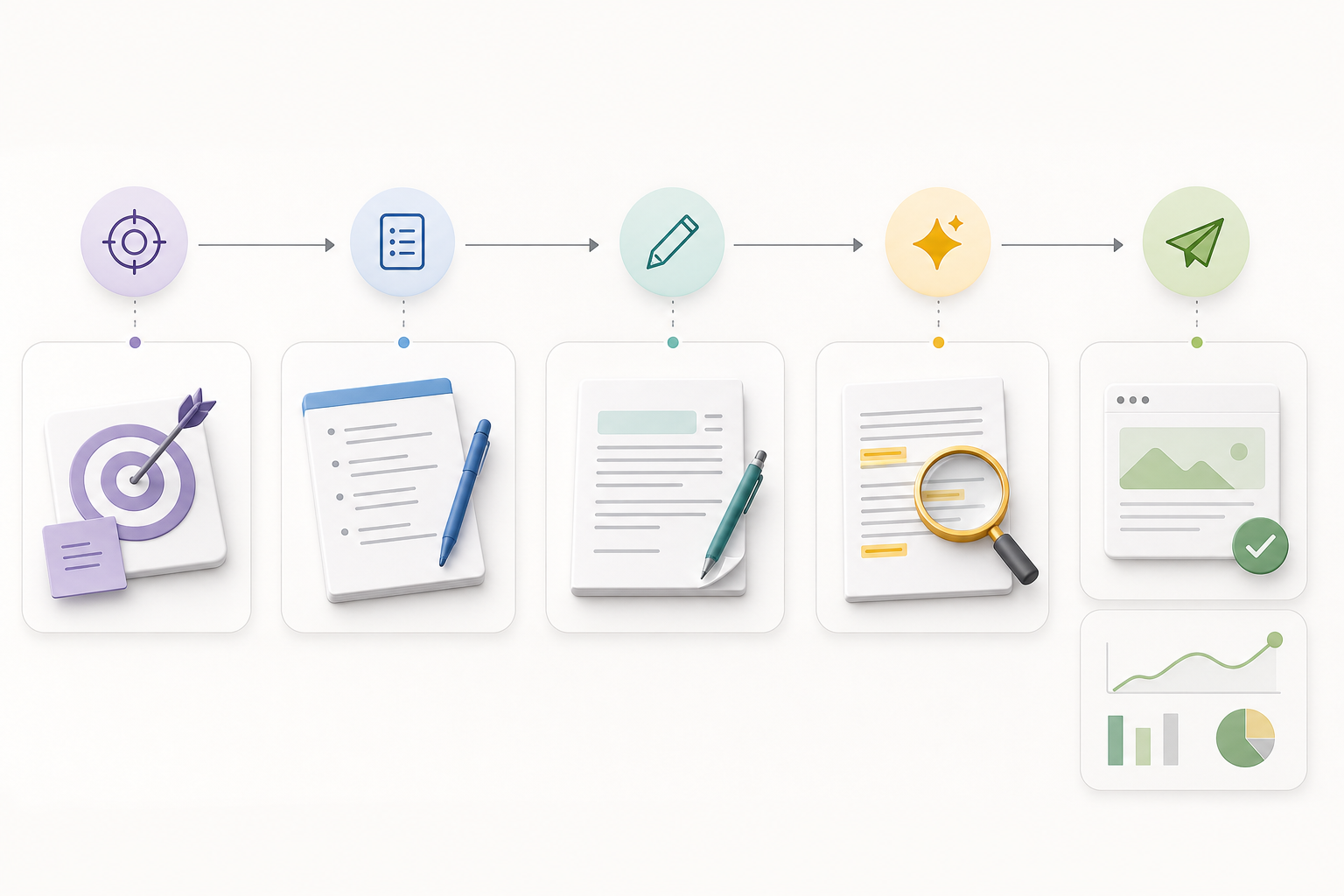
Monday: choose one outcome and lock the topic
Time box: 20–30 minutes
Begin with what the business needs this week. Then choose one topic that helps a specific buyer take a useful next step.
Write these five lines:
- Business outcome: What should this content support?
- Target reader: Who needs this answer now?
- Question: What are they trying to understand or decide?
- Reader promise: What will they be able to do after reading?
- Call to action: What is the most relevant next step?
Example:
> A founder who has plenty of ideas but no publishing habit will learn how to choose one topic and turn it into a finished weekly post.
Set a definition of done before you write. Keep it practical: answers the main question near the start, includes a relevant next step, uses support where claims need it, and is ready for an edit on Thursday.
If even choosing a topic feels like a major task, start with why content planning feels overwhelming as a founder. The answer may be fewer choices, not more inspiration.
Tuesday: research and outline without collecting everything
Time box: 30–45 minutes
Research is there to make the article more accurate and useful. It is not a reason to delay drafting.
Use a short checklist:
- State the search intent in one sentence.
- List the three to five points the reader must understand.
- Gather only the examples, notes, or sources needed to support those points.
- Decide what the article will not cover.
- Write headings in the order a reader needs them.
A good outline has momentum. Each section should answer the next natural question, rather than repeat the same point in new words.
Wednesday: draft the useful version first
Time box: 45–60 minutes
Write to one real buyer, not to an imagined algorithm. Start with the answer, then explain how to use it.
A simple drafting pattern helps:
- Say it: make the point in plain language.
- Show it: give an example, decision rule, or scenario.
- Do it: tell the reader what to do next.
Do not edit every sentence while drafting. Mark uncertain details for later and keep moving. A complete rough draft gives you something real to improve.
Thursday: edit, check the claim, and prepare publication
Time box: 25–45 minutes
Your edit should make the piece easier to trust and easier to use.
Check for:
- A direct opening that answers the reader’s main need.
- Short paragraphs and descriptive headings.
- Specific examples in place of broad advice.
- Claims you can support or qualify.
- One clear call to action that fits the topic.
- Helpful internal links only where they extend the reader’s next step.
For example, if the article comes from an experience or lesson, it may become more useful as a sequence. See how to turn a founder story into a content series rather than treating every story as a one-off post.
Friday: publish, learn, and set up next week
Time box: 20–30 minutes
Publish the article, schedule it, or move it into the next review stage. Then close the loop with a short note:
- What shipped?
- What slowed the work down?
- What question or objection should influence the next topic?
- What should you repeat, stop, or simplify?
Choose one candidate for next week while the context is fresh. This prevents Monday from becoming another blank-page session.
Why content planning systems fail after two weeks
Most systems fail because they are built for ideal weeks. They assume uninterrupted writing time, fixed priorities, and endless motivation. Founders do not have those conditions.
A better system has a recovery path. If you miss Tuesday, outline on Wednesday and publish a shorter version on Friday. If you cannot publish this week, keep the topic and draft moving instead of replacing it with a new idea.
If this pattern sounds familiar, why content calendars keep failing after two weeks can help you diagnose what is breaking: an unrealistic cadence, too many channels, unclear ownership, or no definition of done.
Mistake: treating the calendar as the strategy
A calendar is a container. It is not a decision system.
Dates alone do not tell you which topics fit your offer, which buyer problem matters most, or what to do after priorities change. Use a weekly topic lock to make those decisions before the calendar fills up.
Mistake: brainstorming instead of moving work through a pipeline
Ideas are useful only when they move forward. Keep a simple board or document with these stages:
Backlog → This week → Outline → Draft → Review → Published → Insight
Every item needs a next action. If it has none, it belongs in the backlog, not in your active week.
Founders often lose hours comparing possible topics. Use this guide to choosing content topics faster to establish a decision rule, then return to the weekly rhythm.
Mistake: forcing a niche before you understand the buyer problems
Content planning without a niche can feel scattered, but you do not need to invent a narrow label before you start.
Instead, choose three to five problem clusters that connect to your current offer. A service business might use:
- Pricing and scope
- Choosing the right provider
- Common project risks
- Time to value
- Internal approval and buy-in
Pick one cluster per week. Over four to six weeks, patterns will emerge: which questions you can answer well, which topics lead to relevant conversations, and where your positioning is becoming clearer.
Mistake: measuring outcomes that arrive too late
Rankings, traffic, and sales can matter, but they may not tell you whether the weekly process is working yet. Start with leading signals you can control:
- Did you publish or move the draft forward?
- How long did it take to get from topic to finished piece?
- Did the piece answer a real buyer question?
- Did the call to action match the article’s purpose?
Review bigger patterns monthly, not every Friday.
Copy-and-paste templates for the weekly loop
Weekly planning agenda
Use this 15–30 minute agenda at the start of the week:
- Review: What shipped or stalled last week?
- Outcome: What business goal should this week’s content support?
- Topic: What one reader question will the piece answer?
- Promise: What should the reader be able to do afterward?
- Call to action: What next step fits this question?
- Checkpoints: When will outline, draft, edit, and publish happen?
- Risk: What could disrupt the work, and what is the smaller version you can still finish?
One-page content brief
Copy this into your working document:
Business outcome:
Target reader:
Reader question:
Primary topic:
One-sentence promise:
Evidence or examples to include:
What this piece will not cover:
Call to action:
Definition of done:
Friday learning note:
Acceptance criteria for a publish-ready post
Before you call a piece done, confirm that it:
- Answers one clear question near the beginning.
- Follows a logical path from problem to action.
- Uses examples or support where they improve trust.
- Includes only relevant links.
- Has one next step that matches the reader’s intent.
- Is concise enough that the main point is easy to find.
Review weekly, monthly, and quarterly
Weekly reviews should be small. Their job is to keep the work moving.
Monthly reviews can be broader. In 30–45 minutes, look at the pieces you published and decide:
- Which problem clusters deserve more attention?
- Which topics no longer match the offer or audience?
- Which questions keep appearing in sales, support, or customer conversations?
- What should be updated, expanded, or turned into a series?
Quarterly, revisit the business goal behind the content. If your offer, audience, or priorities have changed, your topic choices should change too.
Make the rhythm easier to maintain
The operating rhythm should reduce work, not add another system to manage. Keep one place for your topic queue and one place for the current draft. Add tools only when they remove a real bottleneck.
Content Redefined AI offers founders a structured way to introduce their business, set content direction, and maintain a consistent publishing schedule. It can be useful when the difficult part is keeping business context, topic choices, and publishing plans connected.
Start with one website, one business goal, and one weekly asset. Run the cycle for a month before adding channels, formats, or elaborate reporting. A small rhythm you repeat is more valuable than a perfect plan you abandon.