
A lightweight editorial process for consistent publishing gives every post a clear path from idea to live content. It is not a large content operation. It is a small set of decisions, stages, and checks you can repeat when sales, client work, and product issues compete for your time.
The goal is not daily output. It is a publishing rhythm you can maintain through normal disruption. Start with one core format, one realistic cadence, and a workflow that makes “done” clear.
Start with a cadence you can actually protect
Consistency and frequency are not the same thing. Frequency is how often you publish. Consistency is whether you can keep the pace you chose.
A useful starting point might be one article every two weeks, one newsletter each week, or two short founder posts per week. Pick the smallest version that still helps your audience, then hold that pace for a few months before increasing it.
If your current schedule works only in a quiet week, it is not your real schedule. A consistent publishing schedule should survive the weeks when customer work takes priority.
Choose one primary format for the next cycle:
- Blog post: best for durable answers to buyer questions, sales follow-ups, and topics that need detail.
- Newsletter: best for a direct, regular conversation with readers.
- Founder-led social post: best for a focused idea, quick feedback, and a short publishing loop.
You can repurpose the core piece later. Do not try to create separate original content for every channel from the start.
Why founders struggle with consistent publishing
Most founders do not fall behind because they lack ideas. They fall behind because publishing creates too many decisions at the last minute: what to write, who it is for, what examples to use, whether it is accurate, and whether it is ready to publish.
As explained in our guide to why founders struggle with consistent publishing, content also competes with the work that feels more urgent: customers, delivery, sales, hiring, and product problems. A vague draft is easy to postpone.
The common failure points
A lightweight process should address four predictable problems:
- Unclear direction: Every topic seems important, so choosing one takes too long.
- Scattered drafts: Notes, links, and partial ideas live in several places.
- Undefined review: “Make it better” has no clear endpoint.
- No busy-week version: Missing one deadline turns into an abandoned schedule.
The fix is not more pressure. It is fewer repeat decisions. Decide your recurring themes, your preferred post formats, and your minimum quality bar before you need to publish.
Keep founder time for founder decisions
In a solo business, you may do every task. Ownership still matters because it tells you what kind of work is blocking progress.
Reserve your attention for decisions that need your judgment:
- the audience problem and strategic angle;
- product facts and business positioning;
- sensitive or high-stakes claims;
- the final point of view and call to action.
Formatting, link checks, metadata, and standard structure should rely on checklists or templates wherever possible. This distinction is useful now and makes delegation easier later.
The minimum editorial workflow
Use one workflow language across your content. The following six-stage process is enough for most solo founders:
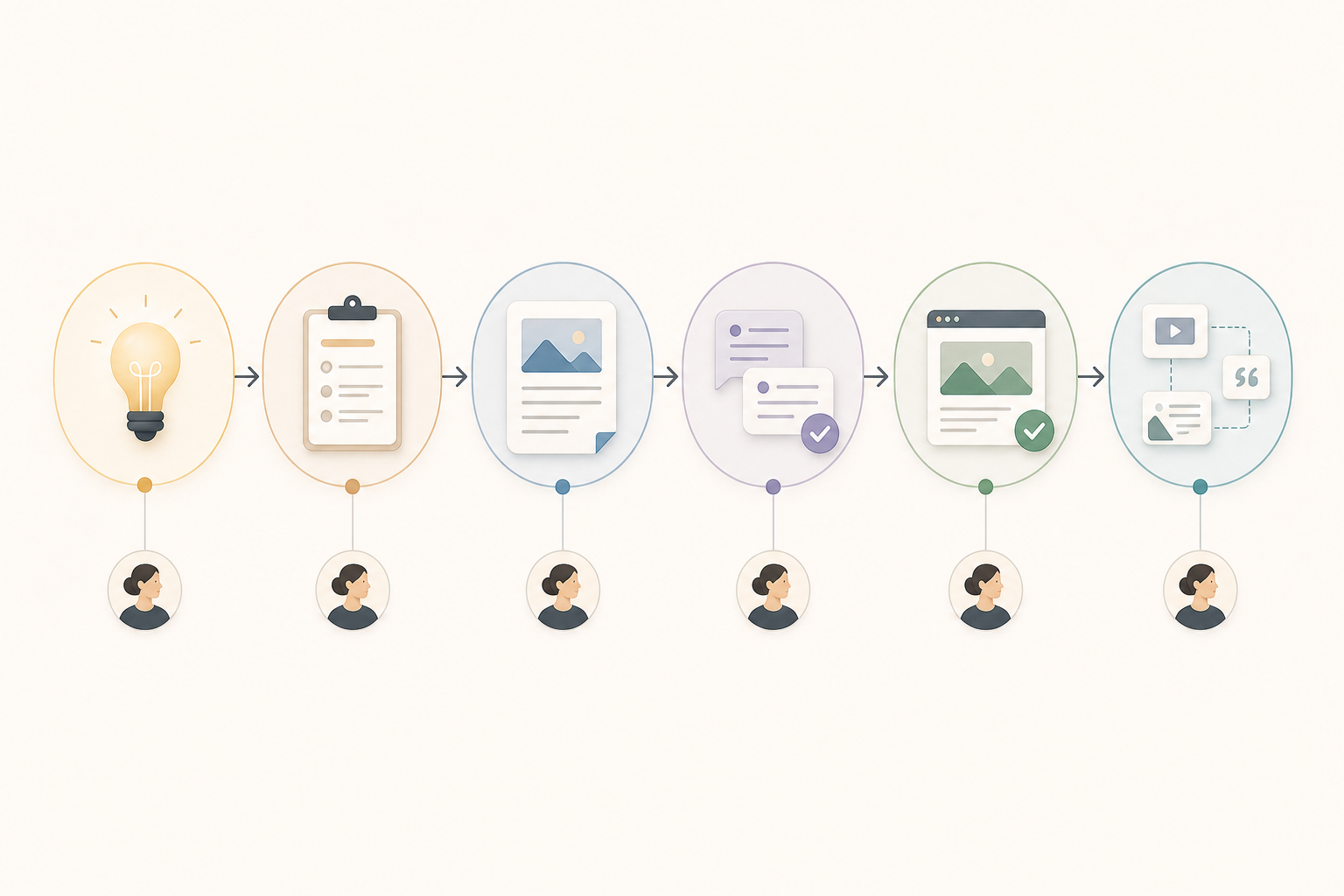
Idea → Brief → Draft → Review → Publish → Repurpose
Visible stages help you see what is stuck. A draft in “Review” needs a decision; a draft in “Idea” needs a clearer angle. Neither should disappear into a vague list called “content.”
| Stage | Owner in a solo workflow | Definition of done |
|---|---|---|
| Idea | Founder | A real customer question, objection, or observed problem is recorded. |
| Brief | Founder | Reader, promise, working title, CTA, and needed evidence or examples are defined. |
| Draft | Founder or writer | The full argument is present, with no gaps that change the meaning of the post. |
| Review | Founder for accuracy | Claims, voice, links, CTA, and structure meet the checklist. |
| Publish | Founder or publishing helper | Formatting, metadata, final proof, and publishing date are complete. |
| Repurpose | Founder or marketer | One or two distribution angles are selected from the finished piece. |
1. Capture ideas from real questions
Do not begin with a blank page. Capture questions from sales calls, onboarding, support requests, objections, email replies, and conversations with prospects.
A good idea is specific enough to answer in one piece. For example:
- “Do I need an editor before I publish regularly?”
- “What should a small agency publish when client work is busy?”
- “How do I choose between a newsletter and a blog?”
Write the question in the reader’s language. This gives the draft a clear job from the start. If you need a repeatable way to collect and prioritize signals, an audience engagement workflow can help turn feedback into a useful queue.
2. Write a short brief before you draft
A brief does not need to be a formal document. It can fit in a few lines:
- Reader: Who is this for?
- Question: What are they trying to decide or do?
- Promise: What useful outcome will the post provide?
- Working title: What is the clearest plain-language title?
- Evidence or example: What must be checked, explained, or illustrated?
- CTA: What is the most relevant next step?
Example:
> Reader: Owner of a small service business
>
> Question: How can I keep publishing when client work fills the week?
>
> Promise: A simple fallback process for shipping one useful piece.
>
> CTA: Read a related guide or join the newsletter.
This step prevents a common problem: discovering halfway through the draft that you have not decided what the piece is meant to accomplish.
3. Draft to a fixed structure
Use a familiar structure so writing time is spent on the insight, not on rebuilding the frame.
For a practical founder guide, use:
- State the reader’s problem.
- Give the direct answer early.
- Explain the key trade-offs.
- Show a concrete example, checklist, or scenario.
- Give a realistic next step.
A complete draft is not a polished draft. It simply contains the full idea and enough detail for review. Avoid leaving research placeholders or open questions that could alter the conclusion.
4. Review against a finish line
Review should not mean “keep changing words until it feels better.” Set a short review window and use the same Definition of Done for every post.
Before publishing, confirm that the piece has:
- one clear reader and useful outcome;
- a direct answer near the beginning;
- a concrete example, scenario, or checklist where it helps;
- claims that are supported, carefully qualified, or removed;
- a CTA that fits the reader’s stage;
- clean headings, links, formatting, and final proofing.
This is how to keep content quality consistent at speed. Quality means the post is useful, accurate, and easy to act on. Polish is optional refinement after those basics are secure.
5. Publish, then repurpose only what is finished
Publishing includes the final operational tasks: formatting, metadata, proofing, scheduling, and sharing. Put a named date next to every post so “almost done” does not become a permanent status.
Then select one or two reuse angles from the finished work. A guide could become:
- a short post built around one common mistake;
- a newsletter summary with one recommendation;
- a sales follow-up resource;
- a checklist extracted from the main article.
Repurposing is not a second original-content project. It is a way to extend a clear idea without reopening the entire editorial process.
Who owns each step when you work alone?
The short answer: you own each stage, but you do not need to perform every task from scratch each time.
Labeling ownership makes bottlenecks visible. If three posts are waiting in review, the problem is not “content.” The problem is that founder approval has not been given a protected slot.
Use a simple ownership map
For a solo founder, this is enough:
- Founder as strategist: chooses the question, promise, positioning, and CTA.
- Founder as subject-matter reviewer: confirms facts, claims, and examples.
- Template or checklist: supplies the repeatable structure and final checks.
- Optional helper: formats, uploads, checks links, prepares metadata, or proofreads.
If you add support later, delegate low-risk, repeatable tasks first. Formatting and scheduling are usually easier to hand off than messaging, product claims, or strategic direction.
Avoid the founder-only approval trap
A founder should approve what only a founder can approve. If your review step includes basic formatting, grammar fixes, fact checking, strategic debate, and publication logistics at once, it will feel too large to start.
Separate it instead:
- A helper or checklist prepares the piece.
- You review the business-critical parts.
- The post is formatted and scheduled from an approved version.
This reduces context switching without giving away control of the message.
Create reusable templates that reduce effort over time
Templates turn recurring choices into a reliable starting point. They do not make content robotic when the examples, perspective, and advice remain specific.
Start with three templates. Add more only when you see a repeatable need.
Customer question template
Use this for common buyer questions.
Structure: Question → direct answer → why it matters → example → steps → CTA
Brief fields: reader, exact question, answer, example, next step.
Objection template
Use this when prospects hesitate over a familiar concern.
Structure: Name the concern → acknowledge the trade-off → explain what is true → show when the concern is valid → offer a practical path → CTA
This format is useful because it avoids pretending every objection is wrong. It helps readers make a better-fit decision.
Process template
Use this to explain how your business approaches a recurring task.
Structure: Outcome → who the process fits → steps → inputs → boundary or limitation → common failure point → CTA
A boundary matters. It keeps the post honest about when your approach may not be the right fit.
Mistake or trade-off template
Use this for a clear point of view.
Structure: Common mistake → why it is tempting → cost or downside → better rule → example → checklist → CTA
Each template should include the same header fields: reader, promise, CTA, and supporting evidence or example. Those fields connect the template to the brief and reduce rework during review.
A weekly rhythm for limited time
A simple weekly workflow can fit into three protected blocks. The time ranges below are recommendations, not rules; adjust them to match your format and available time.
Plan: 15–20 minutes
Choose one item from your idea queue. Confirm the reader question, promise, format, and CTA. Write the short brief.
Do not spend this block researching every possible angle. Its job is to make the next writing session easy to begin.
Create: 45–150 minutes
Draft the core piece using one template. Aim for a complete argument rather than a perfect first version.
If you have less time, reduce scope. Answer one question well instead of trying to produce a large guide.
Review and publish: 15–30 minutes
Use your Definition of Done. Check business facts and claims, clean up the structure, schedule or publish the post, and share it once through your selected secondary channel.
If you want to explore scheduling approaches, consider comparing batch publishing with drip publishing.
Keep a minimal status board
You do not need a complex content calendar tool. A notes app, spreadsheet, or simple board can work if it shows the next action.
Track only these fields:
- working title;
- reader question;
- theme or content pillar;
- CTA;
- status.
Use the same status names as your workflow. That is enough to identify whether you have an idea problem, a drafting problem, or a publishing problem.
What to do when a week goes off track
A durable process includes a smaller version for busy weeks. Do not try to catch up by doubling next week’s workload.
Choose one reset move:
- Shrink the scope: Turn a planned guide into a focused answer or checklist.
- Use the backlog: Pick the closest brief that is ready to draft.
- Repurpose a finished piece: Update one useful section with a fresh example and a relevant CTA.
The goal is to protect the rhythm, not to preserve the original plan at all costs. If disruption is constant, lower the cadence or simplify the format. A smaller schedule you keep is more useful than an ambitious schedule you repeatedly restart.
Do you need a content calendar tool?
No. A tool can make work visible, but it cannot choose your direction, define quality, or complete a stalled review.
Start with the process first: a realistic cadence, a visible queue, clear stages, and a Definition of Done. Add a calendar or software only when it removes a real source of friction. For a wider look at the trade-off, see this comparison of a founder-focused planning system and ad hoc posting.
A lightweight editorial process works when it is simple enough to use during a busy week. Pick one cadence, standardize the six stages, protect three short blocks, and let templates carry the repeatable work. That leaves you more time for the judgment only a founder can provide.