
Here are 11 signs your content direction is unclear: your topics keep changing, your posts sound like everyone else’s, your calendar is full but lacks a purpose, or readers still cannot tell who you help.
These are not always writing problems. They often point to a missing decision about who your content is for, how you want the business to be understood, or what the content should help achieve.
Use this guide to spot the patterns, test them with evidence, and set guardrails so each new idea does not knock your plan off course.
Content direction vs. publishing strategy
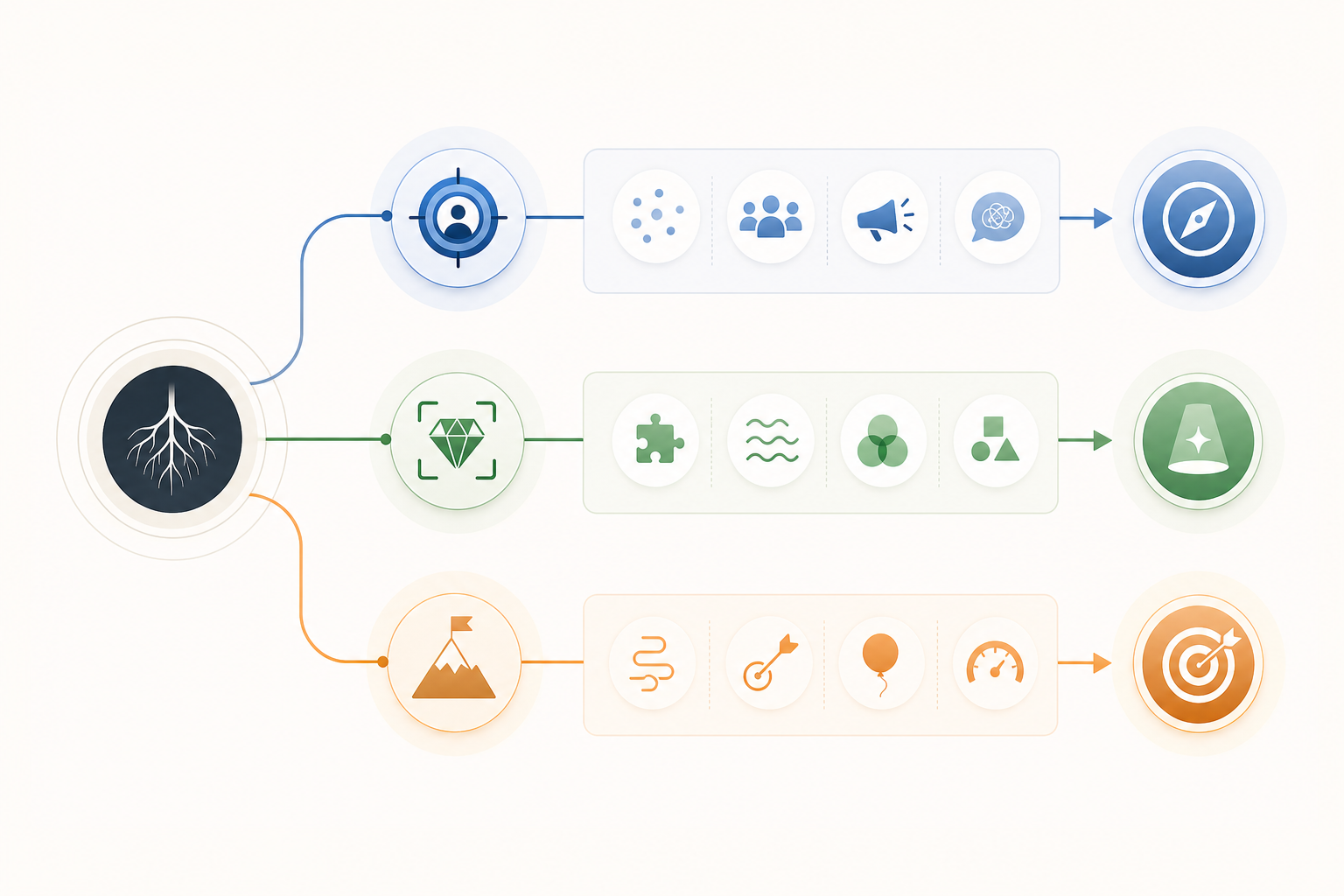
Content direction is the set of choices behind your marketing. It defines:
- Targeting: who the content is for
- Positioning: how you want the business to be understood
- Objectives: what the content should support
A publishing strategy is how you carry out those choices: channels, formats, cadence, workflow, and repurposing.
The difference matters. A packed calendar can look productive while sidestepping the key question: Why does this topic belong in our plan now?
A Bizibl article on content “non-strategy” identifies calendar-first planning, a blind focus on volume, too many channels, and tactical busywork as warning signs when they replace research and deliberate choices.
11 signs your content direction is unclear
One weak post is not a diagnosis. Look for repeated patterns in recent content, planning talks, sales calls, and customer questions.
1. You cannot explain what you do in one sentence
If your answer changes based on who asks, a new reader has no clear way to understand the business. The same is true when a cofounder, salesperson, or freelancer gives a different answer.
Write one sentence that names the audience, problem, and outcome. Then ask someone outside the business to repeat it back. If they cannot, simplify it before creating more content. Different internal explanations are a useful sign of weak positioning, as James Mattison notes.
2. Your posts could belong to almost any competitor
Generic or interchangeable messaging is a common sign of weak positioning. Your advice may be sound, but readers may still have no reason to remember your approach.
Make your difference easier to see. You might share a real method, a trade-off you believe in, a useful distinction, or a clear point of view. You do not need to manufacture a hot take.
3. Your content direction keeps changing with new ideas
One week, you write for beginners. The next, you write for larger teams. Then a competitor, trend, or passing conversation changes the plan again.
New ideas are not the problem. Treating every new idea as an urgent priority is.
Founder-led guardrail: choose one priority audience and a small set of problem areas for a set period. Put other ideas in a parking lot for later review. You are delaying them, not throwing them away.
4. Your calendar is full, but no topic has a clear purpose
A calendar tells you when to publish. It does not explain why an idea deserves your time.
For each planned piece, write one line that states the audience, problem, and next action it should support. If you cannot write that line, pause before drafting. The idea may be interesting, but it may not fit the current plan.
5. You are trying to serve every channel at once
Blog posts, social posts, newsletters, video, and community work can fill the week without making your message clearer.
Bizibl includes trying to serve too many channels among its signs of content “non-strategy.” A practical response is to focus on one main channel, then repurpose with care. Add channels only when you can sustain them without changing the core promise.
6. Most of your effort goes into tools and scheduling
Templates and workflows can make publishing easier. They cannot replace decisions about audience, positioning, and objectives.
If the process looks organised but the message still feels vague, return to what the content should support now. A qualified inquiry, a product evaluation, an email sign-up, or a better sales conversation can each need different topics and calls to action.
7. Your goal is only “more awareness” or “more traffic”
These may be valid ambitions, but they are weak filters for choosing individual topics. When the goal is broad, almost every idea can seem useful.
Bizibl argues that objectives should be measurable and linked to business outcomes rather than vague hopes. For the current period, choose a specific business outcome you can measure. Keep the measure simple if needed, but review it often enough that topic choices become less arbitrary.
8. You get attention, but little of it moves forward
Views, likes, and visits do not prove that you are reaching the right people. Possible warning signs include high views or ad spend with few sign-ups or purchases, uneven engagement, and repeated questions about what you offer. Karen C. Wilson lists these as signals worth investigating when content may be missing its intended audience.
These signals do not prove one cause. A useful next check is whether your message makes clear who it is for, what problem you solve, and what readers should do next.
9. People still ask what you do
If readers often ask what you offer or who you help, your content may give advice without enough business context. Frequent questions of this kind can point to unclear messaging.
Founder check: sample a few recent posts or key pages. Can a new visitor tell who you help and what you offer? If the answer is no, make that context more visible.
For a separate guide on making your introduction feel natural, read How to Introduce Your Business Through Content.
10. The wrong people keep responding
Some off-target attention is normal. A steady flow of wrong-fit inquiries is a signal worth checking. Your examples, language, topics, or calls to action may be speaking to a wider audience than you intend.
Show your audience through its role, limits, experience level, and buying context. A short internal “not for” statement can also help your team make more consistent editorial choices.
11. Your main promise does not match the content people see next
Your homepage headline, social bio, pinned content, and recent posts should tell one connected story. If the promise says one thing but the next few pieces show another, a new visitor has to guess whether they are in the right place.
Try a simple promise-versus-content check. Write down the main promise in your hero section or bio. Then scan the content a visitor sees next. Mark which pieces clearly deliver on that promise and which do not.
On Instagram, Nicole Ialeggio highlights a common clarity issue: a bio or pinned item can promise one thing while recent feed posts show something else.
Find the root cause before fixing the symptom
Unclear direction can involve targeting, positioning, objectives, or a mix of all three. Name the likely cause before rewriting content. Otherwise, you may improve the words while leaving the missing decision untouched.
| Root cause | Common signs | Useful first move |
|---|---|---|
| Targeting | Broad topics, wrong-fit inquiries, vague examples | Write a clear “for” and “not for” statement. |
| Positioning | Generic posts, confused prospects, shifting explanations | State the problem, outcome, and why your approach is worth considering. |
| Objectives | Topic churn, calendar-first planning, unclear calls to action | Choose one measurable business outcome and a review signal. |
Research helps reduce the risk of building on assumptions about what customers want. Bizibl recommends diagnosis before strategy: first understand the market, customer, and current content, then make deliberate choices.
Confirm your direction with evidence, not just instinct
Use this lightweight evidence loop before making a major change. It will not make every decision certain, but it can reveal patterns that instinct alone misses.
Run a one-sentence test
Show your homepage or a few recent pieces to several people. Ask:
- Who is this business for?
- What problem does it solve?
- Why might someone consider it instead of another option?
Include insiders and outsiders when you can. Look for patterns, not word-for-word agreement. If the answers vary widely, you have found a direction gap.
Compare the promise with the proof
Review your hero section, bio, or pinned message against the content a visitor sees next.
- Does recent content serve the stated audience?
- Does it address problems you say you solve?
- Does it show your approach, not just broad advice?
- Does the next step suit the reader’s stage?
This is a practical diagnostic, not proof of one underlying problem. It is useful when your content feels busy but disconnected.
Use customer language
Review sales notes, support conversations, interviews, and emails from current customers. Ask what they were trying to solve, what alternatives they considered, and which words they used for the problem.
Use the patterns you find to sharpen topic choices and explanations. For a broader starting point, see Understanding Your Audience for Content Marketing.
A simple content direction framework for founder-led marketing
The following is a planning recommendation, not a universal template. Keep it to one page and use it when choosing, briefing, and reviewing content.
- Priority audience: Who are we helping now? Who are we not trying to serve with this content?
- Problem areas: Which buyer problems matter to that audience and our offer?
- Positioning: What outcome do we help create, and why is our approach worth considering?
- Proof: What can we show honestly: a method, process, product detail, expertise, or clearly labelled illustration?
- Primary objective: What business action should this content support during this period?
- Calls to action: What is a sensible next step for readers at different stages?
This is enough to start. Keep it visible when reviewing ideas so the calendar reflects your choices instead of replacing them.
For more on setting up that decision layer, read A Content Direction Framework for Founder-Led Marketing.
Set guardrails without making content boring
Guardrails are simple decision rules. They protect focus while leaving room for tests and new ideas.

Use a five-question filter
Before adding an idea to the calendar, ask:
- Is this for our priority audience?
- Which problem area does it serve?
- Does it support our positioning?
- What objective or reader action does it support?
- Would a new visitor see it as consistent with our main promise?
As a founder-led rule of thumb, if two or more answers are no, put the idea in the parking lot rather than forcing it into the current plan.
Review parked ideas on a schedule
Record the idea, audience, problem, and reason it may matter later. Review the list monthly or after a campaign. Move an idea into the plan when it fits your direction or when new customer evidence gives you a reason to change direction.
A new angle can justify a small test when your offer changes or repeated customer questions reveal a gap. Define the test audience, prepare a small group of related pieces, and choose one signal to review. One popular post is not, on its own, a reason to pivot the whole plan.
If ad hoc publishing is making this difficult, Founder-Focused Content Planning System vs. Ad Hoc Posting offers a related perspective.
When to change content direction
Change direction when evidence suggests that a core choice is out of date or wrong, not simply because consistent content feels repetitive to you.
A change may make sense when your priority audience changes, customers repeatedly describe a missed problem, your offer changes in a meaningful way, or your current direction no longer supports the business goal.
Before changing course because results are slow, check the basics. Is the audience clear? Have you covered the same problem area long enough to see a pattern? Does the call to action fit the content? Are you reaching people in a sensible place?
Start with one audit this week: the one-sentence test, the promise-versus-content check, or a review of a few recent pieces. Then make one decision. A clear audience, position, or objective gives each future draft a job to do.