
A monthly subscription cost justification for content planning tools comes down to one question: does the tool reliably remove a repeated bottleneck—such as decision delays, rework, scattered drafts, approval stalls, or manual publishing work—and can you observe the improvement in your own workflow?
For founders, the decision is not about making a calendar look tidier. It is about whether a subscription saves usable time, prevents avoidable errors, and helps content move more reliably.
A subscription can be worth keeping when it reliably does one or both of these things:
- Cuts decision and coordination work.
- Prevents costly mistakes, such as rework, lost context, stalled approval, or missed deadlines.
The key word is reliably. A system that works only in a quiet week is not much help. This worksheet helps you make a cautious decision based on your own workflow, not a feature list.
Start with the real question: what keeps content from moving?
The price is rarely the whole objection. The bigger worry is paying for another system that gets abandoned after a few weeks.
In this worksheet, treat content planning as a chain of decisions. For each piece, someone needs to decide who it is for, why it matters now, what it should say, what action it should support, where the draft lives, and whether it is ready to publish.
Ask these three questions before you subscribe:
- Will this cut decisions per piece? For example, will it make the audience, angle, next step, owner, and status clear?
- Will it reduce tool switching? Can fewer files, messages, and boards hold the working context?
- Will it cut backward work? Will it help prevent rewrites, duplicate topics, unclear review, and lost drafts?
The aim is not to buy the tool with the most features. It is to find a system that removes work rather than moving it somewhere else. For an outcome-first way to assess a platform, see the Content Planning Platform Decision Checklist for Founders.
A monthly fee versus a “free” setup
A spreadsheet, shared document, or blank board may have no monthly invoice. But it still needs upkeep. Someone has to update dates, find drafts, explain feedback, chase decisions, and work out what happens next.
A paid tool should earn its fee by lowering that ongoing effort. It does not need to solve every content problem. It needs to solve a frequent and costly one.
There is also an important category split. StoryChief distinguishes planning tools from publishing tools: planning tools help manage what will be published and when, while publishing tools focus on sending content to chosen channels at a set date and time.
If your bottleneck is deciding what to say and getting a draft approved, a scheduler may not solve it. If your plan is sound but posting across channels is slow and manual, publishing support may matter more.
Benefits that can justify recurring spend
Tie the subscription to an operating result, not a vague hope that the team will be “more organized.” The following are useful things to measure. They are evaluation criteria, not promises about every product.
Fewer decisions before work starts
A long idea list is not the same as a usable plan. Founder-focused content planning mistakes often begin when every idea needs fresh debate about the reader, message, and goal.
A simple active content item can hold:
- The audience or buyer segment.
- The problem they are trying to solve.
- The angle or useful promise.
- The next business step, such as a sales conversation, product page, or newsletter signup.
- The current stage and owner.
This is a structured content planning method for founders: it narrows choices on purpose. You do not need a huge strategy document for every post. You need enough context for the next piece to move.
Test: On a busy day, can you find the next worthwhile item in a few minutes? Or do you still face a blank calendar and a new round of debate?
Less coordination friction
Even a founder with a small team can lose time to scattered context. Ideas may be in notes, drafts in documents, feedback in chat, and dates in a separate board.
A Planable roundup points to missed deadlines, approval bottlenecks, and the lack of a single source of truth as workflow problems in scattered planning systems. Its examples focus on agencies and multi-brand teams, so they do not prove a founder outcome. Still, the warning is useful: more people and more content create more chances for work to stall.
For a founder, lower coordination friction may mean:
- Fewer messages asking where the latest draft is.
- Clear stages for draft, review, approved, and deferred work.
- Fewer feedback rounds caused by missing context.
- Fewer founder interruptions to explain the same decision again.
For any active item, try to answer these questions in ten seconds:
- What happens next?
- Who owns that step?
- What is blocking it, if anything?
If you cannot, you may have visibility without momentum.
Related reading: Content Planning System for a Founder With No Team.
Less rework and fewer avoidable errors
A tool can earn its cost by preventing errors, not just by producing more ideas. Common content errors include a missed date, an old offer, a duplicate topic, a draft for the wrong reader, or feedback that arrives too late to be useful.
Before an item moves into drafting, consider adding these guardrails:
- Audience: Who should see themselves in this piece?
- Problem: What question or friction do they have?
- Outcome: What useful result can the content help them pursue?
- Next step: What should a qualified reader do next?
- Definition of done: What must be true before review or publication?
These are recommended workflow rules, not requirements of a specific tool. Their purpose is to expose unclear work before writing and design time is spent.
A plan that holds up in busy weeks
Your content planning system never sticks when it assumes a calm week. Founders have launches, customer issues, travel, sales work, and delivery deadlines. A usable system lets you pause, defer, and restart without rebuilding the whole plan.
StoryChief lists consistency, planning around important moments, and time savings as benefits of content planning. Those are broad vendor claims, not guaranteed results. For your business, consistency should mean this: after a difficult week, can you see what changed, decide what still matters, and resume?
A busy-week-ready system often has:
- A short rolling list of priorities.
- A way to defer work without losing the reason behind it.
- Clear draft status.
- A simple approval rule.
- Enough context for another person to continue the work.
The founder ROI worksheet: estimate time saved without guessing
Time saved becomes valuable only when it supports useful work: sales follow-up, customer research, product work, delivery, or more reliable publishing. Avoid bold projections. Start with a baseline, test one change, and record what changes.
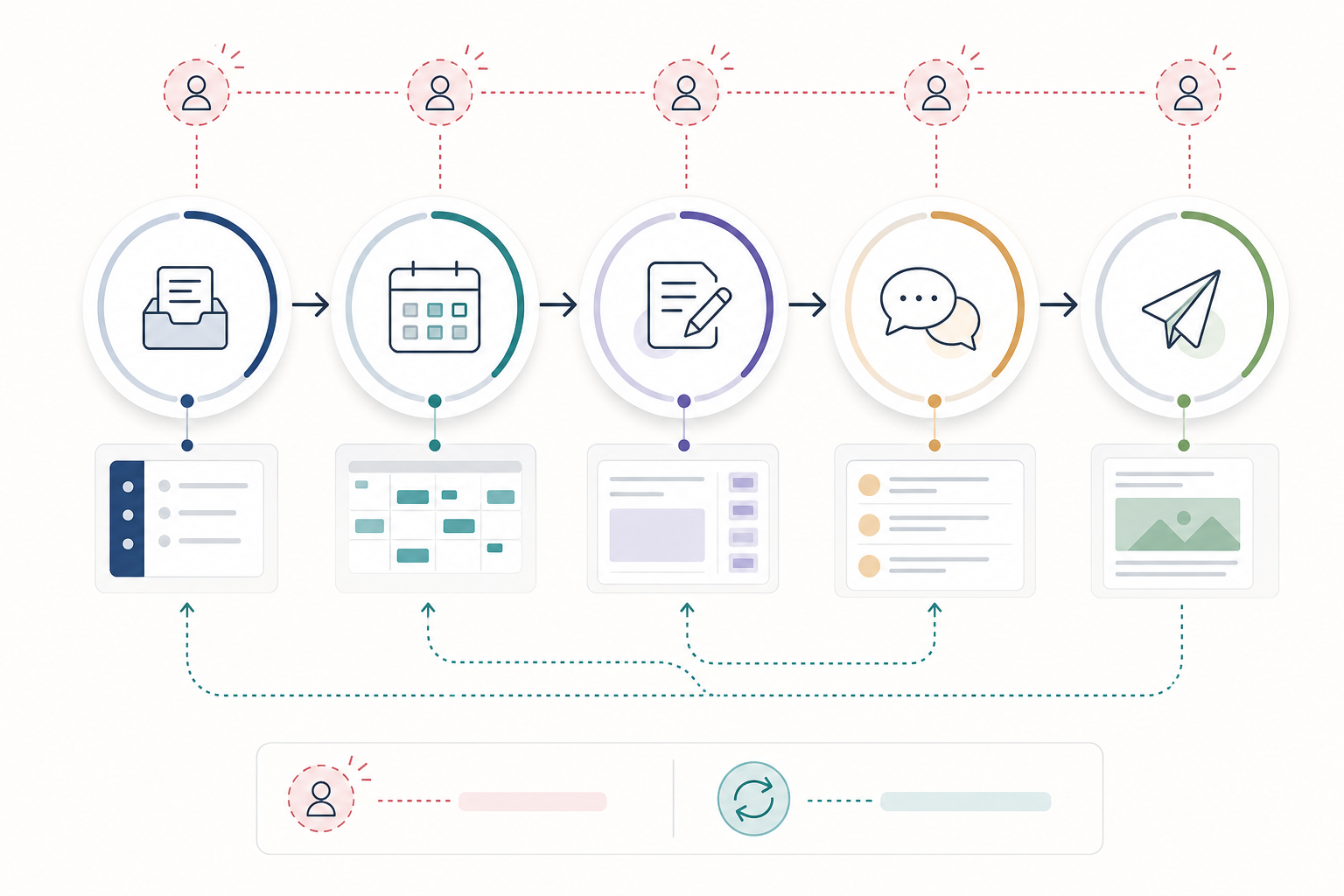
Step 1: map your current workflow
Review your last four to eight content pieces. Map what actually happened:
capture → plan → draft → review → publish
Include detours. Did the brief change halfway through? Did feedback arrive in chat? Did a draft sit because an asset was missing? Do not document the ideal process; document the real one.
| Stage | What “done” means | Time per item now | Founder interrupts | Handoff loops | Notes |
|---|---|---|---|---|---|
| Capture | Idea has enough context to revisit | ||||
| Plan | Audience, problem, angle, and next step are clear | ||||
| Draft | A usable first draft exists | ||||
| Review | Feedback and decision are complete | ||||
| Publish | The piece is live or ready to schedule |
Use timestamps, calendar history, and message threads where you can. If a number is uncertain, make a conservative estimate and mark it as uncertain.
Two measures are especially useful:
- Founder interrupts: Questions, review requests, and context switches needed to unblock content.
- Handoff loops: Back-and-forth caused by missing audience, offer, proof, angle, or call to action.
These measures show where attention gets broken. To explore why that happens, read Why Content Planning Feels Overwhelming as a Founder.
Step 2: find the repeated bottleneck
Choose the stage that causes the most repeat work, not just the one you dislike most.
Common bottlenecks include:
- Planning thrash: Topics and angles keep changing.
- Rewrite gravity: Drafts exist, but the founder keeps rewriting the core message.
- Approval drag: Work waits because the reviewer or review standard is unclear.
- Deadline slips: Dates move because ownership and blockers are not visible.
- Tool switching: The team moves between documents, chat, email, boards, and publishing tools to understand one item.
Tools do not save time in the abstract. They help when they remove a bottleneck that repeats.
Step 3: run a conservative two-to-four-week test
Do not assign large time savings to every feature. Set one modest change that you can see.
For example:
- Reduce review-related founder interrupts from eight per month to five.
- Cut brief clarification loops from three per item to one or two.
- Move an approved draft to publish-ready without copying key information between several places.
- Reduce items stalled for more than two weeks.
For each real item, track:
- Founder interrupts.
- Handoff loops.
- The date it became publish-ready.
Track time too if it is easy. But do not abandon the test because time tracking is imperfect. You are looking for a different operating pattern.
Step 4: turn workflow change into value
After the test, count only gains you can explain and use.
Founder time reclaimed
If interruptions drop, what will you do with that time? Give it a real job: customer follow-up, a sales call, a customer interview, or a protected work block.
Do not count time that will simply disappear into an unplanned inbox. A more credible statement is: “If review interruptions decline, I will spend 45 minutes each week on customer follow-up.”
More publish-ready work
Track items that are ready to publish, not ideas saved. More ideas are not output.
More content does not guarantee revenue. It may, however, give sales conversations useful material, answer buyer questions, and support a more consistent presence. Keep those claims separate from a revenue forecast.
Errors avoided
Count errors that would have caused delay or rework: missed dates, duplicate topics, incorrect offers, unclear ownership, or a draft sent to review without an agreed next step.
Use this simple formula:
> Monthly value = credible founder time reclaimed + credible cost of errors avoided + the value of extra publish-ready work you will actually use.
Compare that total with the monthly fee after the test. If the numbers are unclear, the decision should stay unclear. Extend the test, reduce scope, or choose a simpler category.
When content planning without a niche feels scattered
A lack of topics is not always the problem. Often, the issue is that there is no shared filter for choosing among them.
You do not need permanent positioning before you publish. You do need working anchors for the next planning cycle:
- One buyer type or audience segment.
- One recurring problem they have.
- One outcome you can credibly help them pursue.
For example, “AI trends” is broad and hard to prioritize. “How a service business can reduce proposal back-and-forth” gives you a reader, a problem, and an outcome.
Try this rule: every active item needs an audience, problem, and outcome. If you cannot fill those in quickly, keep the idea in an incubation list rather than treating it as a commitment.
The spreadsheet trap: visibility without movement
Spreadsheets are useful for listing work. They can be less useful for live context: changing status, review notes, version decisions, and the reason an item matters now.
This does not mean every founder needs a complex platform. It means your system should make the next step, owner, and blocker easy to see. If it does not, you may be paying in status checks and repeated explanations.
Mistakes that make a system hard to keep
Small teams often need fewer stages and clearer decisions, not an enterprise workflow. Watch for these patterns:
- Building a long calendar without reviewing what shipped and what changed.
- Adding a complex approval chain when one clear reviewer would do.
- Paying for publishing automation when direction and briefs are the real problem.
- Mixing raw ideas and active drafts in one backlog.
- Asking the founder to approve every detail instead of only the decisions that need founder input.
For ways to reduce decision overload, see Founder-Focused Content Planning Constraints to Set.
Choose the category before comparing brands
Many subscription regrets are category mismatches. A social scheduler can be excellent and still not help a founder who needs direction. A flexible project board can be useful but may take too much setup for a simple content rhythm.
SearchBlueprint’s category-first comparison groups tools as social schedulers, project boards, all-in-one platforms, editorial/newsroom systems, and low-cost options. Its core advice is practical: choose the category first, then compare features.
| Category | Main job | Good fit when | Watch for |
|---|---|---|---|
| Social scheduler | Schedule and publish channel content | Posting is the main bottleneck | Limited help with long-form direction |
| Project board | Track work, owners, and stages | Content is one of several workstreams | Setup burden and limited publishing support |
| All-in-one platform | Combine planning, publishing, and often reporting | You will use the connected workflow | Paying for features you will not use |
| Editorial/newsroom system | Manage complex production | You have real volume and many stakeholders | Too much complexity for a small team |
| Low-cost option | Test a simple cadence | You are validating a process | Limits as collaboration grows |
Should you buy a planner or a publishing tool first?
Buy planning support first when the recurring question is: “What should we create next, for whom, and why?”
Buy publishing support first when the recurring question is: “The work is approved, but posting it is slow, manual, or error-prone.”
If both are true, start with the more costly recurring failure. A perfect scheduler cannot fix an unclear message. A great planning system may not solve a repeated channel-posting problem.
A practical seven-day evaluation
Test one real piece of content, not vendor demo material. The goal is not to explore every setting. It is to learn whether the tool reduces the specific friction you found.
Test 1: choose the next item
Open the system without preparing first. Can you identify the next content item in under ten minutes? Can you see its audience, angle, and next step?
Test 2: move one item through the workflow
Use one genuine piece of work. Move it from planning to drafting to review. Note where you have to copy the same brief or repeat instructions.
A deliberate handoff can work well. The problem is a handoff that loses key context.
Test 3: make a clear decision
Test a real approve, defer, or reject decision. Can the reviewer see what they need? Can other work continue while one item waits? Is the decision visible afterward?
For a cadence to compare during this test, see Content Planning Weekly Vs Monthly Planning Cycle for Founders.
Treat prices as dated references
Prices and plan limits change. Confirm current pricing and included features directly with any vendor before you buy.
For context, Planable’s 2026 roundup says its paid plans start at $8 per user per month at the time of publication. That shows that lower-entry paid options exist. It does not show what your workflow will cost or whether that category fits your needs.
Content Redefined AI’s public site describes entering your website for a quick, read-only pass that suggests your business, audience, language, and voice for you to confirm or correct. It then offers a free week with no card required. If you evaluate it, run the same real-work tests above rather than assuming fit from a product description.
Keep, change, or cancel: a 30-day scorecard
After a month of real use, score each area from 0 to 3.
- 0 — Worse or unused: The tool added friction or was abandoned.
- 1 — Small help: It helped sometimes but did not change the weekly pattern.
- 2 — Clear help: The workflow was easier most weeks and the gain was visible.
- 3 — Reliable support: It worked in busy weeks without much upkeep.
| Area | Question to score |
|---|---|
| Decision reduction | Can you see a short, useful list of what to publish next? |
| Workflow clarity | Can you find the stage, owner, next step, and blocker quickly? |
| Draft movement | Do active ideas become drafts and publish-ready work more often? |
| Approval friction | Does founder review unblock work rather than stall it? |
| Learning loop | Does published work shape the next planning cycle? |
Use the total out of 15 with care:
- 12–15: Keep paying if the observed value fits the cost.
- 8–11: Simplify the workflow, downgrade, or test another category.
- 0–7: Cancel or fix the operating method before paying for more software.
The score is a decision aid, not a validated benchmark. A low score may mean the subscription is a poor fit, but it may also show that the team needs a simpler workflow or a different category of tool.
When a strategist is a better investment
A tool and a strategist solve different problems. A tool is often useful when your audience, themes, and offer are clear enough, but follow-through breaks down. A strategist can be more useful when the hard question is what to say, who to target, or how to position a new offer.
Consider strategic help when:
- Your message changes every week.
- You cannot explain who you serve and what content should achieve.
- You rewrite most drafts because the central angle is wrong.
- You are entering a new market or launching a new offer.
Consider a tool when:
- Direction is clear, but work keeps stalling.
- Drafts and feedback are scattered.
- Founder review comes too late because the process is vague.
- The team spends more time restoring context than creating content.
Related reading: Content Planning Platform vs Hiring a Content Strategist.
FAQ
How do I estimate time saved without optimistic guesses?
Use your last four to eight pieces as a baseline. Then run a two-to-four-week test and track founder interrupts, handoff loops, and when each item becomes publish-ready. Count only changes you can observe.
If an estimate is uncertain, record a range or mark it as uncertain rather than choosing the most flattering number. The goal is a purchasing decision that remains credible after the first difficult week.
Is a content planning tool worth it for a solo founder?
It can be, if it cuts choices and helps protect time. A solo founder usually needs a clear next action more than complex collaboration settings. If the tool adds setup work or too many options, simplify the system.
Related reading: Founder Content Planning Weekly Operating Rhythm.
Should I cancel if it does not produce revenue right away?
Do not assume a short workflow test should prove direct revenue. First look for credible operating change: less rework, fewer interruptions, clearer direction, faster campaign preparation, or more reliable publishing. If that change does not appear, canceling is reasonable.
What if the problem is not the tool but our operating method?
That is a useful result. A tool cannot replace a basic decision about audience, problem, and next step. Before buying more software, reduce the number of active items, define a simple review rule, and decide where the current version of each draft lives. Then test whether a tool makes that lighter process easier to sustain.
The decision to make this month
The strongest case for a monthly content planning subscription is specific: it reduces the repeated bottleneck that stops useful content from moving, and you can see that change in interruptions, rework, readiness, or consistency.
Start with one failure point. Map the current process, run a real test, and review the evidence after a month. Keep the subscription when it reduces friction in the work you actually do. Change category or simplify when it does not.