
What to look for in a founder content planning platform
When deciding what to look for in a founder content planning platform, prioritize a system that helps you choose what to publish, turn those decisions into a realistic plan, and keep control of what represents your business. A calendar or a fast draft generator alone is not enough.
The best fit reduces repeat decisions each week. It should give you a clear path from business context to topics, drafts, review, and a publishing rhythm you can maintain alongside product, sales, and customer work.
Start with the founder workflow, not the feature list
Content planning feels overwhelming as a founder because it combines several jobs: understanding the audience, choosing a message, selecting a format, writing or reviewing the work, and getting it published. A tool may do one of those jobs well while leaving the hardest decisions to you.
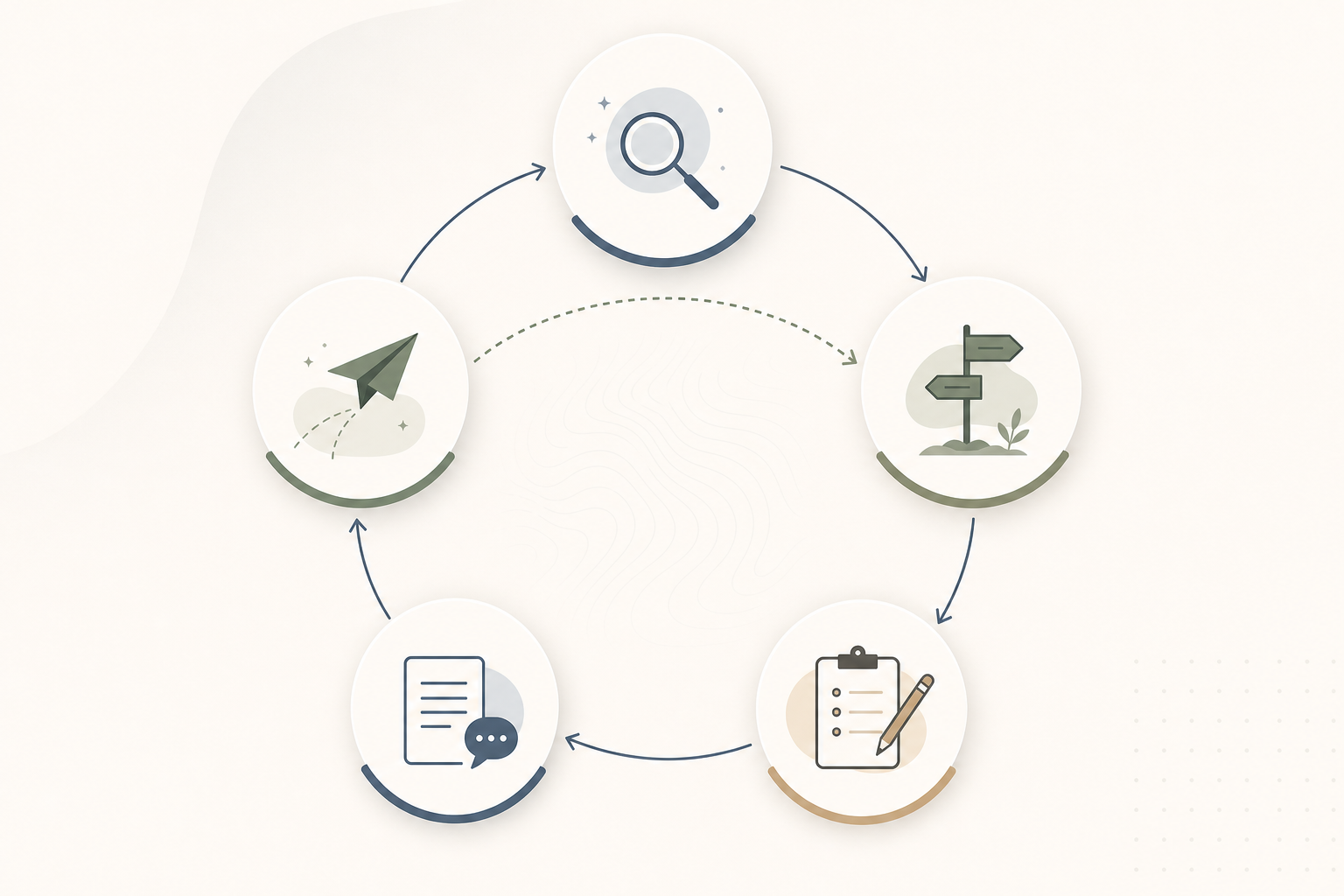
Before comparing platforms, define the workflow you need:
- Discover: clarify what you sell, who you help, and the problems you can credibly address.
- Direct: choose a few themes that support your business goals.
- Plan: turn those themes into a short, ordered backlog and a realistic calendar.
- Draft and review: develop content while keeping founder approval over voice and claims.
- Publish and learn: note what shipped, what prompted useful responses, and what deserves a follow-up.
A platform does not need to automate every step. It does need to make the next step clear. If content planning feels overwhelming as a founder, first identify which part of this workflow is breaking down. Our guide on why content planning feels overwhelming as a founder can help you diagnose that before you buy software.
Do not confuse planning with scheduling
A scheduling tool answers, “When will this post go out?” A planning platform should also answer, “Why is this the right topic now?”
Scheduling matters once a piece is ready. But an empty calendar, bulk idea generator, or library of templates does not create direction. It can produce a larger draft pile: many possible posts, few finished pieces, and no confidence about what deserves your limited time.
For a founder, the better question is not “How many channels does this tool support?” It is “Can this tool help me choose the next useful piece of content without reopening my strategy every Monday?”
Buy decision reduction, not more output
A good platform reduces the number of decisions you make from scratch. It should help you reuse the work you have already done: customer questions, sales objections, product insights, founder stories, and existing website pages.
For example, instead of starting with “What should I post on TikTok this week?”, start with one buyer concern, such as “How much internal time will implementation take?” That concern can become a detailed article, a short video outline, a sales enablement note, and a social post. The core message stays consistent while the format changes.
The must-have criteria for a founder-ready platform
The right features depend on your business, but the following criteria matter more than a long checklist of integrations. They match the practical limits of a small business founder: limited time, limited review capacity, and a need for clear commercial direction.
1. Business discovery that creates usable direction
A platform should begin with your business, not a blank content board. Look for a process that helps you document and confirm:
- what you offer;
- who is most likely to buy;
- the customer problems you solve;
- the proof, experience, or point of view you can stand behind; and
- the goals content should support.
The output should be practical. You should be able to review a short description of your positioning, your core audience questions, and a small set of themes. If the setup only asks for a list of keywords or social accounts, it may be skipping the work that keeps content focused.
Content Redefined AI is designed around this structured approach: introduce the business, establish content direction, and maintain a consistent publishing schedule. As with any platform, assess whether that workflow matches the way you want to work before committing to a monthly subscription.
2. Themes and prioritization, especially when you do not have a niche
Content planning without a niche feels scattered when every new idea has equal weight. You do not need a perfectly narrow niche before you begin. You do need constraints.
Look for a platform that can organize content around a few repeatable themes, such as:
- common customer problems;
- buying objections;
- implementation lessons;
- product education; and
- founder perspectives on changes in your market.
Each planned item should have a clear reader, purpose, and link to the business. A topic titled “AI trends” is vague. “How a five-person operations team can evaluate AI workflows without adding more tools” gives you an audience, a problem, and an angle.
Ask whether the platform helps you rank ideas by relevance and effort. It should make it easy to put good-but-not-urgent ideas in a later queue. That is how a backlog becomes a publishing pipeline instead of a source of guilt.
3. A realistic cadence, not an idealized content machine
A usable plan reflects your actual capacity. Daily posting may be appropriate for a media team, but it is often a poor default for a founder who also sells, builds, and supports customers.
Look for a calendar that lets you see the next few weeks, spot an overloaded period, and adjust the plan without rebuilding it. The platform should distinguish between work that is planned, drafted, in review, and ready to publish.
A sustainable starting point might be one substantial piece every two weeks and one shorter supporting post each week. The exact cadence matters less than your ability to keep it for several months.
For a simple operating model to compare against a tool’s workflow, see this founder content planning weekly operating rhythm. A platform should support that kind of repeatable routine rather than require constant maintenance.
4. Draft management and clear founder review
Fast drafting is useful only when the review process is trustworthy. Your public content represents your business. You need to check tone, claims, examples, and calls to action before anything is published.
Look for clear stages such as:
| Stage | What should be clear |
|---|---|
| Idea | Why the topic belongs in the plan |
| Brief | Reader, angle, key points, and desired action |
| Draft | What is ready for review and what still needs evidence |
| Review | Who has final approval and what changes are required |
| Ready to publish | The approved version and its planned destination |
Avoid vague handoffs. If you cannot tell which version is current, what needs a decision, or whether a draft has been approved, the tool will create more coordination work.
5. A feedback loop that informs the next plan
Analytics do not need to be complex to be useful. At minimum, you need a way to record what you published and what happened next: qualified replies, useful sales questions, visits to a key page, email sign-ups, or another measure that matters to your business.
The key is the loop. After each period, ask:
- Which topics attracted the right questions?
- Which pieces helped sales or customer education?
- Which format was realistic to create?
- What should become a follow-up, update, or series?
General guidance on choosing a content creation platform also recommends defining objectives and non-negotiables before comparing options (Contentoo’s buying considerations). That principle is especially important for founders: a report is only useful if it helps you make the next decision.
Score platforms with a founder-focused shortlist
Use this scorecard during a demo or trial. Give each category a score from 0 to 2:
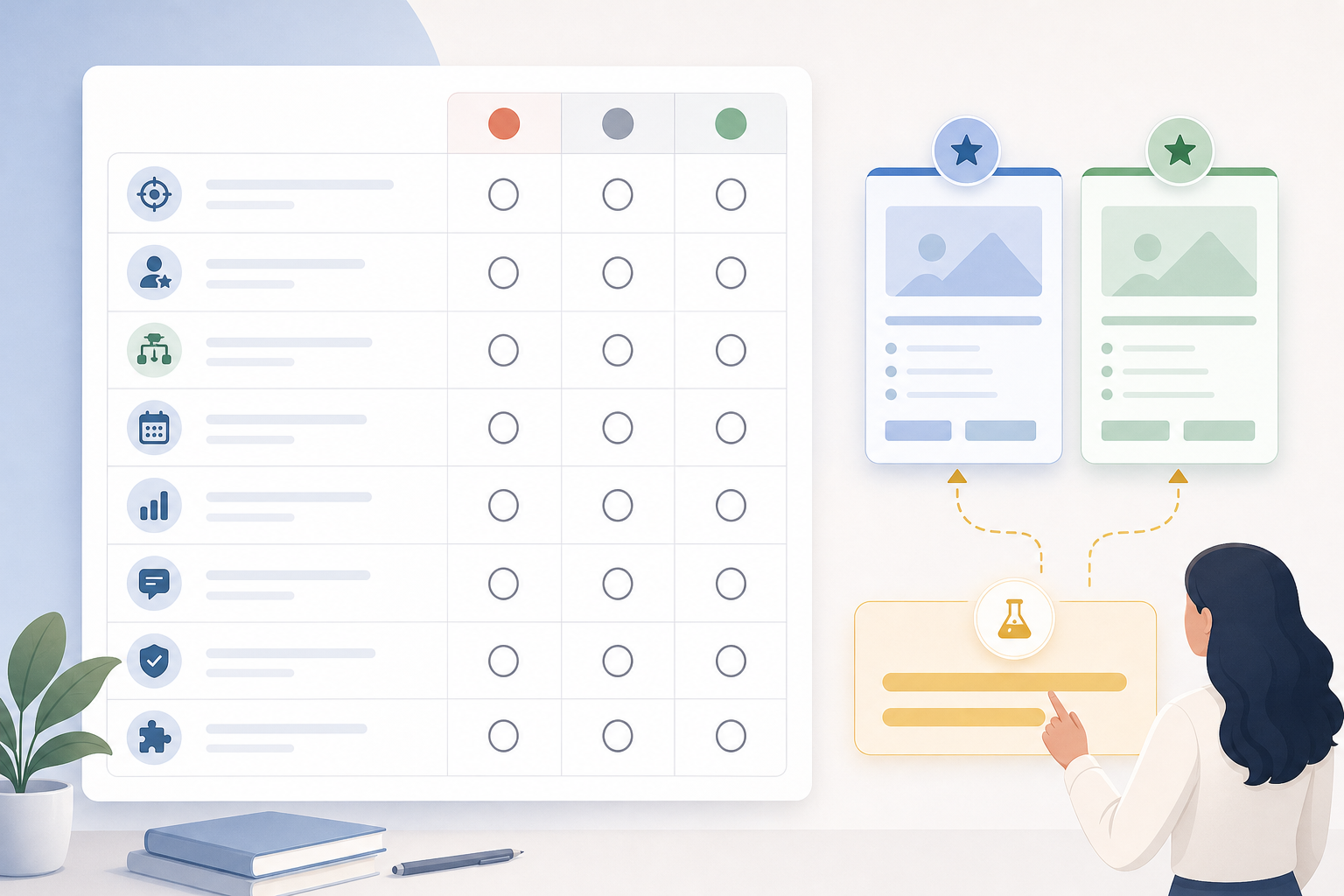
- 0: missing or unclear
- 1: partly supported, but requires workarounds
- 2: clear, practical, and easy to use in your normal week
| Criterion | What strong support looks like | Score |
|---|---|---|
| Business direction | Starts with your offer, audience, and goals | 0–2 |
| Topic prioritization | Helps you choose what to publish now and defer the rest | 0–2 |
| Theme-based planning | Connects individual posts to a clear message or series | 0–2 |
| Sustainable calendar | Shows a manageable cadence and separates stages of work | 0–2 |
| Review control | Makes approval, edits, and ownership easy to see | 0–2 |
| Repurposing support | Lets one core idea inform several formats without duplicate planning | 0–2 |
| Feedback loop | Captures meaningful results and turns them into next actions | 0–2 |
| Low maintenance | Fits your week without constant setup or dashboard work | 0–2 |
A high score is not a guarantee of fit. It is a prompt for better questions. If two tools score similarly, choose the one that feels easier to use when you are busy, not the one with the longest feature page.
Test the draft pile risk
Give each platform the same real exercise: bring 15 raw topic ideas from sales calls, customer conversations, or your notes. In one session, try to narrow them to five priorities.
A strong platform helps you identify the audience, goal, angle, and next action for each priority. A weak one simply stores all 15 ideas and asks you to decide later.
This distinction matters. More unfinished drafts rarely lead to more consistent publishing. A small, well-defined queue is more valuable.
Test cross-channel coordination without multiplying work
Your website, email, and social channels do not need separate strategies every week. They need a shared source idea and format-specific execution.
Ask the vendor to show how one core article or insight can become supporting material for the channels you actually use. Do not assume you need to be active everywhere. If Instagram, TikTok, or YouTube are not part of your current capacity, they should not drive the purchase.
The test is simple: can you create one source piece, select the few useful adaptations, and keep the original message intact? If every channel requires a separate calendar, separate brief, and separate backlog, the system may be too heavy for a founder-led team.
Red flags that signal poor fit
It creates content faster than it creates clarity
Unlimited ideas and one-click drafts can look impressive in a demo. But if the tool does not require a reader, a goal, and a reason to publish now, it may simply produce noise faster.
A platform should help you make trade-offs. If it never helps you say no, it is not solving the planning problem.
It assumes you already have strategy, voice, and capacity
Some tools are built for teams with established brand rules, channel owners, and a content manager. That may be a good fit later. It is not always right for a founder who needs direction first.
Watch for onboarding that jumps directly to post templates and publishing slots without asking what you sell, who you help, or what outcome you want. That is a sign of a strategy gap.
It treats publishing as the only finish line
A piece can publish and still fail to support the business. Look for a system that captures follow-up opportunities, audience questions, and lessons from the work.
Likewise, be cautious about workflows that remove review control. Publishing should remain a deliberate decision, especially when content makes product, pricing, or customer-related claims.
It demands more upkeep than it saves
A complex workspace can be useful for a large marketing team. For a founder, it can become a second job. If a platform needs daily tagging, elaborate status updates, and several views to understand what is due, it may not survive a busy month.
Choose the simplest system that lets you plan, review, and recover. If you miss a week, the plan should help you restart from the next priority rather than punish you with an impossible backlog. A content planning system for a founder with no team should be particularly simple in this respect.
Run a seven-day trial before you subscribe
The best way to assess what to look for in a founder content planning platform is to test it with real work. Do not evaluate only templates, sample data, or a polished product tour.
Day 1: Set a narrow business goal
Choose one outcome for the next 30 days. Examples include better-qualified sales conversations, fewer repeated support questions, more awareness of a new offer, or a clearer explanation of your product.
Then choose one audience segment and one theme. Keep the scope narrow enough to make decisions quickly.
Days 2–3: Build a short plan
Create six to ten topic ideas under that theme. For each one, write:
- the reader’s question;
- the main point you can support;
- the intended action after reading; and
- the format that suits the idea.
Now reduce the list to two pieces you could realistically finish. This is the important moment: does the platform make prioritization easier, or does it give you more options to manage?
Days 4–5: Take one piece through review
Create a brief and a draft. Check whether you can find the source material, leave comments, revise the angle, and mark the work ready only when you are satisfied.
Do not judge a tool solely by how quickly it can generate text. Judge it by how confidently you can review and improve a piece that will represent your business.
Days 6–7: Plan the next action
Decide how the core idea will be reused, if at all. Record what you learned from the process: where you hesitated, what took too long, and whether the cadence felt realistic.
At the end of the trial, ask one decisive question: Would I willingly open this platform during a difficult week? If the answer is no, its feature set will not make it stick.
Choose the right level of support
Software is not the only option. If your core problem is a lack of strategic direction or writing capacity, outside expertise may be more helpful than another platform. If you have the insight but need a repeatable way to organize it, a structured planning platform may be the better fit.
Read content planning platform vs. hiring a content strategist before you decide. The right choice depends on whether you need a system, hands-on strategic support, or a combination of both.
Whatever you choose, start small. Build a plan you can keep for eight weeks, preserve founder review, and use each publishing cycle to make the next one easier. Consistency comes from a system that matches your real constraints—not from a more ambitious calendar.