
If content strategy exists but execution fails, the problem is rarely a lack of ideas. Most founders already have topics, keywords, and business goals. What is missing is a reliable path from an approved idea to a live page.
The answer is not a larger backlog or more tools. It is a small content operating system: clear ownership, a visible workflow, realistic limits on work in progress, and a regular review rhythm. This guide shows how to build one without creating a content-operations department.
The gap between a content plan and published work
Strategy and execution are related, but they are not the same job.
A content strategy sets choices. It identifies the audience, the topics worth covering, the role content plays in the business, and what the team will not prioritize. Execution is the repeatable work of briefing, drafting, reviewing, publishing, distributing, and improving that content.
A strategy can be sound and still fail in practice when those steps have no owner or deadline. The plan stays in a document while the actual work is spread across notes, drafts, messages, and a CMS.
This pattern is not unique to content. One analysis of strategy execution describes the core problem as a missing connection between strategic intent and daily work (Why Strategy Execution Fails). For a small business, that connection needs to be simple enough to use during a busy week.
A useful test is this: can anyone on the team answer these four questions for the next article?
- What is the next step?
- Who owns it?
- When is it due?
- What must be true before it moves forward?
If the answer is unclear, the issue is operational, not creative.
What breaks between strategy and publishing
The handoff chain is usually straightforward: idea → brief → draft → review → CMS → publish → distribution → update. But each handoff is an opportunity for work to stall.
No single owner
When a piece belongs to “marketing” or “the team,” it often belongs to no one. A founder may assume a contractor is waiting for input. The contractor may assume the founder will approve the brief. The draft then sits unfinished.
Assign one directly responsible individual to every item. That person does not need to write every word or make every decision. They are responsible for moving the piece to its next stage and raising a blocker early.
Keep approval simple, too. One approver is usually better than a chain of reviewers. Ask reviewers to choose between “approved” and “changes needed,” with specific comments, rather than reopening the entire direction of the piece.
Too many places to track work
A spreadsheet may hold the calendar, a document may hold the brief, a project tool may hold tasks, and the CMS may hold the draft. None of these tools is inherently wrong. The problem begins when the team cannot tell which view is current.
Choose one planning hub as the source of truth for status. It can be a spreadsheet, a project board, or a lightweight database. For each content item, track only what helps work move:
- Topic and target reader
- Current stage
- Owner
- Due date
- Link to the brief or draft
- One next action
Your CMS can remain the publishing tool. The planning hub should show progress and responsibility. A practical content calendar can provide that shared view without adding a complex process.
More work starts than finishes
A large idea backlog can feel like momentum. In reality, it can hide a throughput problem. Teams start several articles, then switch context when a sales request, client deadline, or product launch appears.
Use a work-in-progress limit. For a founder-led team, three active pieces may be enough: one in brief, one in draft, and one in review or scheduling. Do not start another article until one leaves the system.
This creates a useful trade-off: fewer simultaneous projects, but more finished work. Publishing depends on completed pieces, not on the number of ideas collected.
“Done” means something different to everyone
A writer may see a complete draft as done. A founder may expect citations, a call to action, metadata, and a final check in the CMS. If those expectations appear only at the end, each piece creates another round of delay.
Define “ready to publish” before writing begins. A basic definition of done might include:
- A clear audience and angle
- A complete draft that answers the search intent
- Checked facts and sources where needed
- A title and meta description
- Relevant internal links
- CMS formatting and image requirements
- A planned distribution step
A shared checklist reduces subjective review and makes the finish line visible.
Content loses every priority collision
Founder time is finite. When content has no protected place on the calendar, urgent work will rightly take over. The goal is not to pretend priorities never change. It is to make the trade-off deliberate.
Set a cadence you can sustain, such as one post a week or two posts a month. Treat the publishing block like a client meeting: it can move when necessary, but it should not silently disappear. A realistic schedule builds more trust than an ambitious calendar that is abandoned after two weeks.
Build a minimum viable content operating system
You do not need separate strategy and operations teams to run content well. In a small business, those are often two hats worn by the same person.
The strategy hat makes choices: who the content serves, which problems matter, and which channels deserve attention. The operations hat protects flow: ownership, templates, deadlines, and follow-through.
Start with a direction statement
Before filling a calendar, write a short direction statement. It should name:
- The audience you want to help
- The business problem or question your content will address
- The themes you will return to
- The content you will not prioritize right now
- The business outcome content should support
For example: “We help operations leaders at small service firms choose simpler reporting processes. We publish practical guides and comparison content for buyers who are evaluating options. We do not chase broad news topics unless they affect our customers directly.”
This is more useful than a long topic list because it guides trade-offs. If an idea does not fit the direction, it can wait. If you need to clarify your choices first, begin with a focused content strategy development process before building the production schedule.
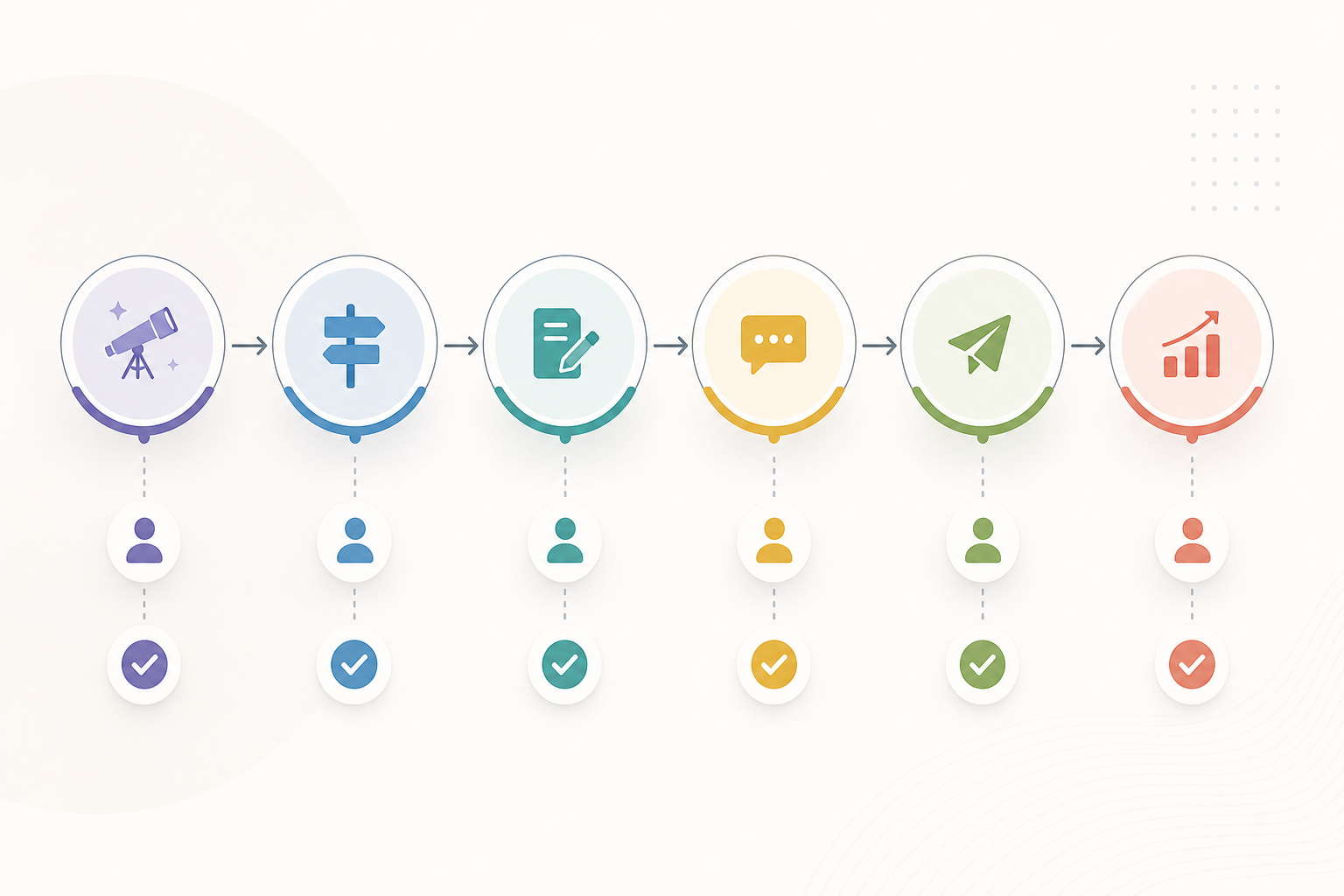
Use a six-stage pipeline
A visible pipeline turns content into a manageable production flow. Each stage needs a clear entry point and exit point.
| Stage | Enters when | Leaves when |
|---|---|---|
| Discover | A real customer question, search need, or business priority appears | The topic, reader, and intent are stated in one line |
| Decide | The topic is in a shortlist | A brief names the angle, keyword, owner, and success signal |
| Draft | The brief is approved | The full draft meets the brief and has sources and CTA placeholders |
| Review | The owner marks it ready for review | It is approved or has one clear list of required changes |
| Publish | Copy, metadata, and formatting are ready | The page is live and its URL is logged |
| Optimize | The page has had time to collect useful data | A decision is recorded: keep, update, expand, merge, or retire |
The point is not to create bureaucracy. It is to prevent hidden work. Every item should have one stage, one owner, and one next action.
Add three rituals that protect the system
A few recurring meetings are enough for most small teams.
Weekly check-in (20–30 minutes): Review the pipeline, identify blocked work, confirm the next publish date, and assign one next action per item. Do not turn this into a broad brainstorm.
Monthly calendar review (30–45 minutes): Choose the next few topics based on customer questions, business priorities, and recent performance. Keep some room for timely opportunities.
Quarterly direction review: Check whether your audience, offers, and priorities have changed. Remove themes that no longer support the business rather than allowing the backlog to grow forever.
Operating habits that make publishing predictable
Protect capacity with work-in-progress limits
A small team should plan according to available hours, not aspiration. If one high-quality article takes several focused hours plus review time, a weekly cadence may be too aggressive. Two strong posts per month may be the better operating choice.
Set the limit before the work begins. For example, allow no more than three pieces to be active at once. When a new priority arrives, decide what it replaces. This makes the cost of switching visible.
Set a review service level
Reviews are a common bottleneck because they are often treated as open-ended favors. Establish a normal response window, such as two business days. If feedback cannot arrive in that window, the owner should either publish with the approved standard or move the date visibly.
Use one canonical draft. Avoid parallel versions and feedback scattered across email, chat, and comments. Ask reviewers to flag factual errors, audience gaps, unclear reasoning, and brand risks—not simply rewrite phrases to match personal preference.
Brief for execution, not just inspiration
A good brief removes decisions before the draft stage. It should state the reader, the question they are trying to answer, the angle, the primary topic or keyword, proof or examples to include, the intended call to action, and relevant internal links.
Keyword research matters here because it helps distinguish what people are actually trying to find from what a business wants to say. Use a disciplined keyword research process for content creation before writing, rather than changing the target phrase halfway through the draft.
Choose a distribution lane before publishing
Publishing is not the end of the workflow. Decide where a useful piece will be shared and who will do it. For a small business, one reliable lane is enough to start: a newsletter, founder LinkedIn post, sales follow-up, or customer resource library.
Avoid creating five distribution tasks that nobody can maintain. Prove one channel, document the steps, then add another only when the workflow is stable.
Make performance data lead to action
Measurement should help the team decide what to do next. A dashboard that produces no action is only a report.

Review the right signals at the right time
Weekly, focus on signals you can influence quickly:
- Was the planned piece published?
- What is blocked in the pipeline?
- Are new pages being discovered and receiving impressions?
- Which distribution actions actually happened?
Monthly, look at outcomes that relate to the business goal: organic visits to key pages, search impressions and clicks, engagement with priority pages, and relevant conversions such as inquiries or email sign-ups. The exact measures depend on the business and the page’s purpose.
For a broader view of connecting search activity to commercial goals, see this guide to SEO for B2B companies.
Turn results into a simple triage decision
At the monthly review, classify each important page:
- Keep: It serves the right audience and continues to support its purpose.
- Upgrade: It has promise but needs a clearer title, stronger introduction, better examples, or a fuller answer.
- Merge: It overlaps with another page and would be more useful as one stronger resource.
- Retire: It is outdated, unhelpful, or creates confusion.
Schedule the decision as work. For example, put a review date on a new article several weeks after publication, then assign the upgrade or refresh if needed. This closes the loop between performance and the next calendar.
Common strategy frameworks, translated for content teams
Framework names vary, so do not treat any list of pillars or letters as a universal standard. Their value is in the operating questions they prompt.
What are the five pillars of content strategy?
A practical set is audience, positioning, topics, channels, and measurement. Each pillar should produce an execution rule.
For example, audience becomes a required brief field. Positioning guides the angle. Topics shape the backlog. Channels determine distribution. Measurement sets the review routine. If a pillar does not change a weekly decision, it is probably still a slide, not an operating tool.
What is the difference between strategy and execution?
Strategy is the set of choices about where to focus and what not to do. Execution is the system that delivers on those choices consistently.
When content strategy exists but execution fails, look first for missing ownership, unclear definition of done, too much active work, or unprotected time. These are more often the cause than a shortage of ideas.
What are the 5 C’s of strategy implementation?
One common version uses clarity, commitment, capability, communication, and control. For content, that can mean:
- Clarity: a brief with a defined reader and angle
- Commitment: a named owner and publish date
- Capability: enough time, skills, and tools for the planned cadence
- Communication: a short weekly check-in to surface blockers
- Control: a definition of done and a review of results
What are the four P’s of strategy execution?
A commonly used interpretation is people, processes, projects, and performance. In a content workflow, that means clear roles, documented handoffs, a visible pipeline, and regular decisions based on results.
The label matters less than the discipline: connect each strategic choice to a person, a process, and a measurable next action.
A practical starting point for founders
Start smaller than you think you need to. Choose one audience, one sustainable publishing rhythm, and one planning hub. Build a two-week pipeline before you add more tools or channels.
Content Redefined AI is designed to support that founder-focused structure: introduce the business clearly, set content direction, and maintain a consistent publishing schedule. It can serve as the connective layer between what the business wants to say and what the team is ready to publish.
For the next month, try this simple sequence:
- Write a one-paragraph direction statement.
- Select two to four topics tied to real buyer questions or business priorities.
- Assign an owner and due date to each piece.
- Use the same brief and definition-of-done checklist every time.
- Hold a short weekly check-in and a monthly performance review.
Once that rhythm is stable, you can expand output with confidence. If you want a structured planning method built for founders, explore Content Redefined AI’s monthly subscription approach and use it to turn direction into a publishing cadence you can keep.