
Why founders struggle with consistent publishing is usually not a mystery of motivation. Content competes with sales, hiring, product work, and customer issues, while the publishing process depends on too many last-minute decisions.
The problem is rarely a lack of ideas or ambition. It is usually a system problem: unclear content direction, scattered drafts, undefined review, and no fallback plan for busy weeks.
This guide helps you identify the breakdowns first, then build a lightweight process you can run with limited time. It is about business content such as blog posts, newsletters, and founder-led social posts—not traditional book publishing.
What consistent publishing means for a founder
Consistent does not mean posting every day. It means choosing a cadence that you can maintain, using a process that still works when the business gets busy, and publishing content with a clear purpose.
A practical cadence might be one article a month, one newsletter every two weeks, or two short social posts each week. The right frequency is the one you can protect for the next several months—not the most aggressive schedule you can manage for one week.
For each piece, decide three things before writing:
- Who is it for? Name a specific buyer, customer, or audience segment.
- What problem does it address? Focus on one question, obstacle, or decision.
- What should it do? Teach, clarify your point of view, address an objection, or support a sales conversation.
This audience-first approach matters. An Inc. article on founder brands makes a similar point: founder content needs to serve the audience rather than act as a personal broadcast.
Why founders struggle with consistent publishing
Most missed publishing dates trace back to a few repeatable failure points. Fixing them is more useful than trying to find more motivation.
Content direction is too broad
When every topic seems relevant, choosing one feels risky. Founders often respond by collecting ideas, researching more, and publishing nothing.
Set three to five content pillars instead. These are the recurring subjects where your business has a useful perspective. For example, a service business might cover:
- Common buyer mistakes before hiring help
- How its process works
- Trade-offs customers need to understand
- Lessons from recurring customer questions
Add boundaries too. You may decide not to cover news, broad industry trends, or topics that require research you cannot complete that week. A focused content strategy gives your calendar a filter for deciding what belongs.
Writing happens only in spare moments
Five-minute gaps are useful for collecting ideas. They are rarely enough to shape a coherent article or newsletter.
Use two separate modes:
- Capture mode: Save customer questions, voice notes, rough observations, and useful examples as they occur.
- Production mode: Use a protected block to select, outline, draft, and prepare one piece.
This separation is a practical answer to how to keep consistent content with limited time. You do not need a clear afternoon every day. You need a reliable place to store inputs and one recurring session to turn them into work.
Review has no owner or finish line
A draft can sit for weeks when “review” means different things to different people. One person wants to check tone, another wants new research, and the founder begins rewriting the opening.
Define who reviews what. In many founder-led teams, the founder should focus on:
- Accuracy of business details
- Strength of the point of view
- Sensitive claims or promises
An editor, marketer, or trusted teammate can handle structure, grammar, formatting, links, and publishing setup. Give founder review a short time limit. A 15-minute review of a clear draft is more likely to happen than an open-ended request for feedback.
Quality is based on a feeling
“Make it better” is not an editorial standard. It creates endless rewrites because no one knows when the work is good enough to publish.
Replace it with a minimum quality bar. Every piece should have:
- One clear point
- One useful example, process, or next action
- Claims that are accurate and supportable
- A clear next step for the reader
This protects quality without asking every article to become a definitive guide.
The founder is the only source of voice
A team may be able to draft, but publishing stops if only the founder can decide whether a piece sounds right.
Create a small voice bank instead. It can include approved phrases, opinions you return to, examples of posts that feel right, and topics you avoid. Record short voice notes after customer calls or meetings. These materials give a writer enough direction to draft without guessing.
Every post starts from a blank page
One-off creation drains time. If each post needs a new structure, new hook, new call to action, and new approval process, publishing becomes fragile.
Reusable formats reduce that friction. They also make it easier to batch outlines and keep a backlog ready for busy weeks.
A minimum viable publishing system
A lightweight editorial process for consistent publishing does not need a large team or a complicated tool stack. It needs visible stages, simple definitions of done, and one owner for each handoff.
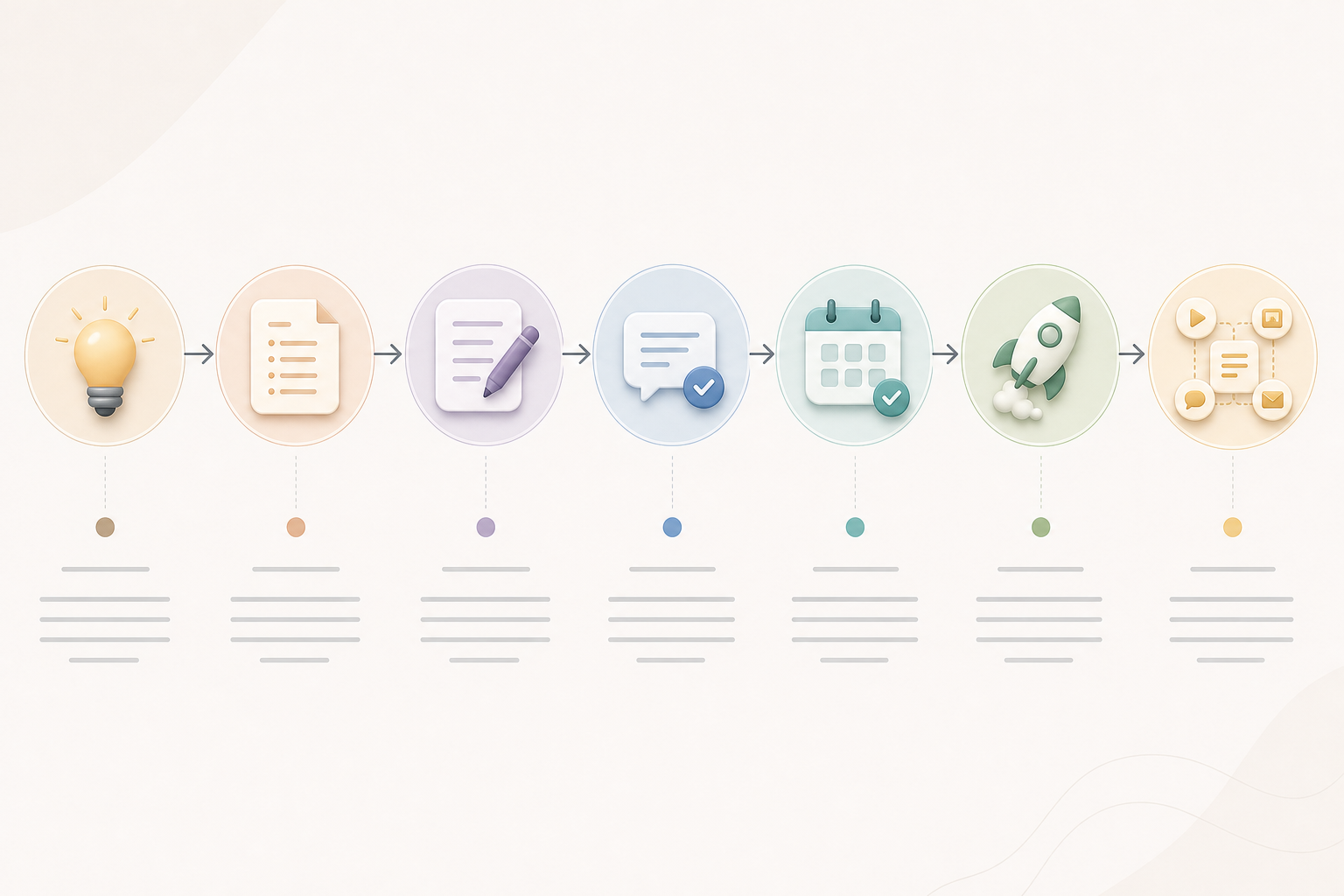
Use this workflow:
Idea → Outline → Draft → Review → Scheduled → Published → Repurposed
The stages matter because they show where work is stuck. A board, spreadsheet, or calendar can work as long as everyone uses the same status names.
Define “done” at every stage
| Stage | Definition of done | Typical owner |
|---|---|---|
| Idea | Working title, target reader, and one-sentence takeaway | Founder or team member |
| Outline | Hook, main sections, supporting bullets, and intended call to action | Writer or marketer |
| Draft | Complete draft with any uncertain facts flagged | Writer |
| Review | Accuracy and point of view approved; edits resolved | Founder and editor |
| Scheduled | Title, formatting, links, image brief, and publish date ready | Marketer or publisher |
| Published | Live page checked and distribution tasks assigned | Marketer or publisher |
Keep work in progress low. For example, do not allow ten pieces to sit in review. Finish or archive older drafts before starting more. This prevents a large backlog from creating the illusion of progress.
Set content rules before ideas arrive
Your workflow runs faster when it does not reopen strategic questions every week. Write down:
- Your primary audience
- Three to five content pillars
- The purpose of each channel
- Topics or claims that need founder approval
- Your default call to action
If your team needs a planning foundation, start with a content calendar that shows topics, owners, deadlines, and publishing dates in one place.
Keep the founder in the strategic lane
The founder should provide the inputs that cannot be delegated: firsthand judgment, product context, customer language, and a distinct point of view.
A simple handoff can work well:
- The founder records a two-minute voice note or sends five bullet points.
- The writer turns it into an outline or draft.
- The founder reviews only the point of view and factual accuracy.
- The editor prepares it for publication.
This protects the founder’s role without making the founder responsible for every comma.
Implementation steps for a consistent publishing schedule
The first goal is schedule stability, not maximum output. These implementation steps for a consistent publishing schedule can be completed over two weeks.

Days 1–2: Choose a defensible cadence
Pick the smallest schedule you can keep during a demanding month. Weekly is useful for some businesses; twice a month may be more realistic for others.
Write a miss rule as well: if you miss a date, do not double your output the following week. Publish the next planned piece and use the gap to improve the system. Catch-up pressure often turns one missed post into a longer pause.
Days 3–4: Create your idea bank
List 15 to 20 potential topics using real inputs:
- Questions from prospects and customers
- Objections heard on sales calls
- Decisions buyers struggle to make
- Product or service misconceptions
- Lessons from work your team repeats often
Rank ideas by usefulness and ease. A strong first topic is useful to a buyer and can be written from knowledge you already have. Avoid choosing a topic that requires a large research project when you are trying to establish a rhythm.
Days 5–7: Build three reusable templates
Use templates to eliminate blank-page friction. The next section includes formats you can adopt immediately.
For each template, write one example title from your idea bank. Then outline the first four pieces. An outline can be brief: a hook, three to five bullets, one example, and one next step.
Days 8–10: Run one focused production sprint
Reserve a two-hour session on the same day each week. Use a fixed agenda:
- 20 minutes: Choose and sharpen the topic
- 30 minutes: Build the outline
- 45 minutes: Draft without editing each sentence
- 15 minutes: Make the clarity and credibility pass
- 10 minutes: Assign review or schedule the piece
If two hours is not available, split the work into two one-hour blocks. The important part is preserving the sequence: choose, outline, draft, then edit.
Days 11–14: Schedule ahead and review the bottleneck
Aim to get one piece scheduled before its publish date. Then repeat until you have a small buffer. A four-week buffer is helpful, but do not create it through unsustainable extra work. Build it one scheduled piece at a time.
At the end of each cycle, ask:
- Where did the work stall?
- Which decision took too long?
- Was the topic too broad?
- Did review involve the right people?
Fix one constraint at a time. If introductions take too long, improve your hook template. If approval delays the process, set a review deadline. If ideas are weak, spend more time collecting customer questions.
Once the basic workflow works, automating a blog content calendar with AI can help reduce planning admin. Automation should support clear decisions, not replace them.
How to keep content quality consistent at speed
Speed should not mean publishing unsupported claims or generic advice. It should mean removing avoidable rework.
Draft and edit in separate modes
Drafting is for getting the thinking onto the page. Editing is for making decisions about what stays, what needs support, and what the reader needs next.
During the draft, write placeholders rather than stopping to solve every detail. For example: “[add customer question here]” or “[confirm product detail].” During the edit, resolve or remove those placeholders.
This is one of the simplest ways to keep content quality consistent at speed. It prevents a 45-minute writing block from becoming a 45-minute battle over one sentence.
Use a four-pass editing checklist
- Structure: Does the opening answer the reader’s problem? Do the headings follow a clear order? Remove repeated points.
- Clarity: Shorten long sentences, define internal terms, and make the next action easy to see.
- Credibility: Check names, numbers, product details, and any claim presented as fact. Cite a reliable source, reframe it as an opinion, or remove it.
- Conversion: Make sure the call to action fits the article. A reader who learned a planning method may be ready for a planning next step, not a hard sales pitch.
Use AI as drafting support, not as authority
AI can help with outlines, alternate headlines, draft structure, and repurposing. It cannot verify business facts, supply your experience, or decide what your company should claim.
Before publishing AI-assisted work, check every factual statement and add the context only your team can provide: your process, your constraints, your customer language, and your judgment. These best practices for publishing AI-generated blog posts offer further guidance on keeping the human review in place.
Reusable post templates for consistent content
Consistent content can create reusable post templates that make publishing more reliable. Start with three formats and use them often enough to learn which ones fit your audience.
Founder point of view
Use this when you have a clear belief or lesson to share.
- Hook: “Most people think , but we have found .”
- Context: Explain the problem or situation.
- Point of view: State what you believe and why.
- Example: Add a real, non-confidential example or a clearly labelled hypothetical scenario.
- Next step: Give the reader one action to try.
Diagnose and prescribe
Use this when a buyer has a recurring problem.
- Hook: “If you are seeing , the cause may not be .”
- Symptoms: Describe what the problem looks like.
- Causes: Name two or three likely causes.
- System fix: Give a simple sequence of actions.
- Next step: Suggest the first action for this week.
Practical playbook
Use this for a process your audience can follow.
- Outcome: State what the reader will be able to do.
- Steps: Give three to five steps in order.
- Common mistake: Explain what often goes wrong.
- Checklist: Summarize what to confirm before acting.
- Next step: Point to the relevant service, resource, or conversation.
Objection or FAQ post
Use this to support buyers who are comparing options or hesitating.
- Question: State the question in the customer’s words.
- Short answer: Answer directly in one or two sentences.
- Nuance: Explain the trade-off or condition.
- Decision guide: Explain when each option may fit.
- Next step: Give a low-friction action.
Keep a template library where your team works. Save examples of finished posts beside the templates, not only instructions. Examples make voice and quality easier to reproduce.
A note on book-publishing questions
Searches about “publishing” often mix founder content publishing with traditional book publishing. They are different jobs with different costs and constraints.
How much does it cost to start a publishing company?
There is no responsible single number. Costs depend on the publishing model, rights, editing, design, printing, distribution, marketing, and the scale of the operation. Starting a book-publishing company is an operations-heavy business decision. It is not the same as creating a content system for your existing business.
What author was rejected 23 times?
This claim appears in many retellings, but the supplied sources do not establish a reliable answer. Avoid using a rejection count as a business benchmark. For founders, the more useful lesson is to build a publishing process you control rather than waiting for perfect conditions.
Is selling 3,000 copies of a book good?
It depends on the book’s niche, price, costs, author goals, and broader business model. Unit sales alone do not tell you whether a book succeeded. The founder-content version of this question is: did the piece help the right reader take a meaningful next step?
How hard is it to traditionally publish a book?
Traditional publishing can be difficult because publishers and agents make selective choices about fit, audience, and commercial potential. Founder publishing has a different challenge: you own the channel, so the constraint is building a process that produces useful work on a repeatable schedule.
Make consistency easier than inconsistency
The goal is not to turn every founder into a full-time writer. It is to make useful publishing routine enough that it continues through normal business pressure.
Start with one realistic cadence, three content pillars, a visible workflow, and a few templates. Then improve the one bottleneck that slows each cycle.
Content Redefined AI offers founders a structured approach to introducing their business, directing their content, and maintaining a publishing schedule. If your team has ideas but lacks a repeatable planning process, consider using a structured monthly workflow to turn those ideas into a calendar you can actually keep.