
An audience engagement loop for consistent content ideas turns questions people already ask into a ranked list of topics. For founders, it is a practical way to avoid starting from a blank page each week: collect signals, shape them into useful topics, publish, learn, and repeat.
The goal is not to chase every comment or post more often. It is to find questions tied to real audience needs, answer them clearly, and use the response to decide what to create next.
What is an audience engagement loop?
An audience engagement loop is a repeatable process for using audience feedback to guide content decisions:
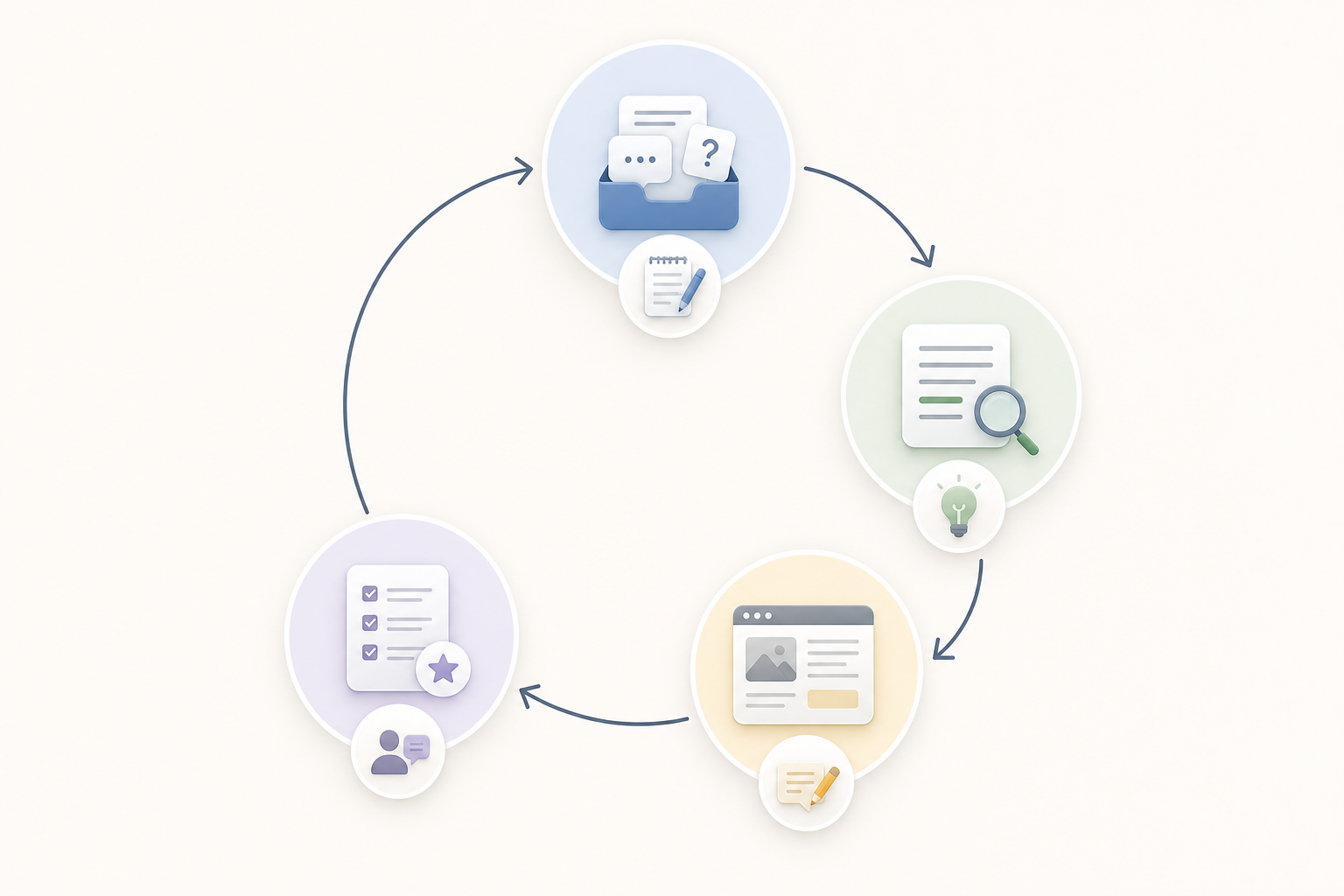
- Collect questions, objections, and repeated points of confusion.
- Translate them into clear, useful topics.
- Publish an answer with a relevant prompt for feedback.
- Review the response and add new signals to the backlog.
A content calendar tells you when to publish. Keyword research can show how people search. An engagement loop helps you decide what deserves to be published based on the words and problems your audience has already shared.
For a founder, this matters because content time is limited. A topic raised in a sales call, onboarding email, or support thread often has more business context than a trend found during a quick scroll.
If publishing tends to stop when the week gets busy, start with the lightweight habits in Why Founders Struggle With Consistent Publishing. The loop works best when it is small enough to run every week.
Why audience engagement is inconsistent across posts
When audience engagement is inconsistent across posts, the issue is often not writing quality alone. Posts may speak to different readers, different stages of awareness, or problems that do not feel urgent enough to prompt a response.
Other common causes include:
- Choosing topics from internal assumptions rather than customer language.
- Changing the format, audience, and message all at once.
- Publishing without a clear question or next step for the reader.
- Treating likes or reach as the only useful signal.
- Failing to turn comments, objections, and replies into follow-up content.
A quiet post is not always a bad post. Distribution, timing, and platform behavior also affect results. Still, repeated questions, thoughtful replies, saves, email responses, and sales conversations can show whether a topic is useful to the right people.
Before building the loop, be clear about who you want to hear from and what they are trying to do. Understanding Your Audience for Content Marketing can help you define those needs before you sort and score signals.
Where to collect audience questions
Start with two sources you already use. Adding every channel at once creates more admin work, not better insight. Capture the person’s exact words when you can; your summary can come later.
Prioritize high-intent sources first
These sources are often closest to a buying decision, product use, or renewal. They can reveal objections and practical barriers that deserve a detailed answer.
- Sales and discovery call notes
- Demo questions
- Support tickets and live-chat transcripts
- Onboarding emails and implementation calls
- Proposal feedback and common objections
- Cancellation or renewal feedback
- Replies to customer success check-ins
Listen for phrases such as “How do I know if…?”, “We tried this but…”, “Can you explain…?”, and “What happens when…?” These can be strong raw material for comparison pages, FAQs, checklists, and how-to posts.
Add awareness-stage sources
Broader channels can show the words people use before they are ready to buy. They are useful, but they may need more filtering.
- Newsletter replies
- Social comments, direct messages, and polls
- Webinar Q&A
- Community discussions
- Blog comments and feedback forms
- Site-search queries
- Search Console queries for existing pages
Use competitor reviews and public discussions for language research, not for copying another business’s content. Your published advice should reflect your own expertise, offer, and audience context.
Use a simple signal log
A spreadsheet, note, or workspace page is enough. Create one row for each signal and record:
| Field | What to capture |
|---|---|
| Exact question or quote | The audience member’s wording |
| Source | Sales call, support, newsletter, social, or another channel |
| Audience segment | Role, business type, or customer stage when known |
| Signal type | Pain, goal, objection, comparison, or story |
| Frequency | One-off, recurring, or repeated often |
| Content opportunity | Possible answer, format, or follow-up |
A 15-minute weekly capture session is enough to begin. If content planning feels hard to maintain, Why Content Planning Feels Overwhelming as a Founder offers a practical way to reduce the moving parts.
How to turn questions into publishable topics
A raw question is not always a finished headline. It may be vague, product-specific, or too broad for one post. Your job is to keep the intent while making the outcome clear.
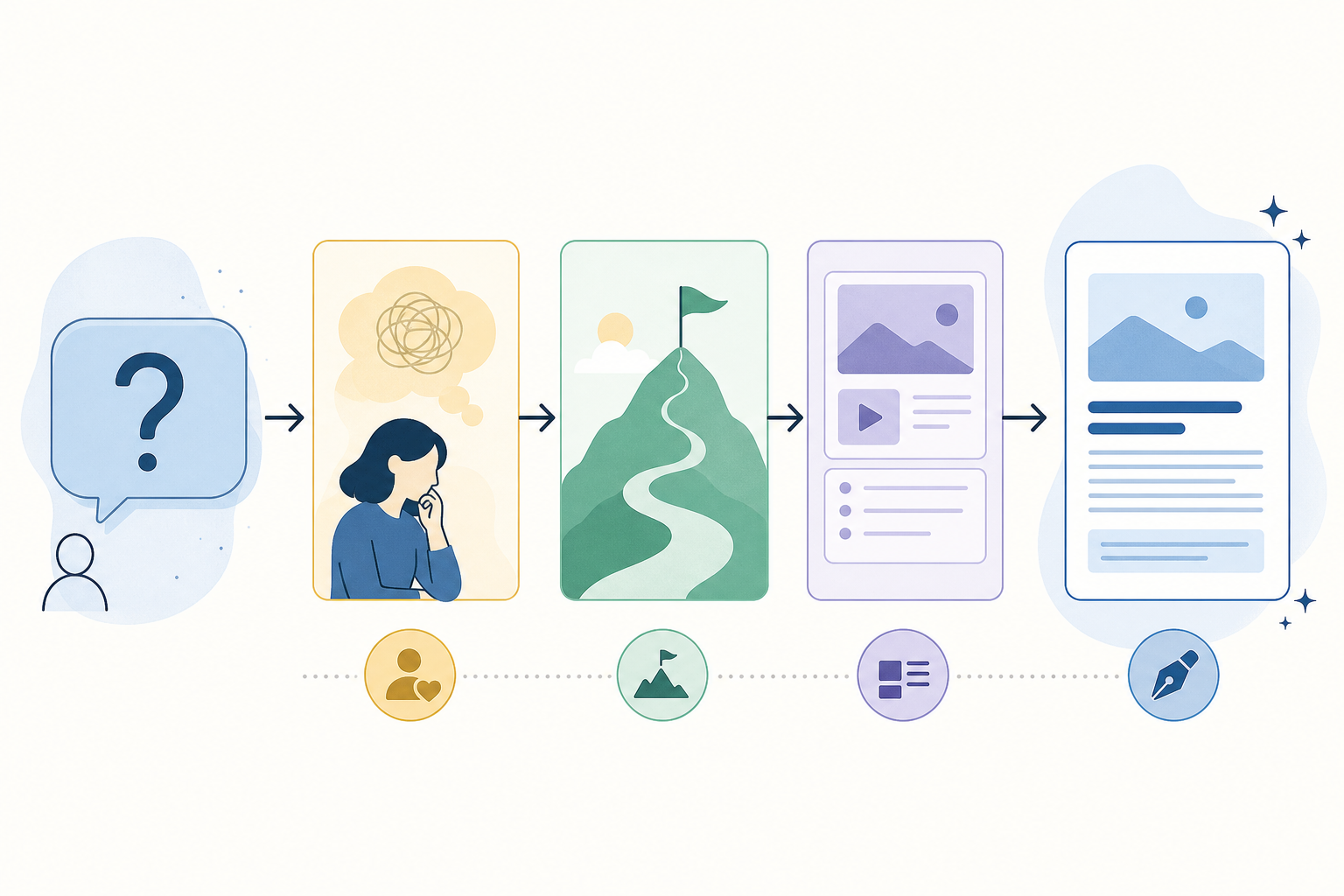
Use this translation method:
Raw question → reader problem → useful outcome → format → working title
For example:
> “How do we keep coming up with ideas?”
- Reader problem: The team relies on ad hoc brainstorming.
- Useful outcome: A repeatable way to create a topic backlog.
- Format: Step-by-step workflow.
- Working title: “How to build a content idea backlog from customer questions.”
Classify the intent before you draft
Choose one main intent for each topic. This keeps the page focused.
- Informational: Explain what something is or how to do it.
- Comparison: Help readers weigh options, methods, or tools.
- Decision: Help readers choose a next step with criteria and trade-offs.
- Troubleshooting: Solve a clear problem or common mistake.
If someone asks, “Should we publish weekly or monthly?”, they need trade-offs and a decision guide. If they ask, “What is a content backlog?”, a direct explanation may be enough. Do not try to answer every related question in one short post.
Create several angles from one good question
One strong signal can support more than one asset without repeating the same message.
| Audience question | Long-form content | Email or newsletter | Short-form post |
|---|---|---|---|
| “What should we post about?” | A guide to building a question-led topic backlog | One question to ask sales this week | A three-step topic translation example |
| “Why do our posts get no replies?” | A guide to clearer engagement prompts | Three prompts to test | Before-and-after CTA examples |
| “How often should we publish?” | A sustainable publishing cadence framework | A minimum viable cadence checklist | A founder’s weekly content routine |
The long-form piece should be the clearest, most complete answer. Shorter pieces can invite a reply, point to the guide, or test which framing earns the strongest response.
Score topics before they enter the calendar
Use a simple score rather than a complex formula. Give each idea a high, medium, or low rating for:
- Frequency: Have you heard this more than once?
- Business relevance: Does it connect to a meaningful problem, objection, or outcome?
- Authority: Can you explain it accurately and usefully?
- Specificity: Can the reader leave with a clear next step?
- Longevity: Will the topic still be useful after this week?
A topic does not need to score high on every factor. A one-time question from an ideal customer may still deserve an answer. The point is to make choices on purpose rather than publish the first idea that appears.
A weekly audience engagement workflow for founder content
This audience engagement workflow for founder content can fit into 30 to 60 minutes a week. Adjust the days to your schedule; the sequence matters more than the calendar.
1. Collect signals: 10–15 minutes
Review two sources, such as sales notes and newsletter replies. Add useful phrases to the signal log. Do not try to write titles yet.
Capture details that change the answer: company size, stage, budget limit, goal, or the approach they already tried.
2. Rank the backlog: 10 minutes
Select one main topic and one possible follow-up. Use the scoring questions above. Mark ideas with a status such as:
Captured → Validated → Outlined → Drafted → Scheduled → Published → Reviewed
Simple statuses keep the backlog from becoming a graveyard of half-formed ideas.
3. Draft one useful answer: 15–25 minutes
Start with the answer, not a long introduction. Give the reader a process, example, checklist, or decision rule. Then add one prompt that fits the topic, such as:
- “Which part of this process is hardest for your team?”
- “What question do prospects ask before they buy?”
- “What have you already tried?”
A prompt should invite a useful response, not demand engagement for its own sake.
4. Review and respond: 10 minutes
At the end of the week, record what happened. Look beyond surface-level reach. Did the post create replies? Did someone ask a more specific question? Did it help a sales conversation, onboarding moment, or customer education effort?
Reply where it makes sense, then capture new questions. That final step closes the loop.
When the strategy is clear but posts still do not get finished, Why Content Strategy Exists but Execution Fails can help you find where the workflow is breaking down.
Use a monthly review to make the loop stronger
A weekly loop produces raw material. A monthly review helps you spot patterns and remove weak ideas before they take up calendar space.
Review your published content and backlog for:
- Questions that appeared in more than one channel
- Topics that triggered useful replies or follow-up questions
- Pages with strong impressions but weak clicks, which may need a clearer title or promise
- Posts readers misunderstood or left quickly
- Older guides that need a current example, clearer explanation, or a new FAQ
For each published piece, note the audience segment, theme, format, reader question, and next follow-up angle. Tags such as pricing, onboarding, hiring, planning, or comparison make it easier to find gaps and avoid accidental repetition.
Plain language helps. State the main point early, define unfamiliar terms, and use headings that explain what follows. Digital.gov also recommends tailoring content to audience needs, using a conversational tone, avoiding needless complexity, and testing content with users (An introduction to content | Digital.gov).
Once your ideas are ranked, they can move into a calendar without losing context. For help linking a backlog to publishing dates, see How to Automate Your Blog Content Calendar Using AI.
Practical frameworks: use them as guides, not rules
What are the 5 C’s of content creation?
There is no single universal version of the “5 C’s.” A useful founder-friendly set is Clarity, Customer, Context, Consistency, and Conversion.
- Clarity: Make one clear promise.
- Customer: Base the topic on a real audience need.
- Context: Explain when the advice applies and when it may not.
- Consistency: Use a cadence you can sustain.
- Conversion: Offer an appropriate next step, such as a reply, resource, or conversation.
Use these as an editing checklist, not as a replacement for listening to your audience.
What is the 70/20/10 rule in content marketing?
The 70/20/10 split is a common planning guide, not a fixed standard. A practical version is:
- 70%: Proven themes your audience returns to
- 20%: Variations on those themes, such as a new format or audience segment
- 10%: New or more experimental ideas
Your engagement loop helps define “proven.” Repeated questions and qualified conversations are stronger evidence than an assumption that a topic should perform.
What should you track?
Track signals that show usefulness and learning, including:
- Number of recurring questions captured
- Number of validated topics in the backlog
- Replies, comments, and email responses that add context
- Saves, bookmarks, or shares where those metrics are available
- Follow-up questions created by a published piece
- Qualified conversations or product questions influenced by the content
Do not expect every metric to rise at once. Look for a steadier flow of audience language, sharper topic choices, and a backlog that is easier to maintain.
Start the loop this week
Choose two signal sources. Capture ten questions or objections. Rank the best three. Publish one answer that solves a specific problem, then ask one relevant follow-up question.
Repeat that process for four weeks before adding more channels or formats. You will get a clearer view of the themes your audience returns to and a practical base for an audience engagement loop for consistent content ideas.
Content Redefined AI is built to help founders introduce their business clearly, direct their content, and maintain a consistent publishing schedule. If you want a more structured way to organize ideas and turn them into a monthly plan, explore a monthly subscription when you are ready.