
An audience engagement workflow for founder content turns everyday feedback into a practical publishing plan. Instead of guessing what to post after a quiet week, capture the questions, objections, replies, and clicks that reveal what your audience needs next.
For founders, the goal is not to maximise likes. It is to learn which messages build trust, clarify your offer, and start useful business conversations. This workflow helps you collect those signals, choose what matters, and turn them into consistent posts.
Why audience engagement is inconsistent across posts
A strong post can still receive little visible engagement. Timing, distribution, audience fit, format, and message clarity all affect the response. A useful post will not necessarily produce the same reaction every time.
The bigger problem is treating every signal as equal. Views tell you that people may have seen a post. A detailed reply, a question about your service, or a relevant click can tell you more about what they need next.
Audience engagement includes active actions people take after seeing content, including comments, clicks, and shares. Salesforce’s overview of audience engagement offers a useful starting definition.
Before changing your calendar, diagnose the likely weak point:
- The message is unclear. Readers cannot quickly tell who the post is for or why it matters.
- The topic misses a live need. You are sharing updates while readers need help making a decision.
- The format does not fit the question. A nuanced choice may need a guide rather than a short social post.
- Distribution stops at publish. You post but do not respond, follow up, or share through an appropriate owned channel.
- Feedback disappears. Questions from calls, emails, and comments never reach the next content plan.
If your audience is still broad or unclear, first define the problems, language, and decisions that matter to them. Start with this guide to understanding your audience for content marketing.
Track signals that reveal trust and intent
You do not need a large dashboard. Use a short scorecard that helps you decide what to write next.
| Signal type | What it can indicate | Examples |
|---|---|---|
| Attention | Whether people noticed or consumed the content | Reach, impressions, time on page |
| Resonance | Whether the idea felt useful enough to retain or pass on | Saves, shares, thoughtful comments |
| Intent | Whether the post prompted a next step | Replies, profile visits, relevant link clicks |
| Buying friction | What a prospective customer needs explained | Pricing questions, objections, comparison requests |
For many B2B founders, intent and buying friction deserve the closest reading. A question such as, “How would this work for a team like ours?” is more useful for planning than a generic compliment. It identifies a topic, a segment, and often an explanation your content has not yet made clearly enough.
Use a small weekly scorecard
Keep five to seven measures at most:
- Meaningful comments and direct replies
- Saves or shares, where available
- Clicks to one or two important pages
- Qualified questions from email, calls, or demos
- Repeated objections or points of confusion
- A short note using the audience’s own wording
The qualitative note matters. Numbers show that something happened; a real question tells you what to answer. Remove names, private details, and sensitive commercial information before recording feedback.
Do not judge a post on one metric alone. A low-reach post that surfaces two precise sales questions may be more useful than a broadly seen post that earns passive reactions.
Build an Engagement Inbox
An Engagement Inbox is one place to collect useful feedback. It can be a spreadsheet, notes database, or another simple tool your team already uses. The tool matters less than the habit: capture signals before they vanish across calls, inboxes, and social platforms.
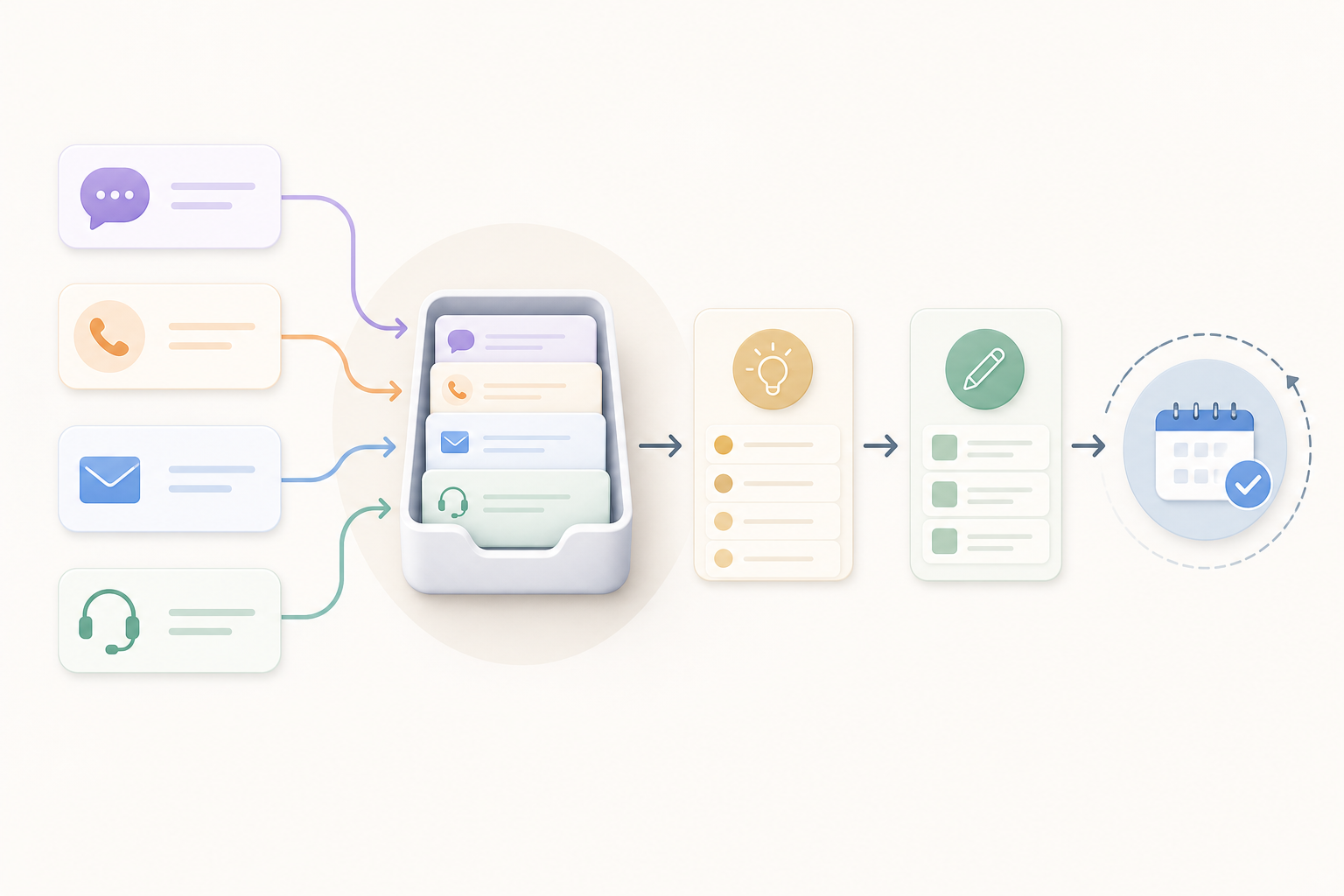
Create one entry for each useful signal:
- Source: Comment, email, sales call, support conversation, newsletter reply, or site behaviour.
- Audience segment: The role, business type, or stage involved.
- Theme: A content pillar such as pricing, implementation, capacity, risk, or results.
- Exact question or objection: Preserve the audience’s wording where possible.
- Intent: Learn, evaluate, solve, compare, or validate.
- Potential next action: A post, FAQ, product explanation, sales note, or follow-up conversation.
For example: “A 20-person agency owner asked whether content planning requires a full-time marketer.” The theme is capacity; the intent is evaluation. A useful next post could explain a lean planning process, its trade-offs, and who should not use it.
That is far more actionable than a vague note to “write about planning.” It gives you a real need, a specific reader, and a workable angle.
Set aside 15 minutes once or twice a week to review call notes, sales emails, comments, support messages, and newsletter replies. Capture only signals that could lead to a clearer business or content decision.
If content planning feels overwhelming, the issue is often not a lack of ideas but a lack of a reliable way to sort them. Why content planning feels overwhelming as a founder explores that challenge in more detail.
Turn feedback into next posts
The audience engagement loop for consistent content ideas is straightforward: collect feedback, group it, decide what it means, publish an answer, then capture the response to that answer.
1. Cluster similar feedback
Group entries by the question beneath the question. “Is this expensive?”, “Can we start small?”, and “Do we need a specialist?” may all point to perceived risk. A pattern is usually more useful than an isolated idea.
2. Identify the reader’s intent
Choose one primary intent for the cluster:
- Learn: They need a plain-language explanation.
- Evaluate: They are weighing options, cost, or fit.
- Solve: They need a process, checklist, or example.
- Validate: They want reassurance that their concern is normal or their approach is sound.
Intent helps determine format. A learning question may become a short explainer; an evaluation question may need a decision guide that includes trade-offs.
3. Choose the smallest useful format
Match the format to the depth of the question:
- Repeated basic question: FAQ or short post
- Common objection: myth-versus-reality explanation
- Complex choice: comparison or decision guide
- Recurring process problem: checklist or step-by-step article
- Useful founder lesson: story with a clear takeaway
4. Write a clear promise and honest angle
Start with the reader’s problem, not your company update. Add your point of view, an example you can support, and the limits of the advice.
For example: “A weekly content plan can be enough when your team has one clear audience, two reliable channels, and someone who owns review. It is not enough when no one owns the work.” That gives a decision rule, not a slogan.
5. Publish, respond, and recapture
End with one specific invitation, such as: “Which part of planning creates the most drag for your team?” Save useful replies back to the Engagement Inbox. Your next post should come from what readers ask after your answer, not from a blank brainstorm.
A founder story can also become several useful angles when it addresses real audience questions. See how to turn a founder story into a content series.
Six feedback-to-post templates
Use these transformations to move from raw feedback to a publishable idea:
- Question to FAQ: “Do we need to post every day?” becomes “What a sustainable publishing cadence looks like for a small team.”
- Objection to explanation: “AI-written content sounds generic” becomes “Why generic content happens, and what a founder still needs to decide.”
- Confusion to guide: “What is a content pillar?” becomes “How to choose three themes your business can credibly discuss.”
- Comparison request to decision guide: “Should we hire a writer or use a planning tool?” becomes “How to choose based on time, budget, review capacity, and risk.”
- Repeated mistake to checklist: “We keep missing publishing dates” becomes “The checks that keep a content plan from slipping.”
- Request for proof to process breakdown: “How do you decide what to write?” becomes “The signals to review before choosing next month’s topics.”
Run a weekly engagement retro
A weekly retro prevents engagement work from becoming a daily distraction. Block 30 minutes at the end of the week and review patterns, not just the loudest post.

- Review posts that led to useful replies, relevant clicks, shares, or qualified questions.
- Read the language people used to describe their problem, hesitation, or goal.
- Check which themes attracted the people you want to help—and which attracted the wrong audience.
- Choose three actions: one idea to repeat, one to improve, and one small test.
- Add the selected topic, format, distribution step, and call to action to next week’s plan.
If plans exist but publishing and follow-up keep slipping, the constraint may be execution rather than strategy. Read why content strategy exists but execution fails.
Use simple decisions after the retro:
- Double down when a topic repeatedly earns useful questions or buyer-fit conversations. Explore a new angle rather than repeating the same post.
- Iterate when the topic matters but the opening, example, or call to action was unclear.
- Retire when a theme repeatedly attracts the wrong audience, creates confusion, or does not support the position you want to own.
Common social engagement rules—and their limits
Rules such as 5-5-5, 3-3-3, and 5:3:2 are informal frameworks, not universal standards. Their meanings vary by creator and channel. Use them as prompts for a repeatable habit, not as proof that a particular mix will work.
The 5-5-5 engagement habit
A common version is five thoughtful comments, five genuine replies, and five relevant conversations within a chosen period. Adapt the volume to your capacity. Quality matters more than the count: reference a specific idea, add a useful perspective, or ask a real question.
The 3-3-3 content balance
Some creators use 3-3-3 to plan three educational posts, three trust-building posts, and three conversion-oriented posts. It can reveal when your content leans too heavily on one kind of message. Let the Engagement Inbox supply the topics.
The 5:3:2 content mix
A common interpretation is five value-led posts, three community or relationship posts, and two promotional posts. The exact ratio is less important than the balance. If readers understand your advice but not your offer, explain the offer more clearly. If every post sells, add more useful answers from real questions.
Start this week
Set up one Engagement Inbox. Capture five useful signals from the past seven days. Group them into themes, choose one question with clear trust or buyer relevance, and create the smallest post that answers it well.
Then schedule a 30-minute retro for next week. Content Redefined AI provides founders with a structured approach to content planning, direction, and publishing consistency; your audience feedback gives that plan a stronger foundation.
That is the audience engagement workflow for founder content: listen closely, make one clear response, and let that response improve the next decision.