
A content planning system for founder with no team should reduce work, not create another job. You need a plan that tells you what to write next, fits around real business demands, and still works when a customer issue or product deadline takes over.
Start with a 30-day loop: define a temporary focus, build a short queue, choose a cadence you can sustain, and review it each week. Keep one active piece at a time. When the week gets busy, reduce the scope rather than abandoning the system.
The real job of content planning: reduce decisions
A content calendar is a list of dates. A content system is a set of decisions you make before writing time begins.
That difference matters when you are the founder, strategist, writer, editor, and final approver. “Publish on Tuesday” does not tell you what to publish, why it matters to the business, or what to do when Tuesday disappears under urgent work.
A useful founder system does three things:
- Sets constraints. You know who you are trying to help, which problems you cover, and what business goal the content supports.
- Keeps a small queue ready. You do not have to invent a new plan every week.
- Includes a recovery path. A busy week changes the size of the work; it does not erase the plan.
Use a simple default rotation when you need direction:
> Problem → practical method → objection → founder perspective → offer connection
This is not a rigid publishing formula. It is a way to avoid starting from zero every time you sit down to write.
Why content planning feels overwhelming as a founder
The problem is rarely a lack of ideas. The problem is that each piece starts with too many open questions:
- Who is this for?
- What should I say?
- Should this be a blog post, email, or social update?
- Is this topic worth the effort?
- What should happen after I publish it?
When every answer is undecided, planning becomes another form of procrastination. A workable system answers most of these questions in advance.
For a closer look at the causes of planning fatigue, read why content planning feels overwhelming as a founder.
Give every topic one job
Random posting can feel productive, but disconnected topics make readers work to understand what you believe, who you help, and why your offer matters.
Give each planned piece one clear role:
| Content role | Reader need | Example topic |
|---|---|---|
| Education | Understand a problem | What to fix before building a content calendar |
| Evaluation | Compare approaches | A spreadsheet versus a planning tool for a solo founder |
| Trust | Understand your method | Why review should happen before publishing |
| Conversion | Decide on a next step | What a structured monthly content plan includes |
You do not need every role every week. The goal is to know why a topic belongs in the queue.
Why content planning systems fail
If your content planning system never sticks, do not assume you need more discipline. Most systems fail because they were designed for an imaginary week: clear mornings, stable priorities, plenty of energy, and no urgent work.
Common founder-focused content planning mistakes include:
- Overbuilding the workflow. Too many tags, views, and templates turn planning into a second job.
- Planning too far ahead. A six-month calendar creates false certainty while priorities and customer language change.
- Treating every idea as equal. An unranked backlog creates choice paralysis.
- Using motivation as the process. Inspiration helps, but it is not a dependable workflow.
- Choosing an unsustainable cadence. One missed week can feel like failure when the plan was too ambitious from the start.
- Starting a fresh draft whenever a better idea appears. This creates draft sprawl instead of published work.
The fix is smaller than most founders expect: choose a minimum viable cadence and make the next decision obvious.
If topic choice is taking too much time, start with a question your best-fit buyer asks before they take the next step. How founders waste time choosing content topics offers a practical way to narrow the field.
The Founder-Only 30-Day Loop
A content planning system for founder with no team works best as a rolling 30-day loop:
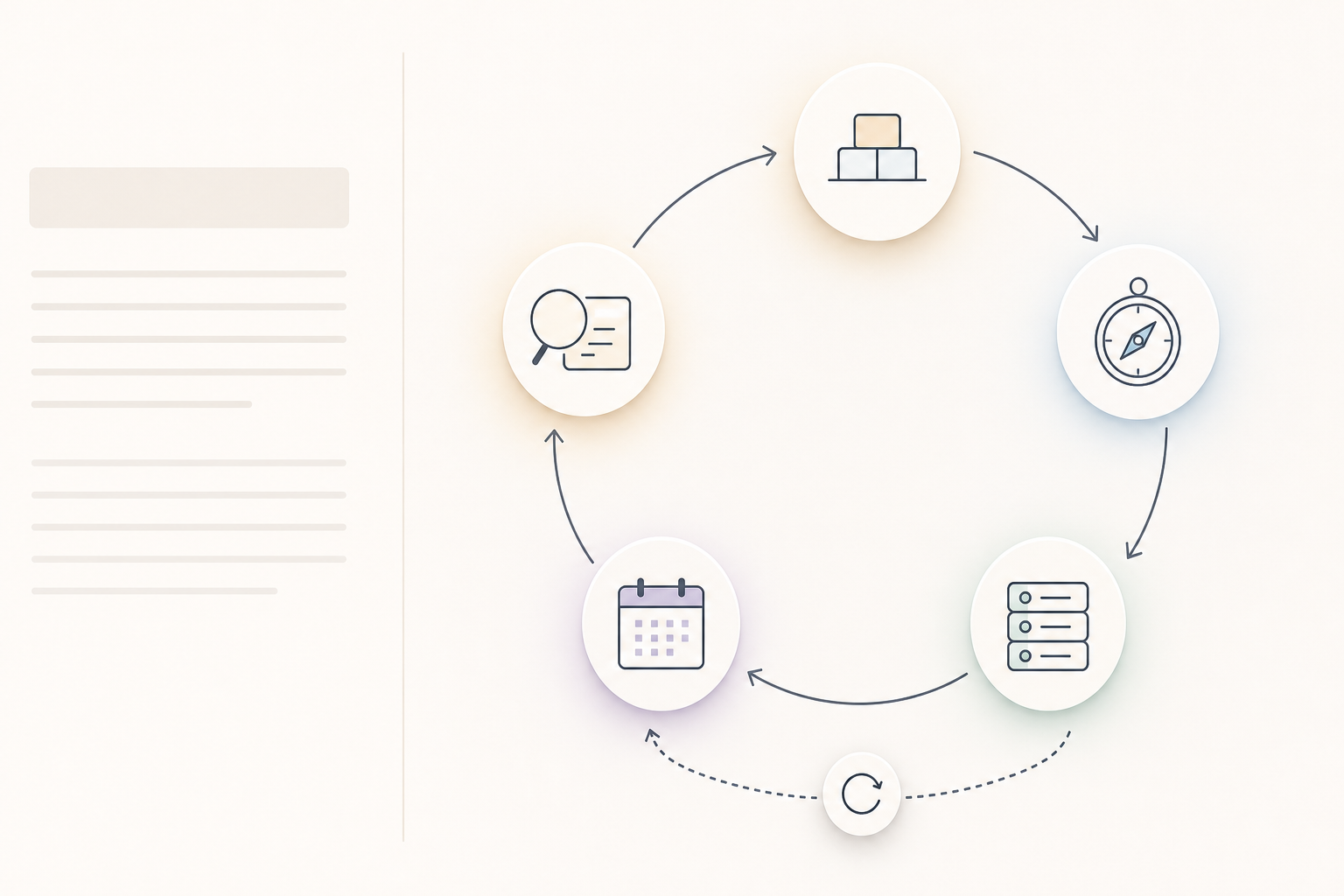
> Foundation → direction → queue → cadence → review
A month is long enough to establish a rhythm and short enough to adapt when the business changes. Founder planning guidance often makes the same distinction: the system should fit limited weekly capacity, rather than copy a large team’s editorial operation. Averi’s startup content-planning guide frames content planning around that practical constraint.
1. Create a foundation snapshot
At the start of the month, set aside 30 minutes to answer five questions:
- Who are we trying to help right now?
- What problem are they actively trying to solve?
- What outcome can we credibly help them pursue?
- What is our approach or point of view?
- What business action matters this month?
Your action might be a sales conversation, newsletter sign-up, trial start, qualified inquiry, or clearer positioning feedback. Choose one primary action so your calls to action do not compete.
Use a positioning statement as a filter, not a slogan:
> We help [specific audience] achieve [outcome] through [method], so they can [business result] without [common pain].
For example:
> We help independent HR consultants explain complex services through clear educational content, so prospective clients can understand the value before a sales call.
If these questions are hard to answer, solve that issue before forcing a calendar. Business discovery questions founders avoid answering can help identify the inputs your plan needs.
2. Choose three to five content lanes
Content lanes are recurring themes, not one-off headlines. They give your audience useful repetition without making every piece sound the same.
For a service business, your lanes might include:
- Mistakes buyers make before seeking help
- How your service or process works
- Questions and objections that delay a decision
- Founder lessons and informed opinions about the category
- Practical checklists and decision frameworks
Write one sentence for each lane that states your angle. For example:
- “Many best-practice lists fail because they ignore the time a small business actually has.”
- “A useful content plan starts with business context, not trending topics.”
- “Consistency does not require publishing every day.”
These statements make the lanes easier to use when it is time to write.
3. Build a prioritized queue
Create eight to twelve possible pieces for the month. This gives you room to adapt without creating an intimidating backlog.
Each item needs only five fields:
- Working title
- Intended reader
- Question or problem it addresses
- Content role
- Next step or call to action
| Working title | Reader question | Role | Next step |
|---|---|---|---|
| How to plan content when you have one hour a week | Where do I begin? | Education | Save the 30-day loop |
| Why your content calendar fails after two weeks | Why can’t I keep up? | Trust | Review your workflow |
| What to prepare before using an AI content tool | What still needs my input? | Evaluation | Explore a structured planning approach |
| How one founder story becomes a month of content | What can I write about? | Education | Develop a short series |
Prioritize by likely business value and ease of execution. A timely answer to a common buyer objection is often more useful than an ambitious topic that needs ten hours of research.
4. Set a cadence that survives reality
Base your cadence on the hardest normal month, not your most productive week.
| Available time | Sustainable starting cadence | Suggested use |
|---|---|---|
| 30 minutes a week | One substantial post a month and one short weekly reuse | Maintain visibility with limited writing time |
| 60 minutes a week | Two posts a month | Build a reliable rhythm without weekly pressure |
| 90 minutes a week | One post a week | Test more topics and build a stronger habit |
These are planning examples, not rules. Choose the smallest cadence you can maintain during a difficult month. You can increase it later when the process is genuinely working.
5. Review before adding more work
At the end of each week, spend 15 minutes asking:
- What shipped?
- What blocked the planned piece?
- What customer question or objection should enter the idea bank?
- What is the one item in “Now” next week?
At month-end, spend 60 minutes deciding what to keep, stop, and test. A system becomes sustainable when the review changes the next plan.
Plan content before your niche is fully clear
Content planning without a niche feels scattered when you start with topics before deciding who the content is for and what it should accomplish.
You do not need perfect positioning before you publish. You do need a temporary focus.
Choose one audience-and-problem slice for the next 30 days. For example:
- Local service businesses that need a clearer estimate follow-up process
- HR consultants trying to explain a complex offer
- B2B founders who need a simpler way to choose content topics
For that month, publish only content that helps this group solve this problem set. Then review:
- Which topics were easiest to explain with real expertise?
- Which pieces led to useful replies, conversations, or qualified interest?
- Which audience language felt most specific and commercially relevant?
You may keep the focus, tighten it, or deliberately test another one. The point is to learn through a constrained experiment, not to change your audience halfway through every draft.
Keep the queue moving with Now, Next, and Later
A three-bucket queue is enough for most founders:
- Now: One active item for this week.
- Next: Two to four pieces ready to begin after it.
- Later: Ideas worth capturing but not committing to yet.
If “Now” is empty, you have an idea list, not an operating system.
Give every active item a one-sentence promise, such as:
> This post will help a founder choose one audience focus for the next 30 days instead of writing to everyone at once.
That promise becomes the test for your outline. If a section does not help deliver it, remove it or save it for another piece.
Prevent draft sprawl
Use three rules:
- Keep one active draft. New ideas go in Later, not into another half-written document.
- Capture ideas as bullets. Record the headline, audience, and point you want to make.
- Define “ready for review.” A draft is ready when it has a clear title, direct opening, coherent structure, accurate claims, and an appropriate next step.
A planning or drafting tool can organize context and prepare work, but you should still check the message, factual claims, links, and final publishing decision. If you have a strategy but struggle to finish, why content strategy exists but execution fails explores that gap.
Use a busy-week protocol
Busy weeks are not proof that your plan failed. They are the reason you need one.

Decide in advance how you will reduce the work when capacity disappears.
Choose a fallback option
Publish a smaller maintenance piece. Answer one specific question you heard from a prospect or customer.
Reuse a strong section. Take a checklist, example, or argument from an older article. Add a current introduction and publish it as a short update.
Write a short Q&A. Use a recurring buyer question, give your answer, explain the trade-off, and offer one next step.
Move the date without rebuilding the plan. If nothing can ship, move the Now item forward and preserve the queue. A missed date is not a reason to start over.
Good-enough consistency means keeping a clear path back into the work, not publishing at any cost.
Choose the smallest useful tool stack
The best planner for content creators is not universal. The right tool reduces startup effort: it helps you capture an idea, find the next item, and move it toward review.
Before adding a tool, ask:
- Can I capture an idea in under a minute?
- Can I see the next item without opening several views?
- Can I store the brief or link to the draft?
- Can I mark an item ready for review?
- Does this remove a real bottleneck, or add another place to check?
| Function | Simple option | Purpose |
|---|---|---|
| Capture | Phone notes, document, or spreadsheet | Save questions and rough ideas quickly |
| Planning | Spreadsheet, Notion, or Trello | Manage Now, Next, Later, and dates |
| Drafting | Your preferred writing space | Create and edit articles |
| Publishing | Your CMS and, if needed, a scheduling platform | Review and publish approved work |
Notion can suit founders who want notes, briefs, and drafts in one place, but it can invite over-customization. Trello can suit people who think visually in stages such as Planned, Drafting, Ready for Review, and Published. A spreadsheet is often fastest when you only need a queue and a few status fields.
Scheduling platforms help when distribution is the true bottleneck. They are not the answer when the main challenge is deciding what to say. Start with what you already use and switch only when you can name the friction a new tool will remove.
If your calendar fails after an enthusiastic first week, software may not be the issue. Why your content calendar keeps failing after two weeks can help you diagnose whether the problem is scope, cadence, unclear priorities, or workflow friction.
Where AI can help—and where it cannot
AI can help you expand an idea into possible angles, create a first outline, or turn an approved article into shorter posts. It can reduce blank-page friction.
It should not be the source of your positioning, customer evidence, product promises, or final judgment. Review output for accuracy, tone, unsupported claims, and whether it sounds like something you would genuinely say.
Content Redefined AI offers a structured approach to introducing your business, directing your content, and maintaining a consistent publishing schedule. Treat generated planning or draft material as an input to review, not a replacement for founder judgment.
Run a 15-minute weekly review and 60-minute monthly reset
Measurement should help you decide what to do next. If reporting takes an hour to interpret, it is not helping a founder without marketing support.
Track a minimal KPI set
Review only a few useful signals:
- Published pieces: Did you ship the work you planned?
- Search impressions and clicks: If you use Google Search Console, are pages appearing and being selected?
- Relevant responses: Comments, replies, emails, or sales conversations from the audience you chose.
- One conversion signal: Choose one monthly signal, such as qualified inquiries, trial starts, demo requests, or newsletter subscriptions.
A high view count does not automatically make a topic valuable. A modestly viewed piece that starts relevant conversations may be more useful than a broad post with lightweight engagement.
Run the monthly reset
Once a month, spend 60 minutes on the next loop:
- Revisit the foundation snapshot.
- Keep lanes that fit current sales priorities or produced meaningful interest.
- Remove one lane that is not helping.
- Select the next eight to twelve ideas.
- Reconfirm a cadence you can maintain.
- Put one planning block and your weekly review on the calendar.
FAQ
What is the simplest content planning system that still works?
Use a 30-day loop: define the audience and business goal, choose three to five content lanes, prepare a short prioritized queue, set a sustainable cadence, and review weekly. Keep one active draft and one clear next item.
How do you keep content planning running during busy weeks?
Use a pre-decided fallback. Publish a short answer to a customer question, reuse a useful section from an existing piece, or move the current item forward without rebuilding the plan. Preserve the queue so you can return to it.
Can I plan content without a niche?
Yes. Use a temporary niche for 30 days: one audience segment and one problem set. Publish only for that focus, then review which topics created useful responses and business conversations.
What are common founder-focused content planning mistakes?
Planning too far ahead, choosing too many channels, setting a cadence that does not match available time, leaving the queue unprioritized, starting too many drafts, and tracking metrics that do not affect decisions.
What are effective tools for content planning?
Start with a capture tool, a simple planning board or spreadsheet, a drafting space, and your publishing workflow. Notion, Trello, and spreadsheets can all work. Choose based on workflow fit and friction, not the longest feature list.
Start with one month, one audience focus, one realistic cadence, and one weekly review. The best plan is the one that helps you publish useful work, learn from it, and make the next decision with less effort.