
To make or buy a content planning system for SMB founders, start with the work you need the system to do: help you choose useful topics, move them to publication, and learn from the result. A calendar alone will not do that.
The right choice depends less on which tool has the longest feature list and more on your time, your clarity, and whether your process survives a busy week. This guide gives you a practical way to decide, then shows how to run either option without turning content into another full-time job.
A content planning system is more than a calendar
A content calendar answers: what will we publish, and when? A content planning system also answers:
- Who is this for, and what problem does it address?
- Which business goal does it support?
- What proof, example, or expertise makes it useful?
- Who reviews it before it goes live?
- What will we check before planning the next month?
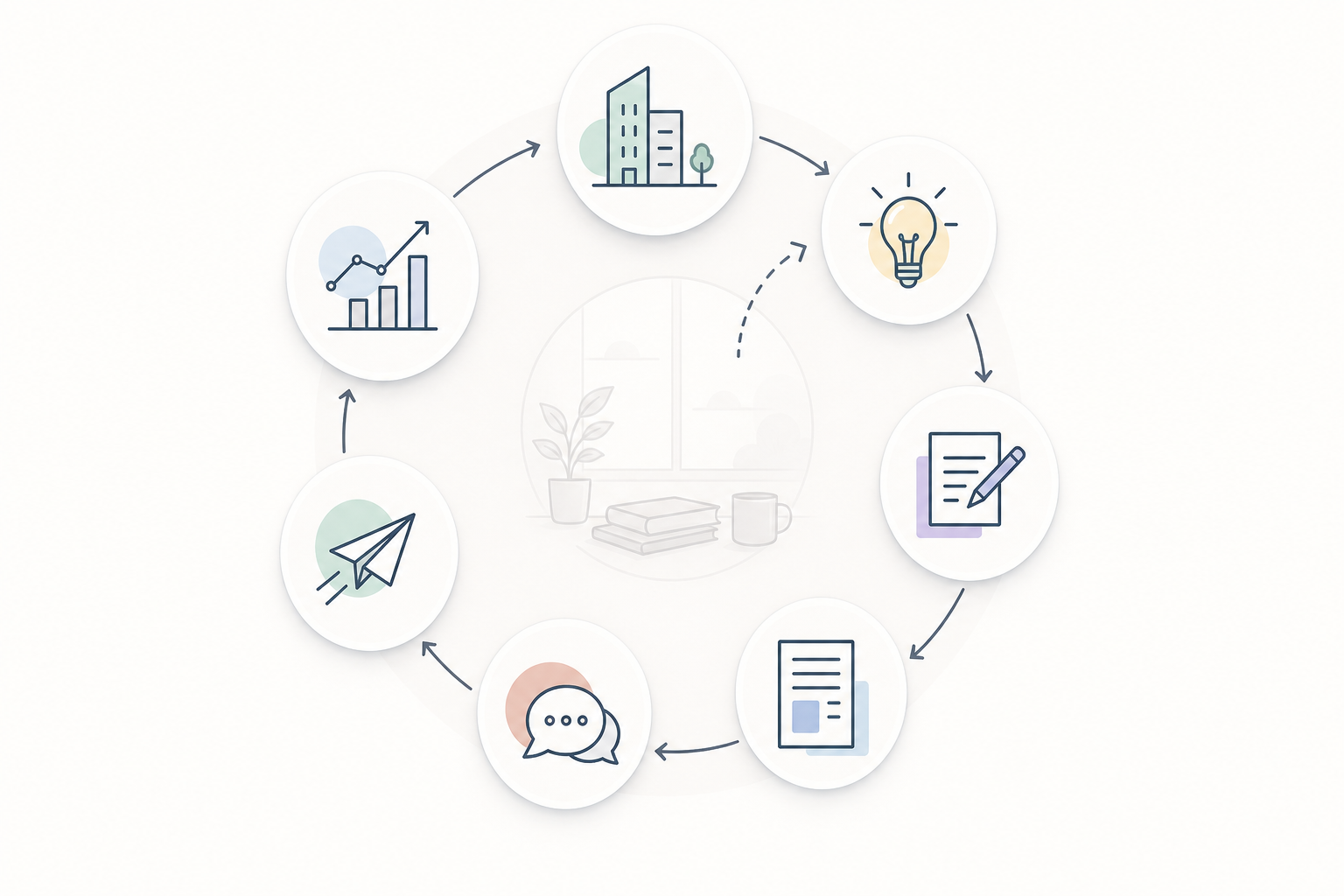
Think of the system as a loop: business context → topic choice → brief → draft → review → publish → learn. A spreadsheet, a project board, or a subscription platform can hold that loop. The value comes from the decisions and the rhythm, not the app.
This distinction matters when content planning feels overwhelming as a founder. The problem is often not a shortage of ideas. It is having to restart the same decisions each week while sales, delivery, and customer work compete for attention. For a closer look at that pattern, read why content planning feels overwhelming as a founder.
Why founder systems fail to stick
Most founder-focused content planning mistakes are design problems, not failures of discipline. A plan that needs a long planning session, several tools, and perfect focus will fail when the business gets busy.
Too many channels create too many decisions
A blog, newsletter, LinkedIn, Instagram, and video channel may all have merit. They do not all need to be active this month. Each channel adds choices about format, tone, timing, and reuse.
Start with one primary channel, often your website or newsletter. Add one distribution channel only when your core publishing rhythm feels stable. This is especially important for a founder with no team; a content planning system for a founder with no team should make the next action clear, not create more admin.
Ideas are mistaken for a plan
A long topic list can feel productive, but it does not tell you what to do next. Each planned piece needs four fields:
- Reader: the person it is for.
- Promise: the question or outcome it addresses.
- Business link: the offer, objection, or goal it supports.
- Proof: a truthful example, process, product detail, or source you can use.
If you cannot fill in those fields, keep the idea in the backlog. Do not force it into the calendar.
No niche makes every idea seem urgent
Content planning without a niche feels scattered because there is no useful rule for saying no. You do not need a perfect niche statement before publishing, but you do need a temporary focus.
For the next 30 days, write a working sentence: “We help [audience] solve [problem] in [context].” Use it to create two or three temporary pillars, such as:
- Problems your audience needs to understand
- How your approach works
- Questions or objections that arise before purchase
Review the response after a month. Keep the pillars that bring useful conversations, qualified visits, or sign-ups. Drop the rest. If the business message itself is still unclear, work through these business discovery questions founders avoid answering before building a bigger content machine.
The plan has no feedback loop
Publishing without review turns a calendar into a checklist. Once a month, look at the few measures tied to your goal. For example, a service business may track enquiries, calls booked, email sign-ups, or clicks to a key service page. A product business may also look at trial or demo interest where it can be traced.
Do not treat traffic alone as the verdict. Ask which topics brought the right readers, which pages helped sales conversations, and what questions keep repeating. Then use those answers to change next month’s brief list.
Option A: Build your own system
DIY is a sensible choice when your offer is stable, your audience is reasonably clear, and you can protect a small weekly planning block. It gives you full control and may be all you need at an early stage.
The minimum viable DIY setup
Keep the setup deliberately plain. One spreadsheet can be enough if it becomes the single source of truth.
| Part of the system | What it needs to contain |
|---|---|
| Business notes | Audience, offer, differentiators, common questions, and approved proof |
| Content pillars | Two to five repeatable themes tied to the business |
| Backlog | Topic, reader, angle, goal, and evidence needed |
| Calendar | Publication date, primary channel, CTA, and owner |
| Workflow | Idea → brief → draft → review → ready → published |
| Monthly review | Results, lessons, topics to repeat, and topics to retire |
A calendar can make the work more organised and easier to schedule in advance, as this small-business content calendar guide explains. It is useful only when it reflects a workflow you can keep.
For the operating rhythm, reserve a short weekly session to choose the next piece, remove blockers, and confirm the publication date. This founder content planning weekly operating rhythm offers a lightweight model.
The hidden costs of DIY
Tool fees are rarely the main cost. The less visible costs are usually:
- Setup time: deciding fields, templates, naming rules, and workflow stages.
- Context switching: moving between notes, briefs, drafts, calendars, and analytics.
- Maintenance: cleaning a stale backlog and updating the system when your offer changes.
- Decision fatigue: reopening choices that should have been settled by your pillars and rules.
- Onboarding: explaining a system that exists mainly in your head if you hire help later.
- Missed publishing: losing momentum whenever client work or product work takes priority.
None of these costs means DIY is wrong. They mean you should count founder attention as a real input. If building and maintaining the process feels like another project you will avoid, the cheaper tool stack may not be the cheaper option.
When DIY is the right call
Build your own system when most of these statements are true:
- You have one main audience and a clear offer.
- You are publishing on one channel, or can keep the others secondary.
- You enjoy setting up processes and can maintain them.
- You know who writes, reviews, and publishes each piece.
- You can explain the next action for every item in your calendar.
In this situation, resist tool sprawl. A simple system you run every week beats a sophisticated one you abandon.
Option B: Subscribe to a founder-focused planning system
Buying does not remove the need for judgment. It should remove repeated setup work and give you a clearer path from business context to a realistic publishing plan.
A useful subscription should help you establish direction, make topic choices, and maintain a manageable cadence. It should not promise that more content alone will create demand or rankings.
What you are really paying for
The best reason to buy is not “more ideas.” It is a repeatable structure that reduces avoidable decisions. Look for:
- A way to capture what the business does, who it serves, and what it can honestly claim
- Clear content direction rather than an endless generic idea bank
- A short, prioritised plan that fits your capacity
- A visible workflow for moving work toward review and publication
- A regular review point that helps you adjust the next plan
Ask a direct question before subscribing: “What will be different in my week after I use this?” If the answer is vague, the system may add another place to log in without changing the work.
What a subscription cannot do for you
No platform can reliably supply the facts that only you know. You still need to confirm product details, assess accuracy, add real expertise, approve the final message, and decide what is appropriate for your customers.
It also cannot make an unclear offer clear by publishing around it. If your positioning shifts every week, use the planning process to settle your message first. A structured system works best when it supports founder judgment rather than replacing it.
Where Content Redefined AI fits
Content Redefined AI provides a structured approach to content planning for founders. It is designed to help businesses introduce themselves, direct their content, and keep to a consistent publishing schedule.
That makes it a potential fit if you want more structure than a blank spreadsheet but still want to retain control over business accuracy, positioning, and approvals. If missed publishing is your main issue, start with why founders struggle with consistent publishing to identify the bottleneck before choosing a solution.
A 15-minute make-or-buy scorecard
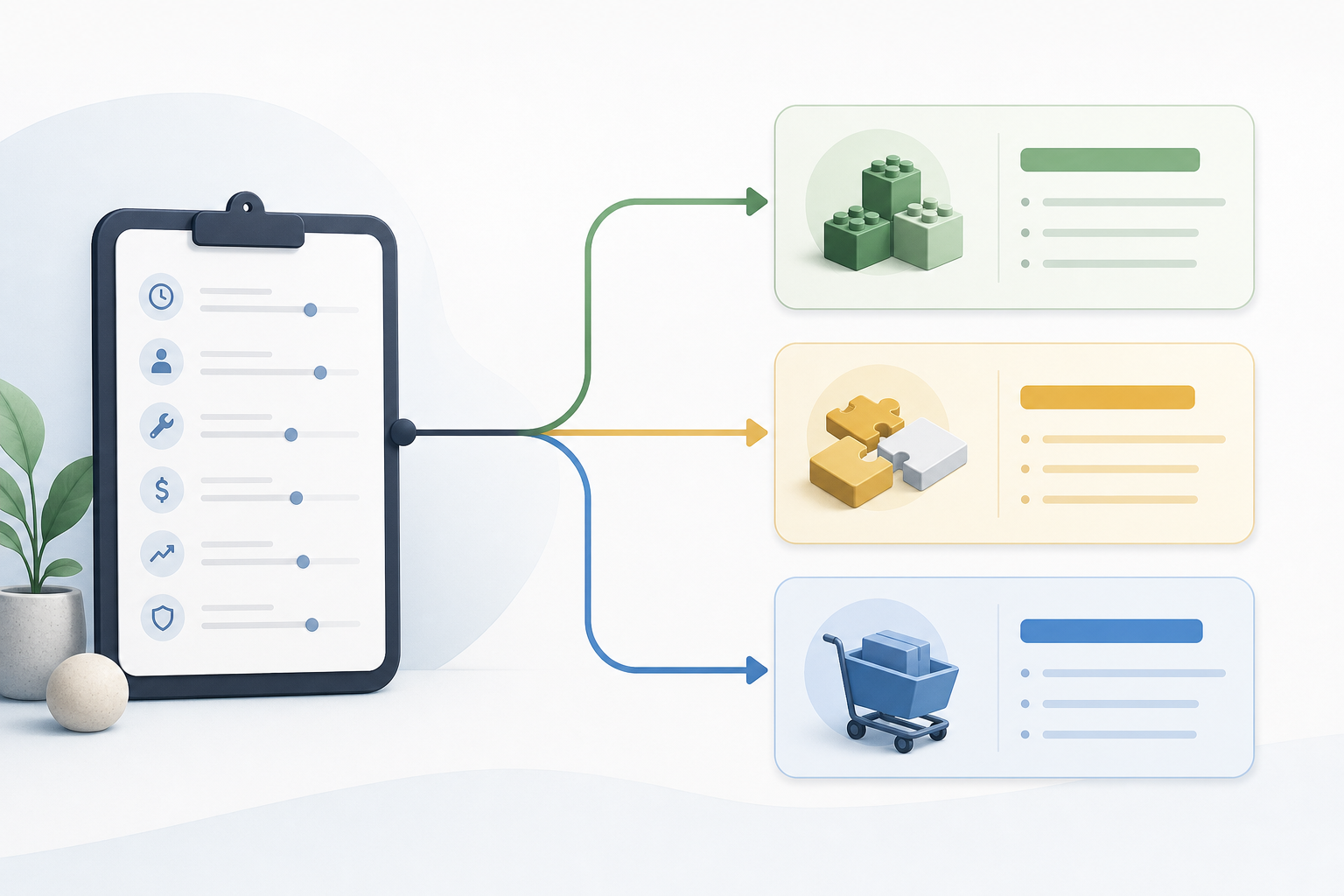
When deciding whether to make or buy a content planning system for SMB founders, use this scorecard as a conversation with yourself, not a scientific calculation. Give each statement one point when it is true. A higher score means external structure may be more useful than building every part alone.
| Statement | Point if true |
|---|---|
| I regularly miss planned publishing weeks. | 1 |
| Planning takes a lot of time, yet I still do not know what to publish next. | 1 |
| My topics feel disconnected from my offer or audience. | 1 |
| I use several tools and lose track of drafts or decisions. | 1 |
| Drafts often stall before review or publication. | 1 |
| I need a predictable cadence but client or product work keeps taking over. | 1 |
| I need a clearer way to brief a contractor or team member. | 1 |
| I want a monthly review process but never get around to setting one up. | 1 |
0–2 points: Make. Keep your system lean. Create two or three pillars, one workflow, and a monthly review. Do not add tools until the process itself works.
3–5 points: Try a hybrid. Keep your own calendar and business notes, but use a structured method or subscription to set direction and create a dependable rhythm.
6–8 points: Buy may be the better fit. Your challenge is likely system design and consistency, not effort. Evaluate a subscription by how well it reduces the specific friction you identified.
The score is not a purchase instruction. Budget, timing, and confidence in your positioning still matter. Its purpose is to make the hidden cost of repeated restarts visible.
Plan channels, reuse, and measurement without creating duplicate work
Choose channels based on where your audience can act on the content. A practical starting point is one durable home for the full idea, such as a blog or newsletter archive, and one place to distribute a shorter version.
Repurpose the underlying insight, not the exact text. For example:
- A blog post can explain a customer problem, method, and supporting detail.
- An email can lead with one takeaway and link readers to the fuller explanation.
- A social post can share one lesson, question, or short example from the same topic.
This keeps the message consistent while giving each channel a job. It also avoids the copy-and-paste habit that makes every channel feel repetitive.
For UK audiences, include local intent in the brief when it is relevant: UK spelling, service areas, local terms, and examples that fit the buyer’s context. Do not add location language when it does not change the reader’s decision.
At the end of each month, spend 20–30 minutes on four questions:
- Which piece supported the month’s goal most clearly?
- Which topic led to qualified replies, enquiries, or useful sales questions?
- Where did the workflow slow down?
- What should we repeat, improve, postpone, or stop next month?
Then update the backlog and schedule only the work you can realistically complete. This is how a structured content planning method for founders becomes a working habit rather than a one-time setup.
Your next step
If your DIY process is small, clear, and running, keep it. Improve one weak point at a time.
If you are rebuilding the same calendar every month, missing weeks, or losing time to scattered tools, buying structure may be the more practical choice. In either case, start with one audience, one monthly goal, a short list of publishable topics, and a review date. That is the foundation of a system that can last.