
How to Introduce Your Business Through Content (Without Cringe)
Learning how to introduce your business through content can feel surprisingly difficult. A typical “we’re excited to announce…” post often sounds like an ad, says little about the customer, and gives readers no reason to care.
A better introduction is specific, calm, and useful. It helps the right person understand three things quickly:
- Who you help
- What problem you help them solve
- What they can do next
That is the real purpose of introductory content. You are not trying to make a grand entrance or tell your whole company history in one post. You are creating a clear first encounter that earns enough trust for a reader to continue the conversation.
For founders, the most effective approach is rarely a single launch announcement. It is a small system of content: an introductory post, a plain-English offer explanation, useful proof, and a logical next step. Together, those assets help people move from “What is this business?” to “This may be relevant to me.”
What intro content is—and what it is not
Intro content is foundational content that explains your business to people who do not know you yet. It can live on your website, in a newsletter, in a LinkedIn post, or across several channels. Its job is not to persuade every reader. Its job is to help the right readers identify themselves and understand whether you may be able to help.
Think of it as a small library with distinct roles:
- A positioning or “start here” page: States who you serve, what problem you address, and the outcome you work toward.
- A how-it-works explanation: Shows your process in clear, concrete terms.
- A proof asset: Shares examples, process details, relevant experience, or honest constraints.
- A next-step asset: Gives readers one appropriate action, such as reading a guide, subscribing, requesting information, or booking a conversation.
A strong introduction does not need all of this information in one place. In fact, trying to cram it all into one post usually makes the writing feel overly promotional. Let each asset answer one important question well.
What intro content is not
Intro content is not:
- A founder biography with no connection to the buyer’s problem.
- A vague mission statement that never explains the offer.
- A list of every feature, service, credential, or tool you use.
- A launch post that says you are “excited” but never says who the business is for.
- A social post designed for attention without a useful path to your website or offer.
- A collection of claims you cannot substantiate.
The test is simple: after reading, could a stranger explain your business to someone else in one or two sentences? If not, the content may be polished, but it is not yet doing the work of an introduction.
The real job behind the search
People searching for advice on introducing a business are usually not asking how to announce a startup. They are asking how to explain their business in a way that feels credible.
They want clarity, credibility, and a next step.
- Clarity means a reader can understand your offer without decoding jargon.
- Credibility means you support your message with useful detail rather than inflated claims.
- A next step means the reader knows what to read, click, reply to, or consider next.
This is where content marketing becomes relevant. Content marketing is the practice of creating useful content for a defined audience and connecting it to a business goal. A content strategy can educate or entertain a target audience while helping move them toward an intended outcome, as outlined in HBS Online’s overview of content strategy. Your introductory content is simply the beginning of that path.
Start with business discovery before you write
An introduction cannot be clearer than the business thinking behind it. If you are still changing your audience, offer, or core message every week, publishing an introduction may lock in confusion instead of solving it.
Before drafting, get clear on the reader, the problem, and the next action.
Define one primary reader
Writing for “everyone” produces content that feels like it was written for no one. Choose one primary segment for your introduction, even if your business eventually serves several types of customers.
Use three inputs:
| Input | Question to answer | Example |
|---|---|---|
| Who | Which role or business type are you speaking to? | Founders of small service businesses |
| Context | What does their workday or current situation look like? | They handle marketing themselves and publish inconsistently |
| Trigger | What makes them start looking for help now? | Referrals have slowed, or content feels too random to sustain |
For example, Content Redefined AI is designed for founders of small to medium-sized businesses who want a more structured approach to content planning. A useful reader snapshot might be:
> “I am writing for a founder with a real offer, limited time, inconsistent publishing, and no confidence that their current topics support the business.”
That snapshot is more useful than a demographic profile. It gives you a real situation to write into.
A practical rule: if your advice cannot help that reader make a decision or take a useful action this week, it may not belong in introductory content.
Clarify the problem in the customer’s language
Founders often describe a business through features or methods. Buyers usually start with a problem.
Compare these two approaches:
- Feature-led: “We provide an AI-enabled content planning experience.”
- Problem-led: “You know your business well, but choosing topics and publishing consistently keeps falling to the bottom of the list.”
The second version gives the reader somewhere to stand. It names a recognizable situation before introducing the solution.
To find better language, review sales calls, customer emails, support questions, proposals, and notes from discovery conversations. Look for phrases customers repeat. Keep the wording even when it is imperfect. Real phrases are often more useful than polished marketing language.
Examples of customer-language problems include:
- “We only publish when someone has time.”
- “Our blog feels disconnected from what we actually sell.”
- “We have lots of ideas but no way to choose which ones matter.”
- “Every post starts from a blank page.”
- “Prospects keep asking basic questions we should have answered already.”
Write a plain-language positioning sentence
Positioning is not a slogan. It is a clear promise that connects a specific audience, a useful outcome, a recognizable pain, and an approach you can honestly describe.
Use this formula:
> We help [who] do [outcome] without [common pain], using [approach].
For example:
- “We help local service founders publish useful website content without guessing what to write, using a structured planning method and a consistent schedule.”
- “We help B2B consultants explain what they do in clear articles without relying on generic marketing language, using guided content plans and review steps.”
- “We help small teams turn expertise into helpful posts without starting from a blank page every time, using structured briefs and draft support.”
For Content Redefined AI, a concise version could be:
> “Content Redefined AI helps founders create a clearer content direction and maintain a consistent publishing schedule through a structured planning method.”
Do not try to make this sentence carry every nuance of your business. Its job is to orient the reader. You can explain details later.
If choosing an audience or problem still feels difficult, it may help to step back and develop your foundations first. See How To Develop A Content Strategy: A Comprehensive Guide for a broader planning process.
Know when not to publish an intro post yet
An intro post is not always the next best move. Pause and do more discovery if any of these are true:
- You keep changing who you serve from week to week.
- You cannot explain the offer without buzzwords.
- Your supposed problem is really a feature list.
- You have several unrelated offers but no clear priority.
- You do not know what action readers should take next.
Use this short checkpoint:
- Can you name one clear audience?
- Can you describe their problem in familiar language?
- Can you say what you do in one sentence?
- Can you name one next step that makes sense for a new reader?
If the answer to any question is no, conduct discovery before publishing. Speak to current or past customers, review your sales notes, and document the language people use when they explain why they sought help.
Build credibility without overclaiming
Many early-stage businesses assume credibility requires large customer logos, dramatic metrics, or polished case studies. Those can be valuable when they are real and relevant, but they are not the only forms of proof.
You can make an introduction trustworthy by being specific about how you work, what you know, and where your boundaries are.
Use proof that matches your stage
Useful forms of proof include:
- Process proof: Explain the sequence you use to do the work.
- Decision proof: Show how you choose between options or prioritize work.
- Artifact proof: Share a checklist, framework, anonymized template, or other resource you genuinely use and have the right to publish.
- Relevant experience: Describe experience only when it is accurate and directly relevant to the reader’s decision.
- Transparent limitations: State what your business does not promise or handle.
For example, a founder-led content business might say:
> “We begin by clarifying the audience and customer questions that matter most. Then we turn those questions into a manageable publishing plan rather than chasing unrelated topics.”
That is more useful than saying, “We deliver world-class strategy.” It describes a method readers can evaluate.
Likewise, a business can create trust by naming a constraint:
> “We do not promise rankings or instant lead volume. We focus on helping founders publish accurate, useful content with a clearer connection to their offer.”
A boundary is not a weakness. It tells readers that you understand the difference between what you can control and what you cannot.
Use examples without pretending they are customer results
Examples are especially helpful when you do not yet have publishable case studies. But label them honestly.
You can show a before-and-after change in thinking:
- Before: “We deliver innovative solutions for modern businesses.”
- After: “We help independent clinic owners make their intake process easier to manage when leads are getting lost between inquiry and follow-up.”
Or you can use a clearly hypothetical scenario:
> “Imagine a three-person agency that has recorded recurring client questions in sales calls but has no blog. A sensible first month of content could turn those questions into an introductory guide, a process explainer, an objection-handling article, and a next-step checklist.”
This is useful because it shows the method. It should not be presented as a real customer outcome unless it is one and you have permission to share it.
Apply the cringe filter before publishing
The fastest way to make an introduction feel more credible is to remove phrases that ask readers to admire you before they understand you.
Rewrite or remove the following:
- Vague superlatives: “best-in-class,” “world-class,” “leading,” and “next-generation.”
- Mission-only openings: “Our mission is to empower…” before readers know what you actually do.
- Irrelevant founder backstory: a long origin story with no lesson for the buyer.
- Name-dropping: brands, tools, or affiliations that do not change the reader’s decision.
- Passion filler: “We are passionate about…” without explaining the work.
- Unverified outcomes: rankings, revenue, time savings, customer counts, or results you cannot support.
Replace vague language with a concrete claim:
| Instead of | Try |
|---|---|
| “We are a leading content solution” | “We provide a structured way for founders to plan and maintain content.” |
| “We empower businesses to grow” | “We help founders choose content topics that connect to their customer questions.” |
| “Our innovative platform transforms marketing” | “Our platform helps founders create a clearer publishing direction and schedule.” |
Do one final review. Highlight every sentence and ask whether it does at least one of these things: identifies the reader, names the problem, explains the method, gives useful evidence, or points to an appropriate next step. If it does none of them, cut or rewrite it.
The intro post framework: what to include and exclude
A strong intro post is a clarity tool. It should help the right people self-identify, understand what your business does, and take a low-pressure next step.
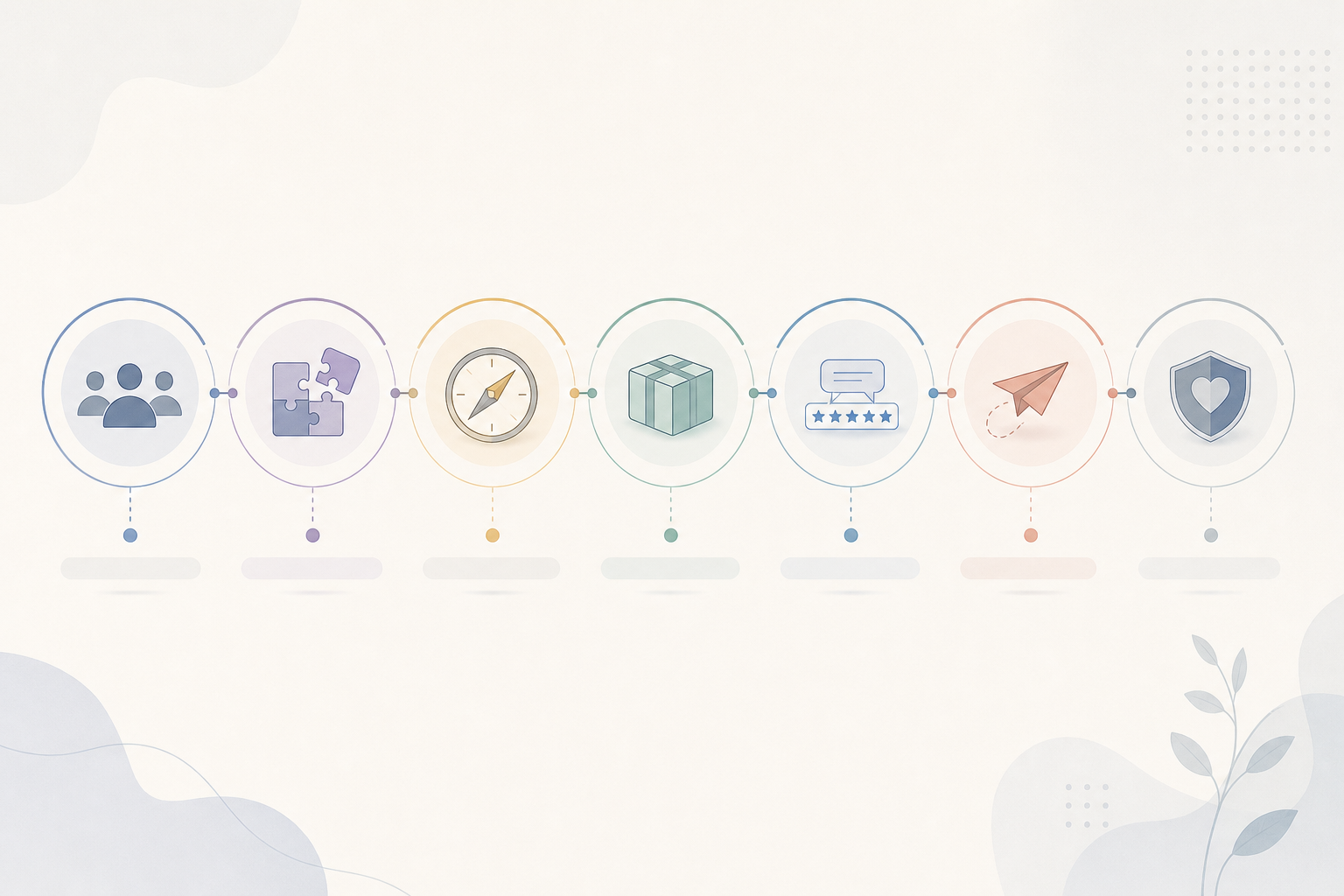
Include these seven building blocks
-
Who the post is for
Name the audience in language they would recognize. “For founders doing their own marketing” is clearer than “for businesses.” -
The problem you solve
Describe the situation behind the purchase. For example: “You publish in bursts, then disappear for months because deciding what to write takes too long.” -
Your point of view or approach
Explain how you think about the problem. This is where differentiation happens without bragging. Example: “We believe consistency comes from a manageable system, not endless motivation.” -
A simple statement of the offer
Say what you provide in one sentence. Avoid describing every feature, package, or future ambition. -
A credible proof signal
Use a process, example, relevant experience, or transparent constraint. Do not invent social proof. -
One clear next step
Invite the reader to do something appropriate for their stage: read a related guide, subscribe, request information, or start a monthly subscription if they are ready. -
A human boundary or value
Include one sentence that shows how you operate. For example: “We would rather publish fewer useful pieces than fill your site with generic pages.”
A stranger should be able to answer “Is this for me?” within the first few paragraphs and “What do I do next?” by the end.
Exclude what makes the post feel salesy
Leave out:
- A long founder bio that delays the customer problem.
- A feature dump that overwhelms a new reader.
- Aggressive calls to action that do not match the content.
- Every service you offer, especially if they serve different audiences.
- Claims about results that require proof you do not have.
- A generic “we are excited to announce” opening.
A good rule is this: if the post could belong to any company in your category, it is probably too vague. If it relies on hype to sound distinctive, it is probably too promotional.
Choose one of three intro structures
Problem-first structure is useful when the audience has a clear pain.
- Describe the exact situation.
- Explain the cost or frustration of staying stuck.
- Introduce your practical approach.
- State the offer and who it is for.
- Add a proof signal or boundary.
- Offer one next step.
Customer-story-first structure works when trust is the major barrier.
- Start with a real, approved customer story or a clearly labelled hypothetical scenario.
- Show the turning point.
- Explain the decisions or process involved.
- Connect the story to your offer.
- State who is and is not a fit.
- Give a calm invitation to continue.
Point-of-view-first structure helps in crowded markets.
- Open with a useful belief about the category.
- Explain why that belief matters to the customer.
- Describe the operating principle behind your approach.
- State what you offer.
- Add evidence, context, or a constraint.
- Invite readers to take the next step.
If you are unsure, use the problem-first structure. It is usually the easiest way to keep an introduction focused on the buyer rather than the business.
A worked intro example
Here is a concise example for a founder-focused content planning business:
> If your business has useful expertise but your content appears only when you find spare time, you are not alone. The difficult part is often not writing one post. It is deciding what deserves to be published and creating a rhythm you can maintain.
>
> Content Redefined AI is built for founders who want a more structured way to direct their content. It helps turn business context into a clearer content plan and consistent publishing schedule.
>
> We do not treat more pages as the goal. The aim is useful content that reflects your actual offer, speaks to a defined audience, and gives readers a sensible next step.
>
> If you are working out what your business should publish first, start by choosing one customer problem and building a short sequence around it.
Notice what this example does not do: it does not claim rankings, customer results, or capabilities beyond the stated product purpose. It introduces a problem, a reader, an approach, and a next action.
Connect your intro content to your offer without forcing a sale
An introduction should not hide the offer in an attempt to sound less salesy. Readers deserve to know how your business relates to the problem you are discussing. The key is relevance, not restraint for its own sake.
Teach one useful idea, make the audience clear, then point to the logical next action.
Use the story-to-solution bridge
A simple bridge is:
> If you are dealing with [problem], here is what to do next.
For example:
> “If your blog feels random and difficult to maintain, begin by choosing one customer problem to publish around for the next month. If you want a structured way to turn that decision into a content direction and publishing schedule, explore whether Content Redefined AI is the right fit for your business.”
The reader gets a useful action even if they do not buy. Your offer is positioned as support for someone who wants a more organized way to carry out that action.
Create an offer map
Use an offer map to keep each introductory asset focused:
> One audience → one core problem → one primary offer → one next step
For a founder content planning business, the map might be:
- Audience: Founders of small to medium-sized businesses.
- Core problem: Content topics and publishing are inconsistent because there is no clear direction or repeatable rhythm.
- Primary offer: A monthly subscription to a structured content planning platform.
- Next step: Learn how the method fits their current content process, then subscribe if it is appropriate.
This map prevents a common problem: writing an article about strategy, then sending readers to an unrelated offer or several competing calls to action.
Match the CTA to reader readiness
A first-time reader may not be ready to buy. Use a CTA ladder instead of making every introduction a hard sell.
- Low-friction CTA: Read the next guide, use a checklist, or reply with a question.
- Mid-friction CTA: Subscribe to receive planning guidance or request more information.
- Higher-friction CTA: Start a monthly subscription, request a demo, or book a fit conversation.
For a first-touch introductory post, a low- or mid-friction CTA is often appropriate. If the page clearly explains the offer and answers the reader’s main questions, a subscription CTA may make sense.
Keep the wording specific and calm:
- “Read the guide to build your first content sequence.”
- “Explore whether a founder-focused content planning platform fits your workflow.”
- “Subscribe monthly when you are ready for a more structured planning process.”
Avoid piling up options. “Subscribe, book a call, download a guide, follow us everywhere, and request a quote” creates unnecessary friction. Choose one primary next step and, if needed, one supporting internal link.
Plan a 30-day introduction sequence
One post cannot explain your business, establish trust, answer every objection, and generate action. A short sequence gives each piece of content a focused role and gives readers more than one way to understand what you do.

The five-asset foundation
-
The introductory post
Explain the problem you see, your point of view, who you built for, and what readers should do next. -
The “what we do” explainer
Describe the offer in plain English: who it is for, what the process involves, what it helps with, and what it does not promise. -
The proof and FAQ page
Address reasonable questions about process, fit, inputs, limitations, and review. This is a good place to explain how you maintain accuracy or where customer involvement matters. -
A worked example
Show how you would approach a realistic scenario. Be explicit about assumptions and unknowns if it is not a real customer case. -
A next-step guide
Help readers take action whether or not they buy. For example: how to write a positioning paragraph, choose five starter topics, or organize two weeks of publishing.
A practical 30-day schedule
- Week 1: Publish the intro post and the plain-English offer explainer.
- Week 2: Publish a proof or FAQ page and a short checklist addressing one common concern.
- Week 3: Publish a worked example and a behind-the-scenes process article.
- Week 4: Publish a next-step guide and an article answering a high-intent customer question.
The goal is not to publish for the sake of volume. The goal is to create a useful set of assets that can be linked together and improved over time.
Topic selection is easier when each article has a job. If choosing topics is taking more time than writing, How Founders Waste Time Choosing Content Topics offers a decision-focused perspective.
Research customer language and search intent
Keyword research can help you understand how people describe a problem, but it should not replace customer understanding. Start with the language you already have.
- Collect phrases from calls, emails, proposals, and support conversations.
- Group them by intent: understand, compare, do, or decide.
- Check wording and variations with a free tool such as Google Keyword Planner.
- Consider paid research tools only when you have a repeatable publishing process and a clear use for the additional data.
Useful intent buckets include:
- Understand: “What is content marketing for a small business?”
- Do: “How do I write an intro post for my business?”
- Compare: “Blog versus LinkedIn for a small business.”
- Decide: “Do I need a content planning platform?”
For guidance on connecting keyword research to practical content decisions, see How AI Can Help You Find The Best Keywords For Your Blog.
Publish where people can act on the message
Your website should usually be the durable home for introductory content. It gives you a page you can update, link internally, share in sales conversations, and build on over time.
Then adapt the message for channels where your audience already pays attention.
Owned channels
- Blog or website: Publish the complete, structured version here first.
- Email: Send a shorter note explaining why the piece matters and invite replies. Responses can reveal valuable customer language.
- Resource hub or start-here page: Link foundational assets together for readers who want to understand the business quickly.
Social channels
Use social posts to surface one useful idea from the larger piece rather than copying the full article into every channel. A LinkedIn post, for example, could focus on the belief that content consistency is a planning problem rather than a motivation problem, then link to the fuller guide.
Adapt the format, but do not change the core message. Readers should encounter the same audience, problem, and offer whether they find you through social media, search, or email.
Partner channels
Relevant newsletters, communities, podcasts, or collaborators can be useful distribution routes when the audience overlap is real. Lead with a useful angle for their audience rather than a generic business announcement.
A partner pitch might be: “I can share a short framework for turning recurring customer questions into a first month of content.” That gives the partner a clear editorial idea and gives you a natural route back to your introductory content.
Measure whether your intro content is working
The goal is not viral reach. For a founder, success often looks more practical: better-qualified inquiries, fewer basic clarification questions, stronger sales conversations, and a clearer message you can reuse.
Track signals that match the job
Use metrics in context:
- Engagement: Are readers reaching the sections that explain your offer and next step?
- Clarity: Are people clicking FAQs, navigating to explanatory pages, or asking the same basic question after reading?
- Conversion: Are readers subscribing, submitting contact forms, requesting information, or beginning the appropriate next action?
- Assisted conversion: Do people read the intro content, return later through another page, and eventually convert?
Pageviews and likes can be useful distribution signals, but they do not tell you whether the message is clear or commercially relevant.
Set up a simple measurement loop
Keep the setup small enough to use consistently:
- Track clicks on the primary CTA.
- Track meaningful form submissions or subscription starts.
- Review the path from intro page to next-step page.
- Separate new visitors from returning visitors when possible.
- Review the questions prospects ask in sales or support conversations.
Then look for patterns.
- High reading time but few CTA clicks: The article may be useful, but the next step may be vague or poorly placed.
- Low scroll depth and quick exits: The opening may be too generic. Move the audience and problem higher on the page.
- Frequent FAQ interaction: Readers may need more reassurance. Consider moving a key answer into the main body.
- Relevant questions and qualified inquiries: The introduction may be successfully filtering and educating readers, even if raw traffic is modest.
Decide whether to rewrite or publish a follow-up
Rewrite the main introduction when the central message is unclear. Signs include readers leaving before the offer is explained, repeated confusion about who you help, or a CTA that does not connect to the article.
Publish a follow-up when the main message is clear but readers need depth. For example, if prospects understand the offer but repeatedly ask how to maintain consistency with limited time, create a dedicated article and link it from the introductory hub. How To Keep Consistent Content With Limited Time: Founder System is a relevant next step for that question.
Make one meaningful change at a time: revise the headline, clarify the audience, strengthen the proof, or improve the CTA. Then observe the new pattern before changing everything else.
A final pre-publish checklist
Before publishing your introduction, ask:
- Is the primary reader obvious in the opening?
- Does the post name a real problem in language they would use?
- Is the offer explained in plain English?
- Have I shown a method, example, or honest boundary instead of relying on hype?
- Have I removed claims, numbers, or outcomes I cannot support?
- Is there one clear next step?
- Does that next step logically match the content?
- Can I link the reader to a useful related page if they need more depth?
If the answer is yes, your introduction is ready to do its job: give the right people clarity, demonstrate that you understand their situation, and make continuing the conversation feel natural.
FAQ
What is content marketing, and how is it different from an intro post?
Content marketing is the ongoing practice of publishing useful content for a defined audience in support of a business goal. An intro post is one foundational asset within that wider system. It answers who you are, who you help, and why the reader should care. Future articles build trust by answering more specific questions, showing your approach, and helping readers make decisions.
How long should an intro post be?
There is no ideal word count. Write enough to remove the reader’s main uncertainty, then link to deeper pages rather than adding every detail. On a website, a longer structured post can work well. On social media, use a shorter version with one clear point and a path to the fuller explanation.
Should I share my founder story if I do not have major wins to mention?
Yes, if the story explains a buyer-relevant insight. Focus on the customer problem you kept seeing, the constraint that shaped your approach, and what you learned. Avoid turning the post into a personal history or implying results you cannot verify.
Where should I publish introductory content first?
For most businesses, publish the full version on your website first. Then adapt it for one channel where your audience is already active, such as email or LinkedIn. This gives you a durable source page while allowing you to start conversations elsewhere.
How do I stay consistent after the introduction sequence is published?
Treat consistency as an operating decision rather than a motivation challenge. Set a realistic cadence, give each post a defined job, and build from the customer questions you have already identified. A weekly planning rhythm can make this easier; see Founder Content Planning Weekly Operating Rhythm for a practical framework.
A credible business introduction is not a performance. It is a useful explanation of who you help, what you do, how you work, and where a reader should go next. Start there, then let the rest of your content earn trust one helpful piece at a time.