
When a structured publishing schedule system beats motivation, it is usually clear: you still intend to publish, but client work, sales, hiring, and urgent problems keep taking its place. The problem is not that you need more discipline. You need a process that tells you what happens next when time is tight.
For founders, a useful publishing system is not a complex calendar or a demand to post every day. It is a small operating loop that turns a customer question into a finished piece of content, with fewer decisions at each step.
The goal is a cadence you can sustain for roughly 90 days, including ordinary disruption. If your plan only works in a calm week, it is a streak—not a schedule.
Consistency is different from frequency
Frequency is how often you publish. Consistency is whether you can keep publishing at the pace you chose.
A founder who publishes two useful articles each month for a quarter is more consistent than one who posts every day for ten days and then disappears for six weeks. More output is not automatically a better plan.
A practical definition of a consistent schedule is a repeatable cadence that survives normal business disruption without heroic effort. The right cadence depends on your available time, review capacity, and the depth of insight you can add. Content Redefined AI’s guidance on a consistent publishing schedule makes the same distinction: start with the smallest pace you can actually maintain, then increase output only when the process has capacity.
That may mean one article every other week, one weekly newsletter, or one detailed monthly guide supported by smaller pieces. The format matters less than the fact that the work keeps moving.
Signs motivation is no longer enough
Motivation can start a publishing habit. It rarely protects it during a sales push, a delivery crunch, or a difficult hiring week. Look for these signs that the issue is structural rather than personal.
You choose the topic on publishing day
You open a blank document, browse old notes, and ask, “What should we write this week?” By the time you choose an angle, the time block is gone.
This is decision overload. Ad hoc publishing makes you decide on the audience, topic, format, message, and call to action every time. A short, prioritized idea queue removes most of those choices before the week begins.
Your message changes from post to post
Individual posts may be useful, yet the full body of work does not explain what your business does or who it helps. One week you discuss a trend. The next week you share a broad opinion. Neither helps a potential buyer understand your offer.
This points to a direction problem. Content needs a small set of themes connected to buyer problems, not a fresh strategy debate for every post. The warning signs are explored further in this guide to founder-focused planning versus ad hoc posting.
Drafts get stuck in review
A draft is nearly finished, but feedback is vague. No one owns the next step. Or every post waits for a founder to rewrite it line by line.
The problem is not necessarily quality. It is an unclear finish line. Without an agreed standard for publication, “review” becomes an endless holding area.
Content vanishes in busy weeks
If publishing happens only when the calendar is unusually quiet, your process has no resilience. A sustainable system includes a lighter default for busy periods and a defined way to restart after a missed date.
A quick self-assessment
Count the statements that are true for your business:
- You regularly decide what to publish on the day you hoped to publish.
- Your message shifts from week to week.
- Posts rarely answer durable buyer questions.
- Drafts sit in review with no clear owner or deadline.
- A busy week reliably stops your publishing rhythm.
- Restarting after a missed post feels harder than creating the next post.
One or two signs may call for a small adjustment. Several signs suggest that willpower is carrying work a system should handle.
The minimum system that creates reliable output
A system does not need more software, more meetings, or a giant spreadsheet. It needs enough structure to make the next useful action obvious.
Start with content direction, not dates
A calendar answers when you might publish. Direction answers what belongs there and why.
Write a simple statement of what you want your content to be known for. For example: “We help service businesses reduce onboarding chaos with practical operating systems.” That statement becomes a filter. A post about onboarding handoffs fits. General commentary with no link to that problem may not.
This does not need to be perfect. It needs to be clear enough to stop every topic from becoming a strategy meeting.
Keep a small idea queue
Capture ideas where they arise: customer questions, objections in sales calls, repeated delivery problems, and mistakes buyers can avoid. Add a label such as “question,” “objection,” “proof,” or “process.”
Then review the queue once a week or every other week. Select the next topic before your production time starts.
A queue is not a content graveyard. Keep it short and useful. Remove ideas that no longer match your direction, and promote the strongest items into briefs.
Make the workflow visible
Use visible stages from idea to publication:
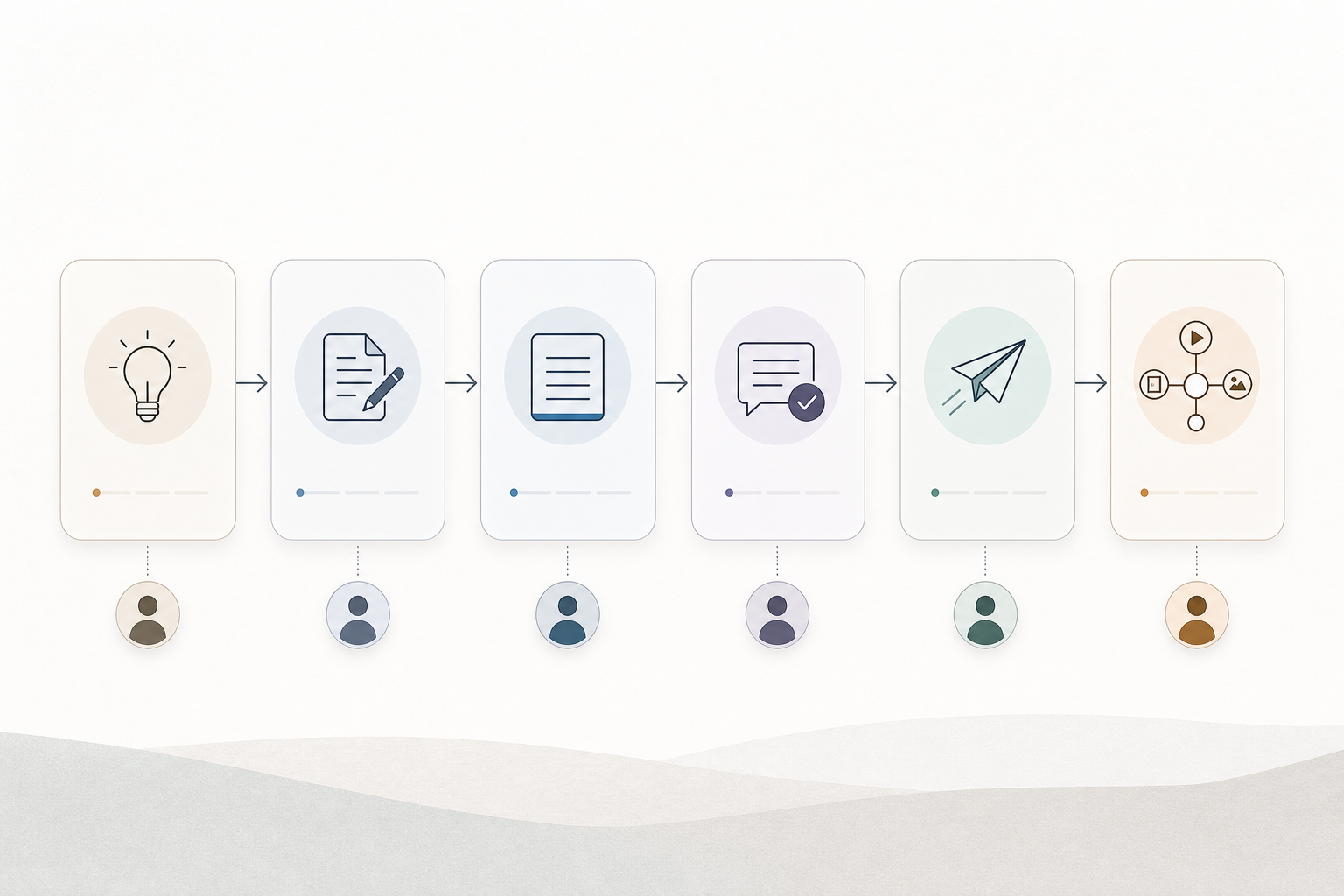
Idea → Brief → Draft → Review → Publish → Repurpose
This lightweight editorial path is recommended in the implementation guide for a consistent schedule. The exact tool is less important than knowing where each piece sits and who moves it forward.
For each stage, define a minimum requirement:
| Stage | Minimum requirement to move forward | Typical owner |
|---|---|---|
| Idea | A buyer question, problem, or clear angle | Founder or team member |
| Brief | One audience, one question, and one promised takeaway | Founder |
| Draft | A complete first version built from the brief | Founder or writer |
| Review | The draft meets the agreed quality bar | Named reviewer |
| Publish | Links, formatting, and call to action are checked | Publisher |
| Repurpose | One useful takeaway is selected for a secondary channel | Founder or team member |
The table is a recommended operating model, not a universal rule. Adapt the owners and stages to your team. The key is to remove invisible work and unclear handoffs.
Use repeatable formats
Choose one to three formats you can reuse. Familiar shapes reduce the pressure of starting from scratch.
Useful founder-friendly formats include:
- A direct answer to a customer question
- A myth-versus-reality explanation
- A checklist for a common decision
- A short lesson from a process problem
- A comparison of two approaches, with clear trade-offs
For each format, keep a basic template: who it is for, the main point, one concrete example, and the next step. Templates do not make content generic; they preserve energy for the insight only you can provide.
Define “done” before drafts reach review
Many publishing schedules fail at review, not drafting. The draft exists, but it never feels complete enough to ship.
A Definition of Done gives the team a shared standard. It separates quality from endless polishing.
A practical Definition of Done
Before publishing, confirm that the piece has:
- One clear reader and one useful outcome
- An answer to the main question near the beginning
- A concrete example, scenario, checklist, or explanation where helpful
- Claims that are supported, qualified, or removed
- A call to action that fits the reader’s intent
- A final check of headings, links, grammar, and formatting
This is a recommendation you can adapt. It is not a reason to publish work that is inaccurate or unfinished. It is a way to stop subjective preferences from blocking a useful, honest piece.
Keep founder review focused
Founder time is valuable when it protects decisions only the founder can make: positioning, product facts, sensitive claims, and the point of view behind the post.
Try a 15-minute review window:
- Check whether the reader and promised outcome are clear.
- Flag inaccurate, risky, or missing business details.
- Confirm the example and call to action feel real.
- Send back a short list of necessary changes, then approve publication.
Avoid using the review stage for line-by-line rewrites unless the language creates a real clarity or accuracy issue. If voice feedback is recurring, improve the brief or template instead.
Choose a cadence that survives a busy week
Your best week is not the right basis for a schedule. Choose the minimum output you can sustain when other work is demanding.
Run an 8–12 week test
Pick one primary format and one secondary place to share it for the next 8–12 weeks. For example, publish an article as the core piece and share one takeaway in your main professional channel. Or send a newsletter and turn one section into a short post.
This prevents a common trap: turning one idea into a multi-channel campaign before the core piece exists. The limited-time founder publishing guide similarly recommends narrowing the format and distribution choices to reduce decision fatigue.
At the end of the test, assess the process rather than only the output:
- Which stage created the most delay?
- Did review capacity match the number of drafts?
- Which topics were easiest to develop with real examples?
- Did the cadence survive at least one busy period?
Do not treat a good week as evidence that you should double the schedule. Increase only after your current pace feels repeatable.
Separate capture time from production time
Ideas often arrive while you are selling, delivering, or speaking with customers. Capture them quickly. Do not try to turn each insight into a finished post in the same moment.
Set aside a separate production block for outlining, drafting, reviewing, and preparing one piece. This separation helps you preserve ideas without turning every workday into an unfinished writing session.
Plan around review capacity
A pile of drafts is not a content system if no one can approve and publish them. If the founder is the final reviewer, plan around that constraint.
Decide what requires founder approval and what a checklist can handle. Then choose your cadence based on the slowest essential stage. A lower cadence that ships is more useful than an ambitious plan that creates a backlog.
What to do when you miss a posting date
Missing a date does not mean the whole system failed. Treat it as a signal about capacity or a blocked stage, then reset forward.

Use a 48-hour reset
First, review planned items and sort them into three groups:
- Publish: still accurate and ready enough to finish
- Rewrite: the core idea is sound, but context or details need updating
- Remove: no longer relevant, useful, or aligned with your direction
Next, choose the smallest restart level you can sustain. That may mean returning to your normal cadence, using a lighter format for one cycle, or reducing your pace temporarily.
Then publish a stabilizer post: a narrow, helpful piece that does not depend on a large campaign or complex assets. Good options include a customer question, one mistake to avoid, a myth-versus-reality post, or a simple checklist.
The detailed 48-hour reset plan for a missed posting schedule follows the same principle: do not create content debt by trying to backfill every missed item.
Diagnose the stage that broke
Do not write off every miss as low motivation. Look for the actual constraint:
- Topic selection: You could not choose an angle.
- Drafting: The work had no protected production time.
- Review: Feedback had no owner, deadline, or finish line.
- Assets: Visuals, links, or examples became blockers.
- Scheduling: The post was ready but no one prepared it to go live.
Fix the stage that failed. Adding a new tool will not solve an unclear approval process, and a stricter deadline will not solve a weak topic queue.
Decide whether you need a platform or a simpler DIY system
A spreadsheet or basic project board can be enough when you already have clear direction, reliable inputs, and a team that follows through. Use it to hold your queue, stages, owners, and dates.
Platform support may be worth considering when the recurring problem is the system itself: direction is unclear, topics are scattered, drafts have no path to review, or the schedule collapses whenever the founder gets busy.
Content Redefined AI is designed to give founders a structured approach to introducing their business, directing content, and maintaining a publishing schedule. It should be evaluated as support for your operating process, not as a substitute for founder judgment. You still need to confirm product details, choose what represents your business, and approve what is published.
The practical buying question is not, “Will this give me motivation?” It is, “Will this reduce enough repeated decisions and workflow friction for us to maintain a useful cadence?”
If the answer is yes, define the cadence, workflow, and review boundary you need before choosing a tool. A system works best when it supports a clear operating rule—not when it becomes another place for unfinished ideas.
A simple 90-day operating loop
For the next 90 days, keep the loop small:
- Review the idea queue and select one buyer-relevant topic.
- Write a brief with one reader, one question, and one promised takeaway.
- Draft using a repeatable format.
- Review against your Definition of Done.
- Publish the core piece.
- Share one useful takeaway in one secondary channel.
- Note where the work slowed down and improve that stage next time.
Track simple signals you can access, such as whether you published, what topic theme you covered, reader replies, email clicks, or qualified inquiries. A steady schedule does not guarantee traffic, rankings, or leads. It does give you a clearer record of what you published and where your workflow needs work.
The best publishing system is the one that still functions in an ordinary hard week. Build that first. Motivation can then become a helpful bonus instead of the only thing keeping your content alive.