
Content Direction Guardrails to Prevent Off-Topic Posts
Content direction guardrails to prevent off-topic posts are simple pre-decisions: choose a specific reader, problem, business priority, and proof theme for a short focus window—then require every topic to earn its place against those boundaries.
For founders, this is less about finding more ideas and more about stopping every new sales call, trend, competitor post, or AI suggestion from replacing the work already underway. A useful idea can still be the wrong idea for this month.
Use two layers of guardrails:
- Direction boundaries: the audience, problem, priority, and proof that define what belongs.
- Enforcement mechanics: topic filters, short briefs, workflow stages, capacity limits, and stop rules that protect those boundaries during a busy week.
This is not a permanent niche statement. It is a practical system for keeping the next four to eight weeks of content connected.
Why off-topic posts happen
Off-topic content is rarely caused by a lack of discipline or creativity. More often, too many strategic decisions are left until the moment someone is meant to write.
At the blank page, you may be deciding who the post is for, which problem it addresses, what offer it relates to, what proof you can use, where it will be published, and how much time it deserves. That is a strategy problem as much as a writing problem.
A structured planning method separates those decisions from drafting. Instead of making every choice from scratch each week, make a small set of choices in advance and carry them into the work. A Structured Content Planning Method for Founders explores that monthly-direction and weekly-shipping approach.
The cost of a scattered plan
When every plausible idea can enter the calendar, a few predictable problems follow:
- The backlog loses order. It holds many possible titles, but nothing is clearly next.
- The message shifts. One post speaks to prospective buyers, the next to peers, and the next to a broad audience with different needs.
- Publishing becomes fragile. Every post requires a fresh strategy discussion, so a busy week can stop the whole process.
Common symptoms include a growing idea list, stalled drafts, frequent pivots, and posts that do not connect to the work your business is trying to do now. For a fuller diagnostic, see 11 Signs Your Content Direction Is Unclear.
What “off-topic” means in founder-led marketing
Off-topic does not mean “outside our industry.” A subject can fit your industry and still be wrong for the current plan.
Use this working definition:
> A post is off-topic for the current focus window when it does not serve the chosen reader, support the current business priority, or use proof you can explain honestly.
For example, imagine a bookkeeping firm serving small agencies. A post about AI prompts for creators may interest some readers. But if the current focus is helping agency owners manage cash-flow pressure—and the firm has no useful proof or offer connection around AI prompts—it is not a current priority. It may be worth revisiting later. For now, it is not yet.
Signs your content direction is unclear
Unclear direction shows up in the backlog, in drafts, and in how posts relate to each other.
Every idea feels equally important
A raw idea list is not a content plan. A sales objection, product update, industry trend, and founder story can all be worthwhile, but they should not all receive the next calendar slot.
Watch for these patterns:
- The intended reader changes from post to post.
- A new idea often replaces work already planned.
- You cannot explain why one topic should come before another.
- The list contains broad categories rather than specific reader problems.
- The plan follows whatever feels most urgent or interesting that week.
You do not need to settle your business identity forever. You need a temporary boundary that makes the next month easier to plan. A four- to eight-week focus window is one practical approach described in Founder-Focused Content Planning Constraints to Set.
Drafts keep expanding or stopping
Vague titles often create vague drafts. “AI tips,” “marketing thoughts,” or “how to grow your business” do not identify a reader, problem, or useful promise. The writer then tries to cover every angle, the piece expands, and it becomes harder to finish.
A date-only calendar can make this worse because it does not show whether an item is an idea, outline, draft, or review task. A simple status ladder makes the real bottleneck visible:
Captured → Outlined → Drafted → In review → Scheduled → Published → Repurposed
For more on making work stages visible, read Why Your Content Calendar Keeps Failing After Two Weeks.
Posts do not build on one another
Clear direction helps posts stack. After reading several pieces, a prospective customer should better understand who you help, which problem you solve, and how you approach it.
That does not mean every post must sell. It means each post should live in a recognizable problem space. A next step should feel reasonable, not like a sales line added at the end.
Run a 10-minute direction audit
Review your last 10 posts and give each three labels:
- Audience: Who was this for, in a specific situation?
- Problem: What question, pain, objection, or job did it address?
- Next step: What could the reader reasonably do or consider next?
If the audience changes every time, your direction may be too broad. If the problem labels do not connect, you may be collecting subjects rather than building a system. If there is no natural next step, the posts may not relate to a current business priority.
Use the audit to set a clearer boundary for the next focus window. It is not a reason to remove older work.
Content direction vs. publishing strategy
These are related, but they answer different questions:
- Content direction answers: What belongs in our content right now?
- Publishing strategy answers: How will we turn chosen ideas into finished work?
Mixing these decisions is one reason content direction keeps changing with new ideas.
Content direction sets the boundary
Content direction is the decision layer for a defined period. It tells you what you are trying to make easier for a specific reader.
| Direction element | Decision to make | Why it matters |
|---|---|---|
| Audience slice | Which reader are we helping now? | Limits audience drift. |
| Buyer problem or objection | What are they trying to solve or decide? | Gives each post a job. |
| Business priority | Why does this matter now? | Connects topics to current work. |
| Proof theme | What can we support honestly? | Avoids generic or inflated claims. |
Here is an illustrative direction statement for a service business:
> For operations leads at small agencies, we will address concerns that a new workflow could disrupt client delivery. We will support better-qualified onboarding conversations with practical planning and rollout guidance.
This statement does not create finished topics on its own. It does make choices easier. A post about reducing implementation risk may fit; a broad post about workplace trends probably does not.
Publishing strategy sets the work system
Publishing strategy covers execution choices, including:
- One core channel where the full idea lives
- A realistic publishing rhythm
- Workflow stages and review ownership
- A definition of done
- A time cap for each piece
- A limit on active drafts
For example, a simple publishing strategy could be to publish one core piece each week, focus on one main channel, keep no more than two active drafts, and define done as a clear promise, one supported example, a practical takeaway, and an appropriate next step.
Direction tells you whether an idea belongs. Strategy tells you whether you can finish it without overloading the week.
The four direction guardrails for founder-led marketing
This content direction framework for founder-led marketing is designed for a four- to eight-week focus window. Keep it short enough to use when making fast decisions.

Guardrail 1: Choose one audience slice
Choose a reader in a clear situation, not a broad market label.
“Small business owners” is usually too wide to guide a calendar. “Founders of small service businesses who handle sales themselves” is more useful. “Operations leads at small agencies protecting client delivery during a systems change” is more precise again.
Ask: Would this reader recognize their situation in the first few lines? If not, park the topic or change its angle.
Guardrail 2: Choose one buyer problem or objection
A problem is more useful than a broad theme. “Content marketing” is a category. “I have ideas but cannot turn them into a steady plan” is a problem. “I am worried a new process will interrupt client work” is an objection.
Ask: What decision, concern, or obstacle will this help the reader handle? If you cannot answer in one sentence, the idea needs more work.
Guardrail 3: Choose one current business priority
A post can help the right reader and still be wrong for the moment. Your priority may be clarifying a service, supporting a launch, improving sales conversations, or answering a repeated pre-sales question.
Ask: If this helps the right reader, which current business priority does it support? You do not need to promise a result. You do need an honest, plausible connection.
Guardrail 4: Choose one proof theme
A proof theme is the kind of support you can use repeatedly without overstating what you know. It could be your method, a documented process, a decision checklist, a founder viewpoint, or a source-backed explanation.
Ask: What can we show, explain, or document that makes this useful and believable? If the answer depends on speculation or a claim you cannot support, revise the topic or hold it.
What guardrails prevent off-topic posts?
The four boundaries define your scope. The next step is turning them into routine decisions with a filter, a score, and stop rules.
Use the Audience–Proof–Offer filter
Before a topic gets a calendar slot, check three things:
- Audience pain: Can you name the chosen reader and the problem they are facing now?
- Proof: Can you support the post with a process, example, documented observation, or useful decision rule?
- Offer connection: Can the post naturally relate to the problem your business helps solve?
The offer connection is not a demand to insert a sales pitch into every piece. It is a relevance check. If a reader finds the content useful, is there a reasonable next question, resource, or conversation?
Possible proof sources include a process you use, a recurring sales or onboarding question described without private details, a recommended checklist, a documented public source, or an example clearly labeled as illustrative.
Score ideas before they replace planned work
This scoring rubric is a recommendation, not a validated formula. Its purpose is to make trade-offs visible before an exciting idea displaces work already in motion.
Score each item from 0 to 2.
| Criterion | 0 | 1 | 2 |
|---|---|---|---|
| Audience pain | Reader or problem is vague | Reader is clear, but pain is mild | Reader and meaningful problem are clear |
| Proof | Opinion only | You can explain the idea | You can show a process, example, or source-backed point |
| Offer connection | No clear connection | Indirect connection | Natural next step supports the current priority |
| Effort fit | Too large for current capacity | Needs major cuts | Fits the normal time cap |
Use the total as a signal:
- 7–8: Strong candidate for this focus window.
- 5–6: Revise the angle, reduce scope, or keep it as a backup.
- 0–4: Add it to Not yet.
The exact number matters less than judging ideas by the same rules.
Add stop rules for drifting drafts
A topic can fit at planning time and still wander while you write. Stop rules prevent one draft from taking over the week.
- Require a reader-and-promise sentence.
> For [specific reader], this post helps them [specific outcome] without [common concern or friction].
If you cannot write that sentence, the brief is not ready.
-
Shrink the piece before extending the deadline. Turn a complete guide into the first three checks. Use one clear example instead of five. Save edge cases for later.
-
Do not force relevance after the fact. If a draft no longer fits the focus window, park it. A token paragraph will not make a misaligned piece feel connected.
-
Do not open a new draft to escape an unfinished one. Name the blockage: unclear reader, missing proof, too much scope, or missing approval. Fix it or pause it deliberately.
The Not yet list: keep ideas without losing the plan
A Not yet list is a holding place for useful ideas that do not fit the current focus window. It is not a graveyard. It lets you respect a good idea without letting it take over simply because it is new.
| Field | What to record |
|---|---|
| Raw idea | A rough title, question, or observation |
| Why it may matter | One sentence on its possible value |
| Revisit trigger | What must become true before you reconsider it |
Useful revisit triggers include:
- Revisit when we launch the onboarding update.
- Revisit if this objection begins appearing regularly in sales calls.
- Revisit in the next focus window if we choose a different audience.
- Revisit when we have enough proof or a public source to make the piece useful.
The central rule is: capture ideas at any time, but promote them only during planning.
That gives new information a place to go without allowing it to override current work. If idea whiplash is a regular problem, see Content Direction Keeps Changing With New Ideas? Stop Idea Whiplash.
How to enforce guardrails during planning
A direction statement hidden in a document will not help much on a busy Friday. Make guardrails visible in the planning process.
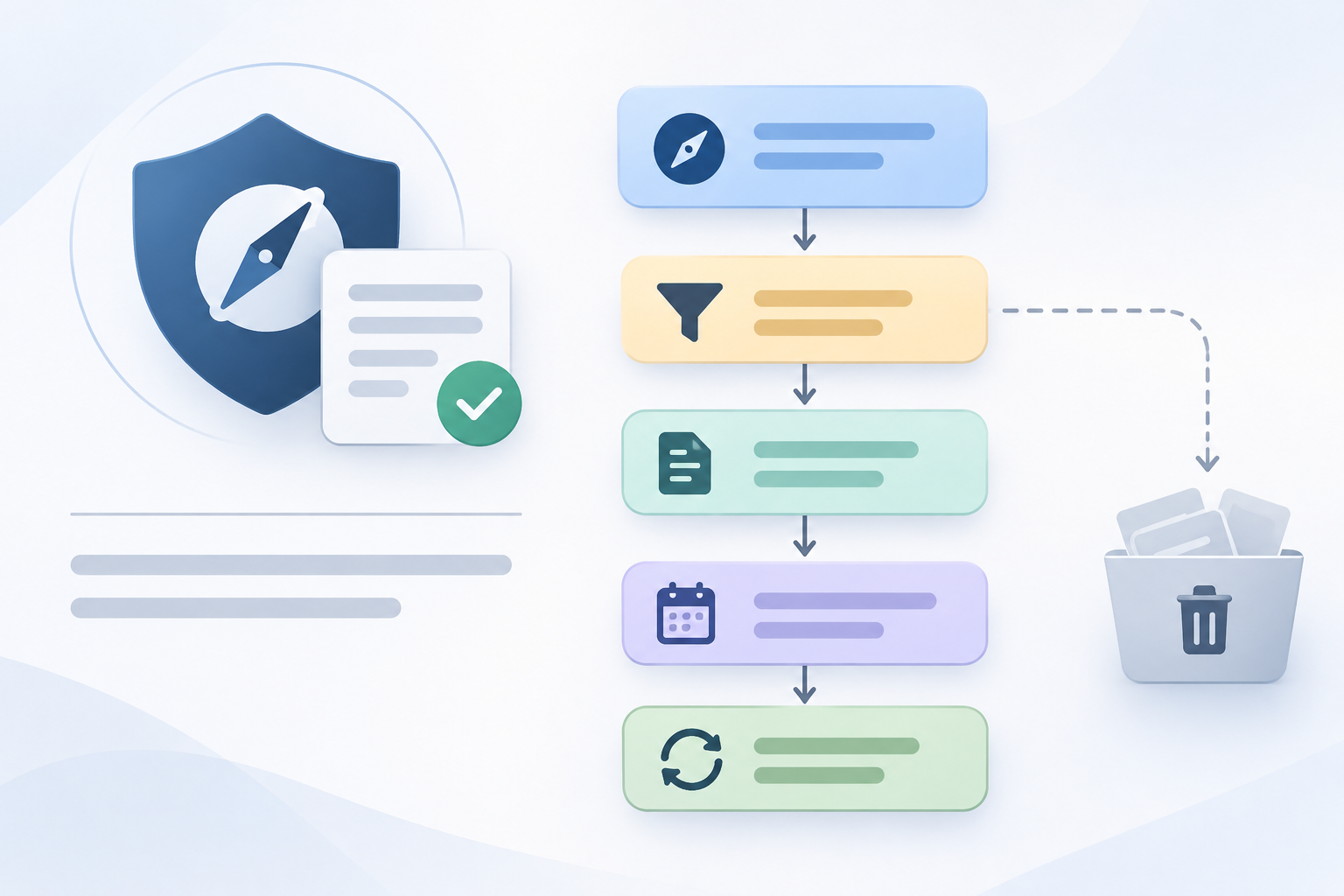
Set direction before choosing topics
At the start of the focus window:
- Write the direction statement: audience, buyer problem, business priority, and proof theme.
- Set operating constraints: one core channel, weekly time cap, definition of done, and active-draft limit.
- Create or refresh the Not yet list.
- Gather candidate topics from customer questions, sales objections, product education needs, and supportable expertise.
- Run the filter and score before adding topics to the calendar.
The order matters. If you choose topics first, it is easy to write a direction statement that merely justifies a random list.
Give every planned post a short brief
A calendar item needs more than a title. Use these required fields:
- Chosen reader: the situation this is for
- Problem or objection: what they are trying to solve or decide
- Angle or promise: the useful outcome of the piece
- Proof source: a process, example, source, or other supportable material
- Next step: what the reader can reasonably do after reading
- Core channel: where the full version will appear
- Definition of done: the smallest version that meets your standard
An illustrative brief might identify a small-service-business founder with many ideas but no steady content rhythm; name the problem as too many decisions at the start of every post; and promise a four-part direction statement that makes weekly topic selection faster.
Track stages, not only dates
Use a visible workflow:
Captured → Outlined → Drafted → In review → Scheduled → Published → Repurposed
At the weekly check-in, move one priority item forward one stage. If it cannot move, identify why.
- Stuck in Captured may mean it does not pass the filter.
- Stuck in Outlined may mean the promise or proof is unclear.
- Stuck in Drafted may mean the piece is too broad or lacks review time.
- Stuck in In review may mean approval capacity—not direction—is the problem.
This stops every blockage from becoming a reason to change the whole plan.
Use capacity limits as guardrails
Set limits such as one core channel for the focus window, one audience focus, a fixed weekly time budget, no more than one or two active drafts, and a realistic definition of done.
When the week changes, keep the direction and reduce the scope. A practical recovery sequence is:
- Cut the topic down to one reader question or objection.
- Use a pre-approved backup topic that already fits the direction.
- Move the larger piece back into the plan rather than rushing an unrelated post.
- Review the time cap at the next planning session, not in the middle of a draft.
Keep adjacent topics without blocking useful ideas
Guardrails fail when they become broad bans instead of clear boundaries.
There is a useful parallel in AI guardrail design. OpenAI’s Off Topic Prompts documentation describes a check that evaluates content against a defined business scope. Clear scope is necessary for that type of check to be useful.
AWS makes a related point in its guidance on denied topics: a broad domain label can block requests that are close in meaning but should still be allowed. Its guidance recommends defining the intention being refused rather than merely naming a broad subject area such as finance or legal. See Best practices for writing Denied Topics in Amazon Bedrock Guardrails.
For editorial planning, the equivalent is not “we never write about AI.” It is:
> During this focus window, we will not publish broad AI commentary unless it helps our chosen reader solve the current planning problem and we can support the point with relevant proof.
That leaves room for adjacent topics that genuinely serve the same reader and problem.
Use the three-question adjacency rule
Before approving an adjacent idea, ask:
- Same reader? Would the selected audience see this as relevant to their current situation?
- Same problem chain? Does it remove friction on the path toward the problem or decision you are addressing?
- Supportable proof? Can you provide an honest example, process, or source-backed explanation?
If all three answers are yes, the topic may fit. If one is no, place it on the Not yet list.
A monthly and weekly guardrail checklist
Use this as a recommended operating routine.
At the start of the focus window
- [ ] Choose one audience slice.
- [ ] Choose one buyer problem or objection.
- [ ] Choose one business priority.
- [ ] Choose one proof theme.
- [ ] Write a one-sentence direction statement.
- [ ] Set one core channel and a realistic cadence.
- [ ] Set a time cap and limit active drafts.
- [ ] Define what done means for the format.
- [ ] Create or refresh the Not yet list.
- [ ] Score candidate topics before scheduling them.
Before a topic gets a calendar slot
- [ ] Does it address the chosen reader’s problem?
- [ ] Does it support the current business priority?
- [ ] Can we support it with honest proof?
- [ ] Is there a natural next step for the reader?
- [ ] Can we finish it within the available time?
- [ ] Does the brief include reader, problem, promise, proof, channel, and definition of done?
During the weekly check-in
- [ ] Move one priority item forward by one stage.
- [ ] Name the blocker if it cannot move.
- [ ] Shrink scope before extending the deadline.
- [ ] Capture new ideas, but do not promote them mid-week.
- [ ] Use a pre-approved backup when needed.
- [ ] Keep the focus window unless a real business change calls for an update.
Frequently asked questions
How long should a content focus window last?
A four- to eight-week window is often practical for founder-led marketing. It is long enough to repeat a message and create related posts, but short enough to revisit as business priorities change.
Use a shorter window if your schedule is unpredictable or you are testing a new message. Use a longer one when a complex offer needs more repetition. The key is not the exact number of weeks; it is avoiding a new direction every time a fresh idea appears.
What if content direction keeps changing with new ideas?
Keep capturing ideas. The goal is not to become less curious or creative.
Separate capture from promotion. Capture ideas whenever they arise. Promote them into the active plan only during a planning review, after they pass the current filters. A meaningful change in customer needs, product direction, or business priority can justify a reset. Curiosity alone usually does not.
How do I decide whether an adjacent topic belongs?
Use the adjacency rule: same reader, same problem chain, and supportable proof. If the topic helps the same reader make progress on the same decision, it may be a useful supporting piece.
If it serves a different reader, requires a different offer, or lacks credible proof, add it to Not yet. Parking an idea is not rejecting it; it protects the current plan.
Can AI help review off-topic drafts?
AI can be used as a review prompt when you provide a clear direction statement and post brief. For example, it can help identify sections that appear unrelated to the intended reader, problem, proof, or next step.
It should not make the strategic decision for you. A tool cannot choose your current business priority, and an overly narrow rule can exclude useful adjacent content. Use it as one review input, not as the owner of editorial direction.
Clear enough to say “not now”
The goal of content direction guardrails is not rigid marketing. It is enough clarity to say “not now” without losing a good idea.
Choose a temporary audience, problem, priority, and proof theme. Use them to filter and score ideas. Carry those decisions into each post brief. Make workflow stages and capacity limits visible. Then revisit the Not yet list when the focus window ends.
That is how content stays connected without becoming repetitive: make a few deliberate decisions, then hold them long enough for the message to build.