
A founder-focused content planning system vs ad hoc posting is not a choice between being strategic and being spontaneous. It is a choice about where you want to make decisions: once, in a simple repeatable process, or every time you need to publish.
Ad hoc posts can be useful. A customer question, product update, or timely insight may deserve a quick response. But if ad hoc posting is your only method, content often stops when delivery, sales, or hiring gets busy. A lightweight system gives you direction and a next step before that happens.
The practical difference: a system reduces repeat decisions
Ad hoc posting starts with a blank page. You decide what to say, who it is for, which format to use, and how to end it each time. That can feel fast on a good day. Over time, it creates a steady stream of small decisions.
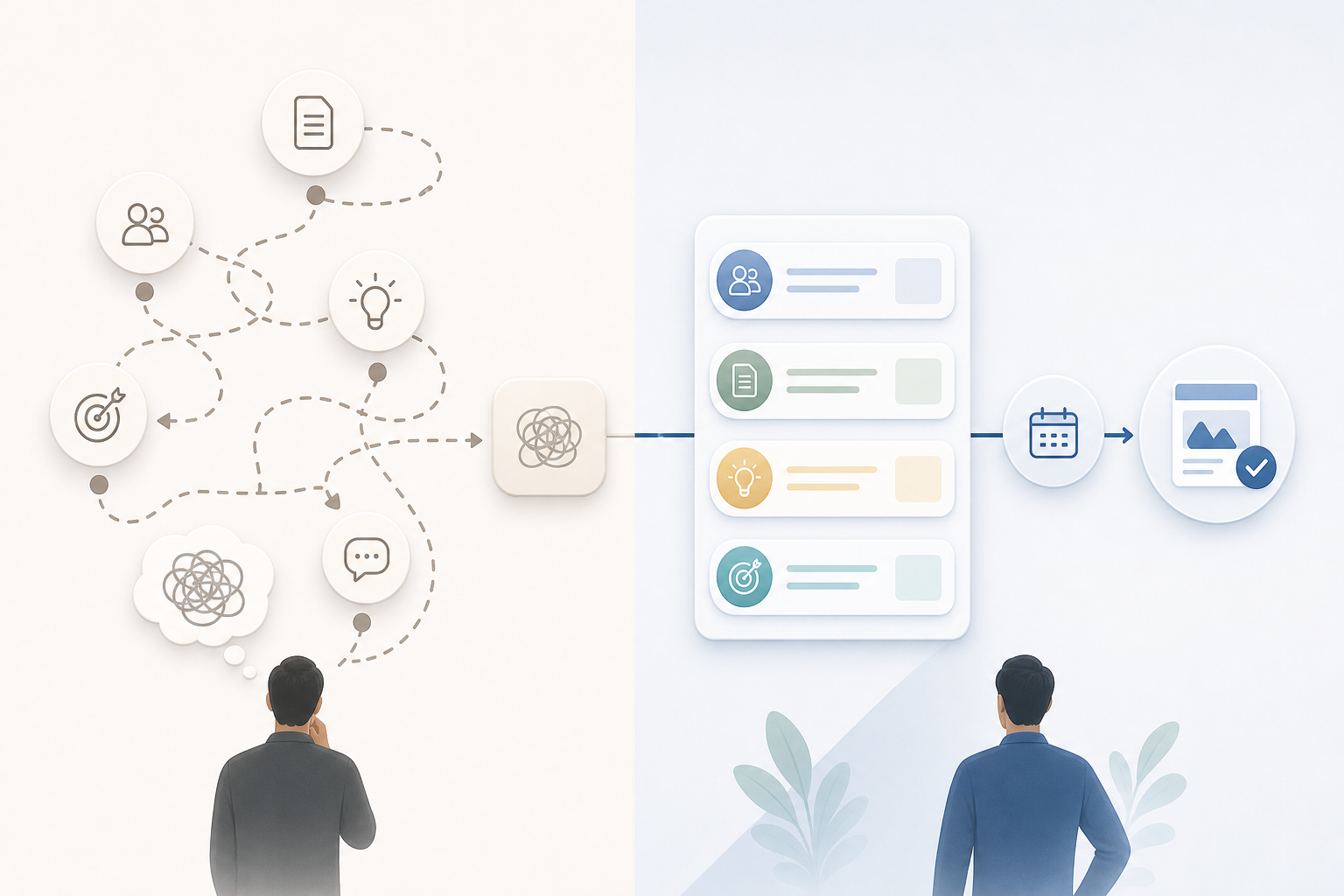
A founder-focused system saves those decisions in advance. It connects your content to your offer, audience, buyer problems, and preferred next step. It does not need a large spreadsheet or a complex tool stack.
| Area | Ad hoc posting | Founder-focused planning system |
|---|---|---|
| Topic choice | Chosen in the moment | Drawn from a small, prioritised queue |
| Message | Can shift from post to post | Built around agreed themes and buyer problems |
| Publishing | Depends on spare time and energy | Uses a cadence that fits the business |
| Calls to action | Often added late or omitted | Matched to the purpose of the content |
| Learning | Hard to compare unrelated posts | Easier to review by theme, format, and outcome |
| Flexibility | High, but can become reactive | Planned work with room for timely posts |
The point is not to make every post look the same. It is to make the underlying choices clear enough that you can publish without reopening your whole marketing strategy.
A calendar alone is not a strategy. Strategy sits above the calendar: it explains the audience, business goal, themes, and action each piece should support. That distinction is also central to this overview of content strategy.
Outcomes founders can expect from each approach
The clearest difference is not the number of posts you publish. It is whether those posts build a coherent path from attention to a useful next conversation.
Consistency when the business gets busy
Ad hoc posting relies on finding time. When the week fills with client work, product issues, or sales calls, content is easy to defer because there is no prepared next item.
A system gives you a small backlog and clear defaults. You may still miss a week, but you do not have to restart from zero. For solo operators, a content planning system for a founder with no team should be light enough to survive busy weeks rather than add another project to manage.
Clearer positioning
Without direction, a feed can become a mix of opinions, announcements, general advice, and occasional offers. Each individual post may be fine. Together, they may not explain what your business does or why a buyer should care.
A system uses a few recurring themes. For example, a B2B founder might publish around:
- the costly problem their buyers face;
- the approach or process they use to solve it;
- proof, lessons, and objections from real work.
That structure helps a reader recognise your point of view over time. It also makes it easier to reuse an idea as an article, email, or sales follow-up.
More useful measurement
Ad hoc content can attract attention, but it is difficult to learn from when every post has a different audience, goal, and call to action. A system makes comparison possible. You can ask whether one theme earns more replies, whether a certain format leads to more site visits, or whether a CTA starts more conversations.
This does not require a large dashboard. Track one signal for awareness, one for engagement, and one for conversion:
- Awareness: impressions, reach, or article visits;
- Engagement: replies, saves, or email clicks;
- Conversion: qualified inquiries, demo requests, or email sign-ups.
Choose measures you can access and that relate to how you sell. A save may be useful, but it is not the same as a sales conversation. Keep those distinctions clear.
Better handoff and reuse
A documented system is easier to share with an assistant, freelancer, or future hire. It also gives you raw material for more than one channel. A buyer question can become a short post, a longer article, a sales enablement note, and a section of a newsletter.
That does not mean every idea must be repurposed everywhere. It means you capture good ideas before they disappear.
Why content planning feels overwhelming as a founder
Content planning feels overwhelming as a founder because publishing is only the visible part of the job. Behind one post are several decisions: what the audience needs, what the business needs, what you can credibly say, what format fits, and what happens after someone responds.
The problem grows when you try to plan too many channels, serve too many audiences, or copy a system designed for a full marketing team. If this is familiar, read why content planning feels overwhelming as a founder for a closer look at the pressure points.
When you do not have a clear niche
Content planning without a niche feels scattered when “niche” becomes a reason to delay all decisions. You do not need a permanent label before you start. You need a working anchor for the next planning period.
Use four prompts:
- Audience: Who are you trying to help first?
- Problem: What costly or frustrating job are they trying to solve?
- Offer: How does your business help them move forward?
- Proof: What can you honestly show or explain that supports the offer?
For example, “operations leads at growing software firms who need cleaner team handoffs” is a more useful content anchor than “business advice.” It gives you buyer questions, examples, and boundaries without forcing you into a lifelong niche decision.
The common mistakes that make a system fail
Many founder-focused content planning mistakes are really design mistakes:
- Too much complexity: A detailed system feels productive until it needs more upkeep than the publishing itself.
- Topics before direction: A long idea list does not help if you have not decided who the content is for or what it should support.
- Too many pillars: Six or eight themes dilute attention. Start with three.
- No review loop: Without a short review, you cannot tell what to repeat, refine, or drop.
- No definition of done: Drafts linger when “publishable” has no clear standard.
These issues explain why your content planning system never sticks more often than a lack of motivation does. The answer is usually a smaller system, not a more ambitious one.
When ad hoc posting is the right choice
Ad hoc posting is acceptable when speed adds real value. Use it for a timely product update, an insight from a customer conversation that you can share safely, a market change, or a useful lesson that does not need weeks of preparation.
The key is that spontaneous content should support your direction rather than replace it.
Use a simple boundary
Keep most of your publishing plan-led, then leave a small amount of room for timely work. The exact mix will vary by business and channel. What matters is that unplanned posts do not crowd out the core content that explains your offer and helps buyers make a decision.
Capture spontaneous ideas in one place. Add a short label such as “customer objection,” “launch,” “proof,” or “market response.” During your next review, decide whether the idea should be published now, added to a series, or discarded.
Watch for these warning signs
Ad hoc posting is no longer helping when:
- you regularly ask what to post on the day you intend to post;
- your message changes from week to week;
- you publish opinions but rarely explain your offer;
- you have ideas but no durable content that answers buyer questions;
- your content disappears during your busiest and most important periods.
In those cases, a founder-focused content planning system vs ad hoc posting comparison should favour a system-first approach. Keep the spontaneous post; remove the need to improvise the entire programme.
A structured content planning method for founders
A workable system is an operating loop: discovery → direction → queue → draft → review → publish → learn. Content Redefined AI is designed around this kind of structured approach: helping businesses introduce themselves clearly, direct their content, and maintain a consistent publishing schedule.
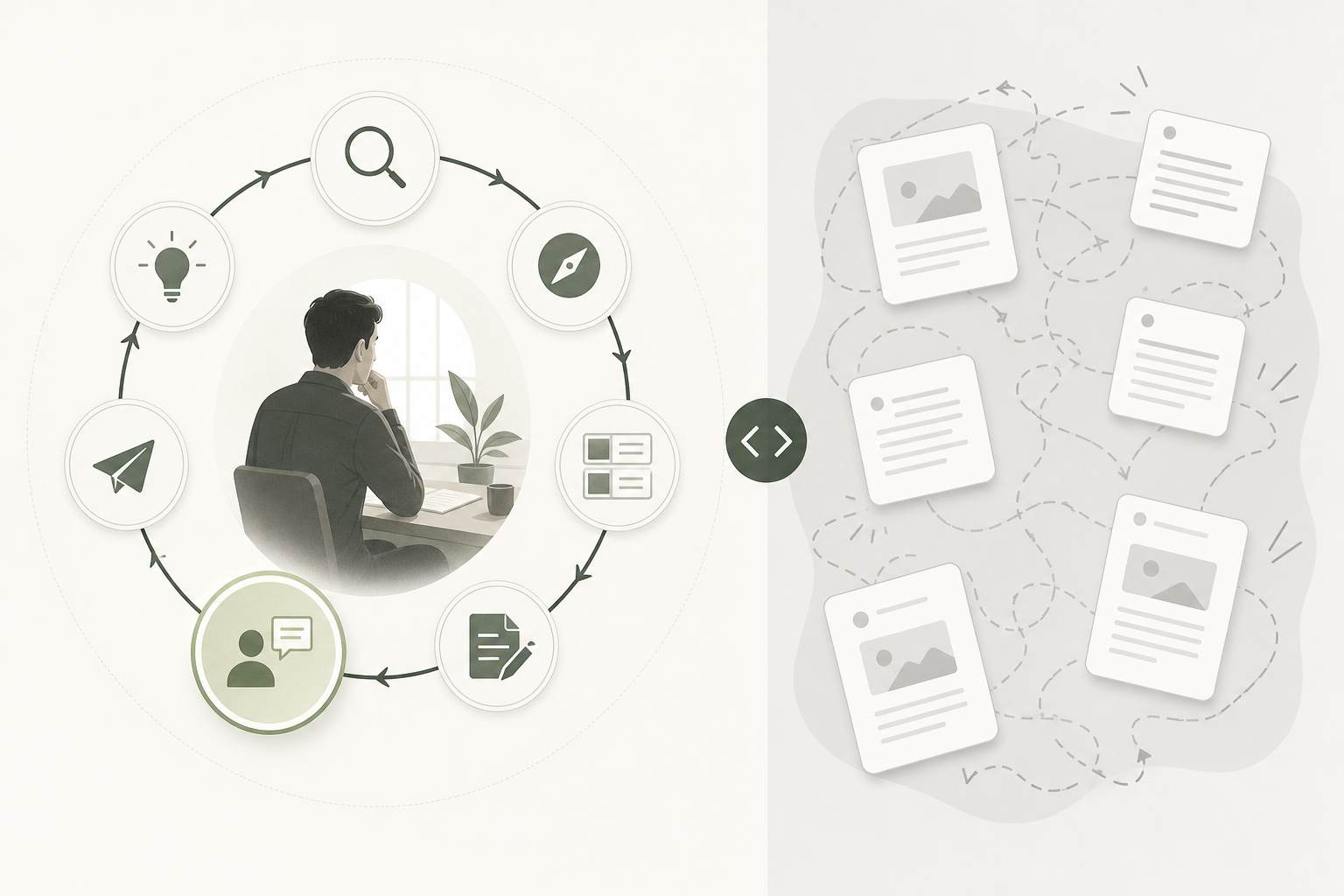
Here is a version you can run without turning content into a second full-time job.
1. Write a one-page business brief
Use plain language. Include your offer, primary audience, three buyer problems, available proof, and one main call to action. Update it when the business changes.
This brief is your filter. If a topic does not help that audience understand a problem, your approach, or a next step, it may not belong in the current plan.
2. Choose three content themes
Keep themes broad enough to generate ideas but specific enough to guide choices. A service business might use:
- buyer problems and misconceptions;
- your method, process, or point of view;
- proof, stories, and answers to objections.
Under each theme, list a few questions buyers already ask. This is more useful than collecting generic content prompts.
3. Maintain a short rolling queue
Plan the next four to eight pieces, not the next year. Give each item a working title, intended audience, theme, format, and one desired action.
A short queue protects momentum while leaving room to change course. Pair it with a weekly founder content planning operating rhythm so planning has a regular home in your week.
4. Set a sustainable cadence and a clear review step
Choose one primary channel and a pace you can keep through a demanding month. For many founders, one useful post per week and one deeper piece per month is more credible than a burst of daily publishing followed by silence.
Before publishing, check four things:
- Is the point clear to the intended buyer?
- Does the example or claim have support?
- Does the content sound like the business?
- Is there a relevant, low-pressure next step?
AI can assist with outlines, first drafts, and editing. It cannot supply your business judgment, customer knowledge, or approval. Keep those decisions with the founder.
5. Review monthly and adjust one thing
At the end of the month, review the three measures you selected. Note which theme, format, or CTA led to meaningful attention or conversations. Then make one change to next month’s queue.
Do not rebuild the system after one quiet post. Look for patterns across a useful sample of work, and consider the wider sales context before crediting content for a result.
How Content Redefined AI fits the system-first approach
A planning platform can be useful when it reduces the work between direction and a publishable draft. It should not take ownership away from the business.
Content Redefined AI provides a structured method for founders to describe their business, set content direction, and maintain a consistent publishing rhythm. The aim is not to replace founder review. It is to make the next decision clearer, so content does not depend on a burst of spare time or inspiration.
If you are weighing software against outside help, compare the level of direction, review, and ongoing involvement you need in this guide to a content planning platform vs hiring a content strategist.
Frequently asked questions
Do I need a niche before I build a content plan?
No. Start with one audience, one problem, one offer, and the proof you can share honestly. Treat that as a working position for the next month or quarter. Refine it as you learn more.
How often should a founder publish?
Publish at a pace you can maintain. Consistency is more valuable than an intense schedule you abandon. Choose a cadence that leaves time for the work that creates genuine insight: serving customers, talking to prospects, and improving the product.
What should I track if I dislike analytics?
Track posts shipped, one engagement signal that matters on your channel, and qualified conversations or inquiries. Review them once a month. Add a brief note about what the post covered and why it may have worked.
Can AI replace content planning?
No. AI can help prepare and improve content, but it cannot decide your business priorities or verify what is true about your customers and offer. A useful process starts with founder direction and ends with founder review.
A simple system gives you a reliable base. Use ad hoc posting when a timely moment deserves it, but do not make it carry the whole job. If you want a more structured way to move from business context to a steady content queue, consider Content Redefined AI on a monthly subscription.