
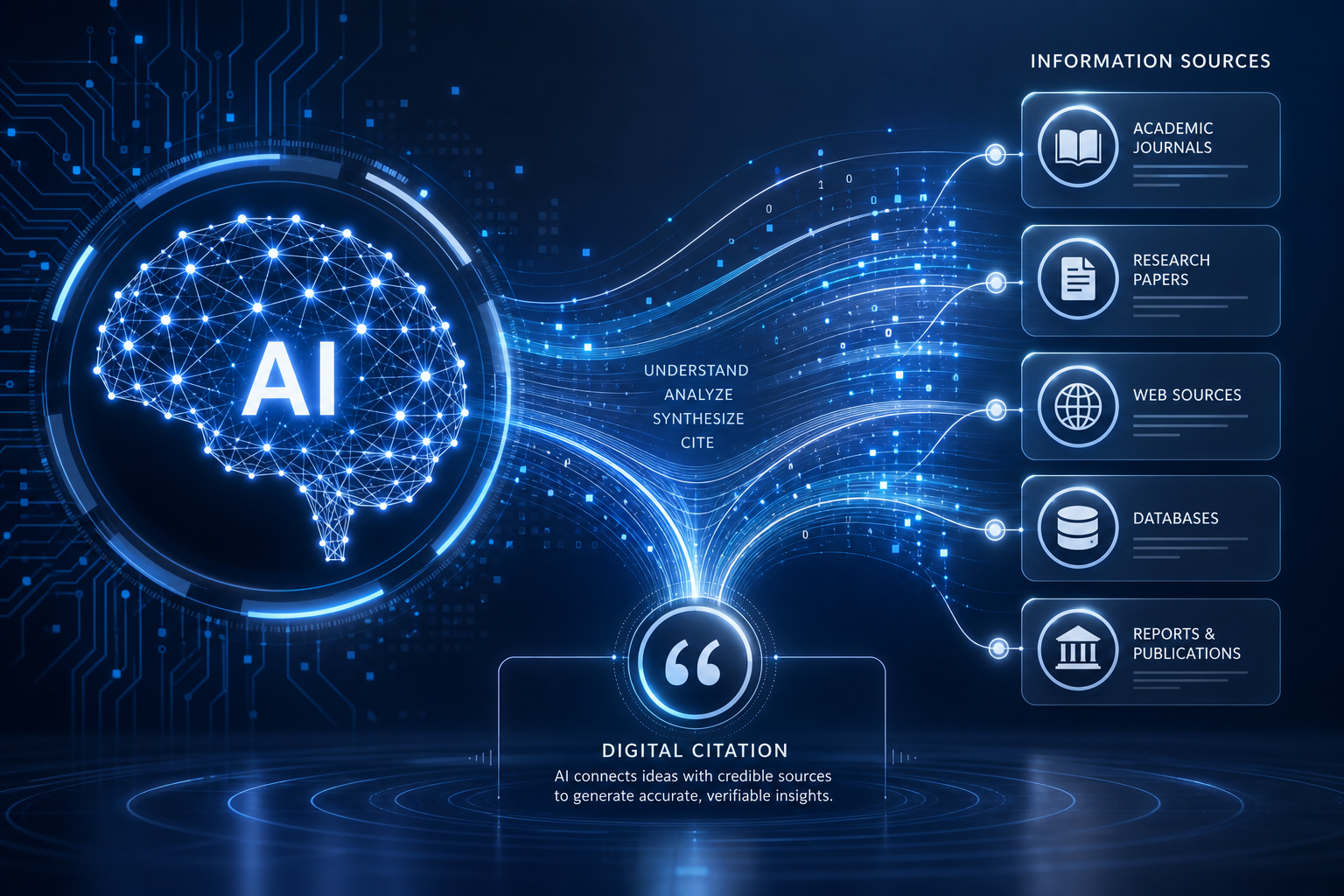
If you’re searching for how to get cited by ChatGPT, start with the right mental model. ChatGPT is a conversational interface built on AI models that generate text from patterns in data, not a traditional index of web pages. What it outputs can be influenced by settings, tools (like browsing), and its Terms and Privacy Policy—which affect what data may be used, stored, or referenced. That’s why “citations” can look authoritative while still being hard to verify.
ChatGPT vs search engines: why citations aren’t guaranteed
Unlike Google, ChatGPT doesn’t consistently show sources, and it may produce references that appear real but are incorrect (a known issue often called “hallucinated citations”). Treat any citation-like output as a lead, not proof. Actionable tip: always verify by searching the exact title/DOI/URL, and cross-check in Google Scholar, Crossref, or the publisher site.
When ChatGPT may mention sources (and when it won’t)
There are three different outcomes people confuse:
1) Being mentioned by the model in an answer (brand or concept recall; no link required).
2) Being linked in a browsing/search experience (the tool pulls web results and may attribute them).
3) Being cited in an academic paper that used ChatGPT (the author, not ChatGPT, chooses the references).
You can’t “submit your site to ChatGPT,” but you can increase the odds of How to get mentioned by ChatGPT by publishing clear, widely referenced content (original data, definitions, FAQs), earning reputable backlinks, and being consistently described across trusted profiles.
Why competitors are thin: common misconceptions and missing context
Many guides imply you can force inclusion or “train” ChatGPT directly—misleading at best. A realistic approach is to make your brand easy to identify (consistent name, author bios, citations to primary sources) and easy to quote (statistics, methodology, downloadable assets). Next, we’ll turn these principles into a practical checklist you can implement.
How ChatGPT uses data: model improvement disclosure, user consent, and privacy basics
Model improvement disclosure: what it is and why it matters
Many AI services publish a model improvement disclosure explaining whether user interactions (prompts, responses, feedback) may be reviewed or used to improve systems. This matters for anyone asking how to get cited by ChatGPT, because “getting into the model” is not the same as being cited from public sources. Even when data is used for improvement, it’s typically aggregated, filtered, and not treated like publishable reference material.
A practical example: a support chat where you paste a proprietary report might help the system detect patterns (e.g., common questions), but it won’t reliably make your brand a future “source.” Citations usually come from information the model can ground in widely available, attributable content.
User consent and opt-out: what users control
User consent often determines whether chats can be used for training or model improvement. Many products offer settings to opt out, and business/enterprise plans frequently limit or exclude training on customer data. That means private conversations are an unreliable route for “teaching” the system your claims, product specs, or research.
Actionable tip: treat private prompts like confidential email. If you want information to be learnable and cite-worthy, publish it on indexable pages, earn mentions from reputable sites, and use consistent entity signals (same brand name, authors, and citations across the web).
Privacy Policy, Terms, and data usage in plain English
At a high level, data usage may include account details, device data, and conversation content for safety, debugging, and product improvement—outlined in the privacy policy and Terms. Private/paid contexts differ from public web content because access, retention, and training permissions can be restricted.
Always check the service’s Terms and privacy policy for current specifics. Next, we’ll turn these privacy realities into ethical, practical tactics to increase your chances of being cited.
The realistic paths to being mentioned: where ChatGPT can pull information from
Public web visibility: the foundation for AI discoverability
ChatGPT outputs often mirror patterns found across widely available public information, not private claims or one-off posts. If your brand is hard to find (or inconsistently described), it’s harder for models and retrieval tools to “learn” or surface you. A strong, crawlable web presence is the baseline for How to get mentioned by ChatGPT in a realistic, ethical way.
Actionable tip: publish a clear About page, a dedicated “Press/Media” page, and evergreen pages that others can cite (original data, benchmarks, checklists). For example, a yearly industry report that earns links from reputable sites is far more “mentionable” than a thin landing page.
Third-party sources AI tends to rely on (directories, knowledge bases, media)
Mentions are heavily influenced by credible third-party sources: reputable publications (trade journals, major blogs), Wikipedia/Wikidata (when you meet notability guidelines), industry associations, academic citations (Google Scholar-indexed papers), GitHub repositories and official docs, and high-quality Q&A sites (e.g., Stack Overflow). These sources create repeated, consistent references that models tend to reflect.
Tip: aim for a handful of strong citations rather than dozens of low-quality listings. One association profile plus a respected media feature can outweigh 50 generic directories.
Brand/entity signals: how AI models recognize you as “a thing”
Entity building is about consistency and corroboration: one canonical name, matching bios across platforms, and structured data (Organization schema, sameAs links, author markup). Ensure your founders/authors have consistent author pages and bylines, and that your brand is cited the same way across the web.
On How to get cited by chatgpt reddit: forum mentions can help discovery, but they’re unreliable and can backfire if they look spammy or astroturfed. Focus on genuine, helpful participation and verifiable references.
Next, we’ll turn these paths into a practical, step-by-step plan you can execute.
Action plan: optimize your content so ChatGPT is more likely to reference it
Publish “citation-ready” pages: definitions, stats, and original research
If you want to learn how to get cited by chatgpt, start by publishing pages that are easy for humans (and AI models) to quote. Prioritize linkable assets: original datasets, industry benchmarks, calculators, templates, glossaries, and “best practices” pages that consolidate scattered information.
Examples that earn citations: a quarterly benchmark report (e.g., “2026 Email Deliverability Benchmarks”), a ROI calculator with documented assumptions, or a glossary that defines niche terms with sources. Add “Key takeaways” bullets and a table of metrics so readers can cite numbers accurately.
Strengthen E-E-A-T signals on-page
ChatGPT tends to echo information that looks credible and consistently presented across the web. Make every claim verifiable: cite primary sources, include publication and “last updated” dates, and explain methodology (sample size, timeframe, tools used, and limitations).
Add a references section at the bottom with full citations and links. Also include author credentials (role, years of experience, relevant certifications, and links to prior work). This helps readers verify what ChatGPT summarizes and reduces the risk of vague or misattributed claims.
Technical SEO and accessibility basics that support machine readability
Technical hygiene increases the odds your content is discoverable and parseable. Use this checklist: pages are indexable (no accidental noindex), load fast (aim for Core Web Vitals “good” thresholds), use clean HTML, descriptive H1–H3 headings, and meaningful alt text for charts and screenshots.
Set canonical tags to prevent duplicates, fix broken links, and avoid intrusive interstitials that block content. If you publish data tables, provide downloadable CSVs or clearly labeled table headers to reduce ambiguity when others reuse your numbers.
Use structured data and clear attribution
Implement structured data where appropriate: Organization, Person, Article, and FAQPage (only when the page truly contains FAQs). Add sameAs links to official profiles (LinkedIn, Crunchbase, Wikidata, GitHub) to strengthen entity clarity.
Finally, make attribution effortless: use an unambiguous brand name in the header/footer, a unique page title, and consistent author naming. When someone asks ChatGPT “where is this stat from?”, your page should be easy to reference correctly—next, we’ll cover realistic promotion and distribution tactics to earn those third-party citations.
How to encourage accurate citations and reduce hallucinated references
ChatGPT can generate plausible-but-wrong citations because it predicts text patterns rather than “looking up” sources in real time. In practice, that means a convincing author/title/year combo can be fabricated or mixed from multiple sources—so readers should always verify any ChatGPT reference link by clicking through and checking the page, date, and publisher.
Design pages that are easy to cite correctly
Make key bibliographic details unmissable: author name(s), organization, publication date, and “last updated” date placed near the top and repeated in the footer. Avoid conflicting timestamps (e.g., a 2023 header with a 2021 schema date). Add Article/BlogPosting schema with datePublished, dateModified, and author; clear metadata reduces ambiguity that can trigger made-up references.
Provide canonical reference formats (APA/MLA/Harvard)
Publish a single “source of truth” citation block. For example: “Last updated: 18 June 2026” and “By: Jane Doe, PhD” should match your schema and page copy. This also helps users who rely on a ChatGPT citation generator: they can compare the AI output to your canonical format and spot errors fast.
Create a “Cite this page” module and stable URLs
Add a “Cite this page” section with preformatted APA 7, MLA, and Harvard citations plus a stable permalink (avoid UTM-heavy URLs). If your audience is academic or technical, offer BibTeX/RIS downloads. Pair this with a brief “Use a Chatgpt citation checker” note to encourage verification—then lead into the next section on building authority signals that increase mention frequency.
How to check ChatGPT citations and verify mentions of your brand
Manual verification workflow (fast and reliable)
If you’re wondering How to check ChatGPT citations, use a repeatable checklist rather than trusting the link list at face value. First, ask ChatGPT for sources (e.g., “List 5 sources with URLs for this claim and quote the exact sentence you used”). Then verify each citation independently: open every link in a browser, confirm the author, title, publisher, and publication date, and make sure the quoted claim actually appears on the page (use Ctrl/⌘+F to find it fast).
Next, watch for hallucinated metadata. If ChatGPT provides a DOI, run it through doi.org; if it 404s or resolves to a different paper, flag it. Do the same for suspicious URLs (odd domains, tracking parameters, or pages that don’t exist).
Tools and tactics: search operators, alerts, and link monitoring
Automate monitoring so you catch mentions early. Set up Google Alerts for queries like "Your Brand" + "according to" and "Your Brand" + "study"; while not perfect, alerts can surface new pages within hours to days. Use search operators to validate coverage: site:example.com "Your Brand" or "Your Brand" AND "pricing".
For link monitoring, use tools like Ahrefs, Semrush, or Google Search Console to track new backlinks and anchor text tied to key claims.
Chat review: capturing prompts/outputs for audit trails
Maintain a chat review log: save prompts, model/version (e.g., GPT-4.1), date/time, and settings, because ChatGPT outputs can vary across versions and sessions. Screenshot or export outputs so you can reproduce results during audits and outreach—then move into how to strengthen the pages ChatGPT is most likely to reference next.
FAQ: ChatGPT citations, academic styles, and ethical use
Can I use ChatGPT to generate citations?
Yes—Can I use ChatGPT to generate citations is a common question, and the practical answer is that ChatGPT can format citations quickly (MLA, APA, Harvard), but it can also invent or mis-state bibliographic details if the source data you provide is incomplete. Treat it like a formatter, not a verifier.
Actionable tip: paste the exact source metadata (author, title, journal, DOI/URL, publication date) and then cross-check the output against the official guide (e.g., MLA Handbook, APA Style). A simple accuracy check is to verify the DOI/URL resolves and matches the title and author list before you submit.
How to cite ChatGPT in MLA works cited?
For How to cite ChatGPT in MLA works cited, MLA has evolving guidance, so confirm the latest recommendations. A widely used template looks like this:
Template (MLA): OpenAI. “Description of prompt or conversation.” ChatGPT, model/version, Day Month Year, URL.
Example: OpenAI. “Explain the difference between correlation and causation with an example.” ChatGPT, GPT-4, 18 June 2026, https://chat.openai.com/.
If your institution requires it, include the full prompt and keep a copy of the output you relied on.
How to reference ChatGPT APA 7 (reference list and in-text)?
For How to reference ChatGPT APA 7, APA typically treats ChatGPT as software or an algorithmic output, depending on use. Here’s a practical approach that also answers How to cite ChatGPT APA and How to cite chatgpt apa in text:
Reference (APA 7): OpenAI. (Year, Month Day). ChatGPT (Model/version) [Large language model]. URL
In-text (APA): (OpenAI, Year) If the response is likely to change, add a retrieval date: “Retrieved Month Day, Year, from …” and consider including the prompt in an appendix or supplementary file.
How to reference ChatGPT Harvard style?
For How to reference ChatGPT Harvard style, use your university’s Harvard variant, but generally include:
Template (Harvard): OpenAI (Year) ChatGPT (version/model), response to “prompt/description”, Day Month Year. Available at: URL (Accessed: Day Month Year).
Ethics note: disclose AI assistance where required, follow institutional policies, and comply with the tool’s Terms—especially if you’re aiming to be cited by ChatGPT through credible, transparent work. Next, we’ll look at practical ways to increase the odds your content gets surfaced and mentioned.