
If you want to know how to keep consistent content with limited time, do not start by aiming for daily posts. Start with a publishing promise you can keep during a busy week.
For most founders, consistency means one useful piece on a reliable schedule for 8–12 weeks. The goal is not to be everywhere. It is to make content production predictable enough that it does not compete with sales, customers, or delivery.
Define a publishing minimum you can sustain
A useful publishing system has three parts:
- Frequency: how often you publish
- Format: what you publish
- Reliability: when the work happens and when it goes live
Choose the smallest version that still helps your audience. If a schedule only works in a quiet week, it is not your real schedule.
A practical minimum is one core piece each week: a short article, newsletter, customer question answer, video, or podcast episode. Keep the same format and publishing window for at least eight weeks before changing the system.
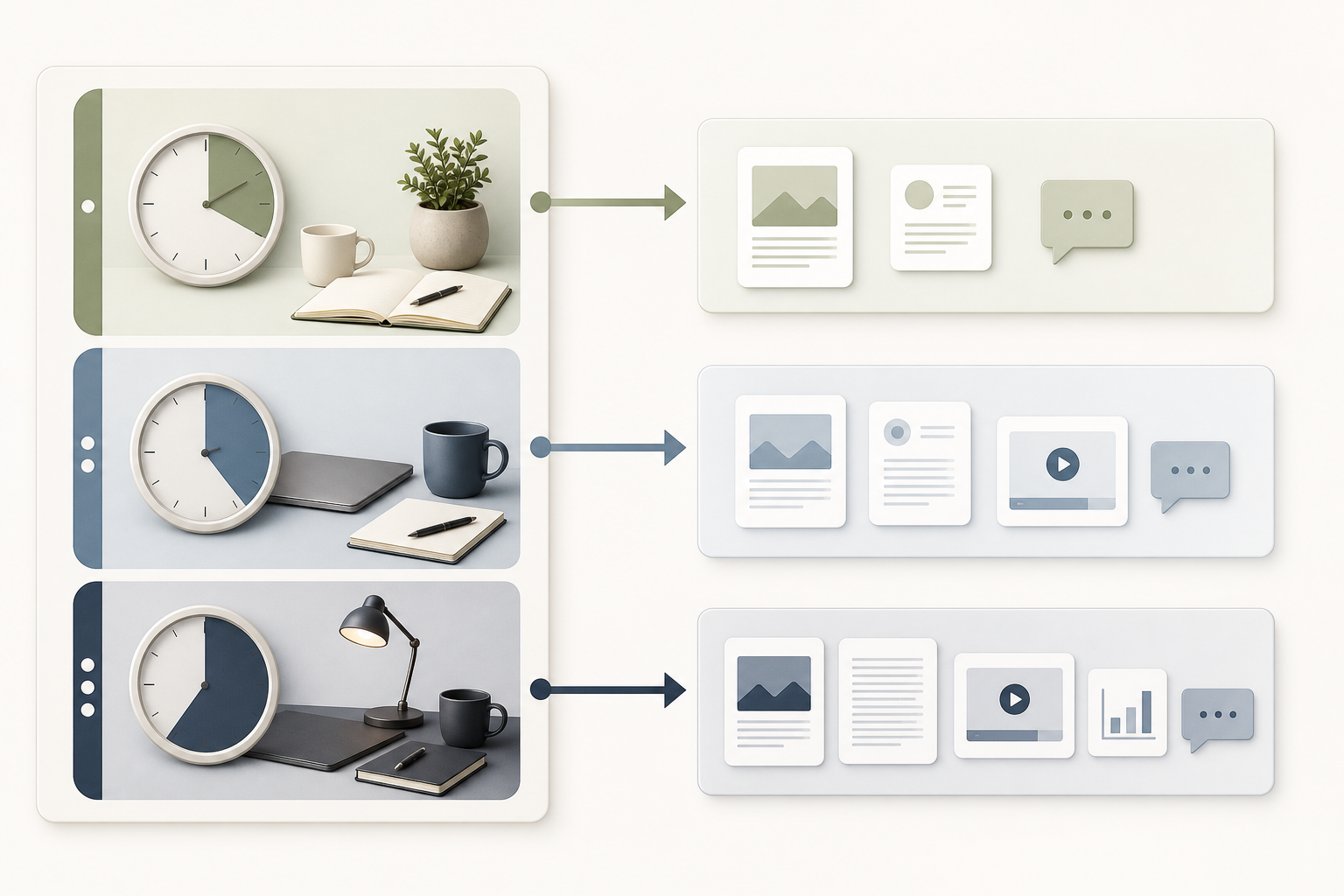
Choose a weekly time budget
Use your available time, rather than an ideal posting frequency, to choose a system.
| Weekly time | What to publish | What to avoid |
|---|---|---|
| 90 minutes | One short post, newsletter, or answer to a customer question | Custom design work, deep research, and multi-channel campaigns |
| 3 hours | One useful core article or newsletter, plus one or two short repurposed posts | Daily posting and complex production |
| 5 hours | One in-depth core piece, planned distribution, and a reusable asset | Adding new channels before the current workflow works |
If a week gets crowded, reduce the scope of the piece instead of skipping the cadence. A 500-word answer that solves a real buyer question is more useful than a half-finished guide that never ships.
Pick one primary format and one distribution channel
For the next 8–12 weeks, choose:
- One primary format: blog post, newsletter, short video, podcast, or webinar recap.
- One secondary channel: the place where you will share it once, such as email or LinkedIn.
This rule cuts decision fatigue. It also prevents a common founder trap: turning one idea into a seven-channel campaign before the core piece exists.
Blog posts and newsletters are often good starting points because they are easy to revise and useful in sales conversations. Video and podcasts can build trust, but they add recording, editing, and publishing work. Choose the format you can still complete when the week is messy.
Why founders struggle with consistent publishing
The issue is rarely a lack of ideas or discipline. More often, founders have too many decisions to make before they can begin: topic, audience, format, angle, examples, promotion, and call to action.
That hidden workload explains why founders struggle with consistent publishing. Writing may take an hour; deciding what to write, finding the right notes, and switching context can take much longer.
For a closer look at those blockers, read why founders struggle with consistent publishing.
Remove decisions before you try to add motivation
Consistency improves when you reduce choices. Set these defaults once:
- A fixed publishing day or publishing window
- Three to five repeatable topic themes
- One preferred format
- One template for each common post type
- One short review checklist
- One distribution action after publishing
For example, a B2B founder might rotate through onboarding, pricing, common objections, implementation, and lessons from customer conversations. Those themes make it easier to choose an angle without starting from a blank page.
If choosing topics is where your time disappears, see how founders waste time choosing content topics. The right topic is usually connected to a buyer question, an objection, or a decision that supports your offer.
Separate quality from polish
Quality does not mean perfect prose, elaborate visuals, or exhaustive research in every post. For a founder, quality usually means:
- The piece answers a real question.
- The claims are accurate.
- The advice is specific enough to use.
- The reader understands the next step.
Polish is different. It includes extra editing passes, custom graphics, complex production, and minor wording changes. Polish can help, but it should not stop a useful piece from being published.
A routine that helps you create and ship is more valuable than waiting for ideal conditions. As Jon Loomer notes in his guidance on consistent content creation, the practical challenge is finding a routine that lets you create faster and publish.
Build a lightweight editorial process for consistent publishing
A lightweight editorial process for consistent publishing should be small enough to run without a content team. You need a visible queue, a clear definition of done, and one review point.
Step 1: Set your content direction
Before filling a calendar, write down four things:
- Who you want to help
- The problem they are trying to solve
- What your business offers
- The next step you want the right reader to take
This prevents random publishing. It also makes content more useful because each piece has a purpose beyond “we need to post something.” If you need to clarify these choices, use a simple content strategy process before building a larger calendar.
Step 2: Create a small topic queue
Build a list of 10–20 topics before your next publishing cycle. Use material you already have:
- Customer questions
- Sales call notes
- Product demos
- Objections you hear repeatedly
- Internal explanations you send by email
- Founder stories and lessons that you can share truthfully
Give each topic one clear job: explain a problem, compare options, show a process, answer an objection, or help someone make a decision.
Do not try to fill a year of content. A short queue is easier to maintain and lets you adjust when you learn more about your buyers.
Step 3: Use a simple workflow board
Any task tool, document, or spreadsheet can work. Use only these stages:
Ideas → This week → Drafting → Review → Scheduled or published
Each content item needs five fields:
- Working title
- Reader question
- Topic theme
- Call to action
- Status
This is enough to see what is blocked. Avoid building a detailed production system unless you have a team that will maintain it.
Step 4: Protect three short blocks
Your weekly workflow can be as simple as:
- Plan (15–20 minutes): choose one topic, reader question, and call to action.
- Create (45–150 minutes): draft the core piece using a template.
- Review and publish (15–30 minutes): check accuracy, format it, publish or schedule it, and share it once.
Put these blocks on the calendar. Content work tends to slip when it is treated as an open-ended task rather than a scheduled commitment.
If calendar management itself is the bottleneck, automating a blog content calendar with AI can help reduce repetitive planning work. Keep approval and final publishing decisions under human control.
Create reusable post templates without sounding generic
Templates should remove structural choices, not remove your point of view. A good template gives you a reliable shape while leaving room for real examples, constraints, and recommendations.
Use a five-part brief before you draft
For each post, fill in these five prompts:
- Concept: What question will this piece answer?
- Customer: Who needs this answer?
- Core message: What is the main recommendation?
- Credibility: What can you support with a source, product knowledge, or a truthful example?
- Call to action: What should the reader do next?
This is a practical way to make reusable post templates. You are not creating a generic article; you are pre-deciding the questions every useful article must answer.
Template 1: Problem, cost, fix, steps
Use this for educational posts and customer FAQs.
- Problem: If you are seeing , the likely cause is .
- Cost: This creates ___ for your team or customer.
- Fix: A better approach is ___.
- Steps: Start with 1) , 2) , and 3) ___.
- Next step: If you need help with , consider .
Template 2: Decision guide
Use this when a buyer is comparing options.
- What decision is the reader making?
- When does option A make sense?
- When does option B make sense?
- What are the trade-offs?
- What would you recommend for a specific type of business, and why?
Be clear about uncertainty. A decision guide earns trust when it helps the reader see where the answer depends on their situation.
Template 3: Founder lesson or case-style post
Use this only when you can describe the experience honestly.
- Context: What were you trying to achieve?
- Constraint: What made it difficult?
- Approach: What did you decide to do?
- Result: What happened that you can verify?
- Lesson: What would you repeat, change, or avoid next time?
Do not invent results or turn a small observation into a broad claim. A useful lesson can simply explain the decision and its limits.
For a more structured way to turn your own background into multiple topics, see how to turn a founder story into a content series.
Automate preparation, not judgment
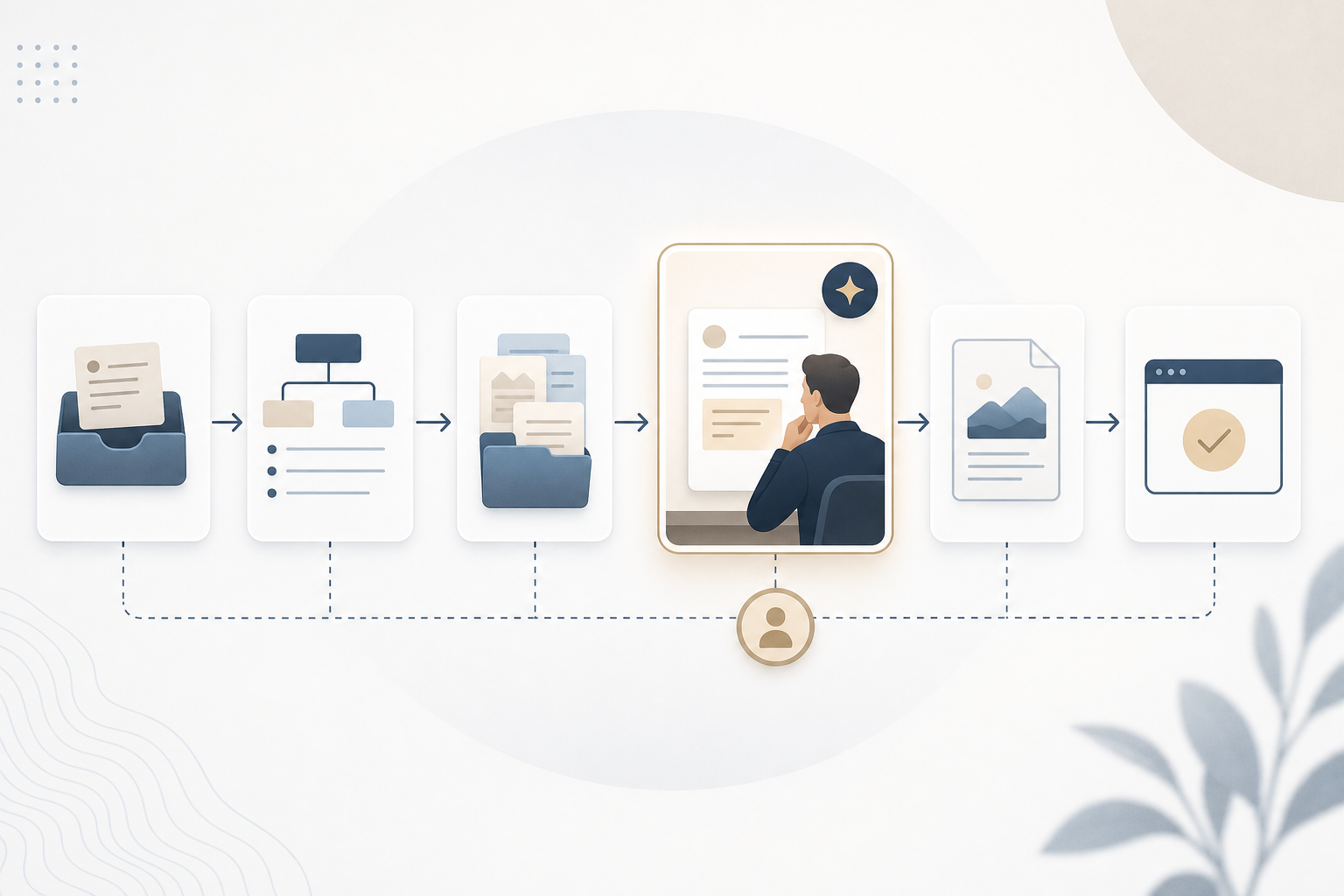
Automation is useful when it handles repeatable, easy-to-check tasks. It becomes risky when it replaces judgment about accuracy, relevance, or what your business can honestly promise.
What to automate or template
| Task | Good use of automation or templates | What still needs founder review |
|---|---|---|
| Topic capture | Forms, notes, recurring topic themes | Whether the topic matters to your buyers |
| Outlines | Reusable structures and draft outlines | The angle, reader question, and point of view |
| Research organization | Saved sources, summaries, and tagged notes | Source credibility and factual claims |
| Draft preparation | First drafts, standard intros, CTA blocks | Product details, examples, tone, and accuracy |
| Editing | Checklists and basic readability checks | Final clarity and business fit |
| Publishing | Scheduling and pre-publish checklists | The final decision to publish |
AI can help organize research, propose an outline, and prepare a draft. It cannot reliably know whether a claim reflects your product, customers, or operating reality. Review is not a final chore; it is the step that protects trust.
Keep a short quality checklist
Before publishing, ask:
- Does the opening answer the reader’s question quickly?
- Is every factual claim supported or clearly framed as opinion?
- Did I add a specific, useful detail rather than generic advice?
- Are product claims accurate and current?
- Is the next step clear and relevant?
- Have I removed repetition and unnecessary filler?
This is how to keep content quality consistent at speed: give the repeatable work to a system, then spend your limited attention on truth, usefulness, and fit.
A simple podcast guest workflow
If a podcast is your primary format, template the guest process so it does not become a separate project each time:
- Use one outreach email for warm introductions and one for direct invitations.
- Collect bio, links, talking points, and boundaries through a short intake form.
- Send one confirmation message with the recording details and rescheduling policy.
- Prepare a one-page brief with the guest’s context, five questions, and your audience goal.
- After recording, turn the episode into one recap, a few short clips, or an email—only if you have time to review them.
The purpose of repurposing is to get more value from a strong idea, not to create a larger publishing burden.
Make consistency a decision, not a streak
A missed week does not mean the system failed. It means you need to restart at the next scheduled block without trying to “catch up” with twice as much work.
Review your system after eight weeks:
- Which format was easiest to sustain?
- Which topics led to useful conversations or sales support?
- Where did drafts stall?
- Which step can be removed, templated, or delegated?
Content Redefined AI is designed to give founders a structured way to define their business context, direct their content, and maintain a consistent publishing schedule. Use any planning tool as a decision aid, not as an excuse to publish more than you can review.
The best answer to how to keep consistent content with limited time is usually simpler than expected: publish one useful thing on a schedule you can defend, use a repeatable workflow, and keep human judgment at the final review point.
FAQ
What is the minimum time needed to publish weekly?
For a short, useful post, 60–90 minutes can be enough when you already have a topic queue and a template. A stronger article or newsletter often needs about three hours. The right amount is the amount you can protect consistently.
Why do I struggle with staying consistent?
You may be trying to make too many decisions at once or holding each post to an unrealistic production standard. Reduce the choices: use recurring themes, one format, a fixed time block, and a clear definition of done.
Is content creation still worth it in 2026?
It can be, if it helps the right people understand a problem, evaluate your approach, or take a useful next step. Treat content as a trust and sales-support asset, not a shortcut to attention or rankings.
What are the main content types?
Common types include blog posts, newsletters, short-form video, long-form video, podcasts, social posts, and webinars or live sessions. You do not need all of them. Start with the one that best suits your audience and your available time.
How often should a founder publish?
Weekly is a practical starting point for many founders, but the best cadence is one you can maintain for 8–12 weeks. One reliable post every two weeks is better than an ambitious daily plan that ends after a month.